I just received a document named “XXX_final_v2”.
Penfinal?
1
I’m hanging out at a local drinkery, waiting for friends, and on the TV is Tiger Woods, who is doing pretty well in the latest tournament, but not great. As usual. THIS IS NOT NEWS!
I don’t follow golf, but even so I get all sorts of breathless “Tiger was in the middle of the pack!” articles before I can click through to actual sports. Tiger is in the middle of the pack. It’s not news anymore. Move on.
So I was looking around for a Web service that could take a string of text and return an MD5 Hash of that string, and I found something disturbing.
An MD5 Hash is a big number that is generated by doing crazy math on the original information. It has two good qualities – when you start with the same text you always get the same result, and it’s pretty much impossible to tell what the text was from the number.
A lot of places store the hash of your password, rather than the password itself. When you type in your password, it’s hashed, and the resulting number is sent over the wire. If the number matches the one in their database then you’re in.
But there is one way to crack the hash I hadn’t considered: keep a database of known strings and the resulting hash. It had never occurred to me to try to keep a table so huge, but with access to this information you could pretty easily crack passwords that lots of people use.
In my search for a hashing service, I came across one such Web site. Also on that site: a service to generate a hash for you. The message: “Hey! We keep a database of hashes to render them useless! You want us to calculate a hash for you?”
Um… No thanks?
At this point, I have to advise, stay away from Web-based hash generators. I know you were about to go and use one.
It’s a little difficult to get a blog episode out when there’s a largish dog begging for your attention. The dog in question is Chiquita, our newest resident. Chiquita’s owner died suddenly and the ol’ gal was was looking for a new home.
She may be the sweetest-tempered dog I’ve ever met, happy to see anyone. She didn’t bark at repair men and delivery guys today, even though she’s starting to get the feel of her new territory.
The first thing we did when we got home was give her a bath; she’s been living outside for the last few weeks. She put up with the water and shampoo stoically, but we missed a few spots.
People over in Facebookland have been asking for pictures, so here for your delight are a few snaps. (You can click to see them larger.)









We had bought a package of rawhide bones for her; after she showed no interest in a tennis ball we gave her one of those. She walked around with it for a while, relaxed in the shade with it firmly between her teeth, but never chewed it. After a while, she found a corner of the yard and buried it. In the second photo she’s pushing more dirt on top of the burial site. Of course I’ve heard about dogs burying bones, but I’ve never seen it before.
As you can see our new doormat could stand to shed a few pounds. Her hip stiffens up and stairs are particularly difficult for her. We’ll be putting he on a diet.
One aspect of successful blogs is that they focus on a single topic. If you’re interested in conservative politics, you frequent blogs that speak exclusively about conservative politics. You’re not interested in what your favorite pundits had for dinner last night. You might tolerate the occasional post about some other passion of the blogger, as long as it didn’t get in the way.
I thought about this today as I finished my third episode this week concerning Internet security. I could become a blogger focused on that very important issue. After a while folks would start to look for me, to accept me as an authority, for better or for worse. That would be kind of cool.
Instead, I thought, “I have to break up all these techno-geek articles with something more fun.” I pushed publication of two of the security episodes into the future. (Whether the intervening episodes are actually fun is another story.) I now realize that it’s not merely that MR&HBI is poorly aligned for success, I’m actively working to keep it that way.
You don’t have to thank me, it’s what I do.


Some time ago I downloaded Edgar Rice Burroughs’ A Princess of Mars
The first coincidence was external: I realized that the main character was named John Carter and there’s a special-effecta-palooza stomping its way into cinemas with that title. I was reading the material from which the movie was adapted. I knew the cinematic beast was based on stories of this ilk, but here I was holding the exact one.
The coincidences didn’t stop, but from then on they were within the story. John Carter is the luckiest SOB I’ve read about in a long time.
“But Jer,” you say, “it’s an adventure story. It’s pulp. Some slack is due.”
Yep indeed, the words I put into your mouth are dead on. Some slack is due. Carter is a lucky SOB all right, but it is his skill and derring-do that make the most of that good fortune. On Earth Carter is a pretty impressive specimen; in the lower gravity of Mars he kicks some pretty phenomenal ass.
It is not just physical prowess that sets him apart, however. While living in a society of heartless warriors, his horses (um… thoats) are far more faithful, because he uses the carrot as well as the stick. When the pragmatic Green Martians see that sometimes a gentle hand gets results, subtle societal changes begin.
As promised in the title, there’s a Princess, the undisputed Most Beautiful Woman on the Planet, and of course she’s captured by (what a coincidence!) Carter’s Green Martian sort-of-captors. You might not be surprised to hear that Carter and the Princess hit it off pretty well, despite some problems caused by culture clash.
Let’s reflect for a moment on some of the things Burroughs did well. There are two intelligent races on Mars, competing for dwindling resources. Death by old age is exceedingly rare, especially among the Green Martians. They spend a lot of time killing each other. I had no trouble at all getting the feel of this race, of the strengths and weaknesses of the society, and how their long history had shaped them. (By a remarkable coincidence, the two Green Martians closet to Carter were throwbacks to a gentler age. By an even larger coincidence the two were related.)
For all the Princess was Unimaginably Beautiful and in need of frequent rescue, she held her own. She did have an affliction I will call diminishing adjectivitis – almost every adjective applied to her minimized her, emphasizing her slightness, her delicacy. Yet she made the decision to sacrifice herself to save her people. That the Manly Men of the story managed to free her and save her people (and unite traditional foes, realigning politics on Mars from “Red vs. Green” to “Cool vs. Asshole”) does not take away from her sacrifice. Were the story written these days, more might have been made of her self-sacrifice, but let’s face it. This story was written for the same demographic that would be sneaking looks at their fathers’ Playboys a few decades hence.
Then there was The Coincidence That Went Too Far. I felt the strain when Carter ran into an old pal in enemy territory. Credulity snapped when Carter’s airship crashed right next to his old Green Chum in the heat of a savage battle, just in time to save the guy and get leverage to assemble an army to go save the princess.
A nation is slaughtered, but their king was a jerk, so that’s OK. Don’t go starting wars if you’re not ready to pay the price. This came out during The Great War.
So, in the shambles of the One Coincidence to Rule Them All, the story winds to a close on a wistful note. It’s a tight read, easy-breezy (though the language is filled with pomp), and it keeps on moving. I wonder, if the math of publishing had been different and Burroughs felt comfortable pushing to 300 pages, if he would have needed those coincidences to get the players into position. I also wonder if the story would have been any better without the Hand of Fate smacking things around so blatantly. After all, this way we get to the next action scene that much faster.
It’s kind of funny – In the end, four-armed men who own guns accurate for miles fighting with swords on the moss-covered beds of the ancient oceans of Mars didn’t bother me at all (well… not much). It was a chance meeting in a city square that pushed me to the breaking point.
I haven’t even alluded to the Greatest Coincidence Of Them All. The Great Mambo Coincidence that makes mere luck rock back on its heels and suck its thumb. A coincidence so stupendous that it can only save all life on an entire planet. It’s actually not that bothersome here since it’s not central to the action. It does put Carter back on Earth, though.
You know what, though? I’m pretty sure John Carter goes back to Mars. Maybe his kid has hatched (best not to think too hard about biology here). I’m equally confident that I’ll read more of these stories. I expect to roll my eyes at some mind-abusing good fortune on the part of our protagonist. But I’ll still have fun, and in the end, that’s what it’s all about.
Note: if you use the above link to buy this book (or a Kindle
A while back I mentioned that if someone got hold of your email password, that all your other passwords, no matter how cryptic or “safe”, would soon follow. To recap, it goes like this: If someone can get your email address, they can go to every bank and hit “reset my password” and get to the automatic email before you do.
A friend of mine recently put up a post that reminded me of another way hackers can get into your accounts (including primary email), one that I’ve been meaning to mention. You know those security questions they ask you, so they can confirm your identity? Those questions aren’t very secure. Questions like, “Where did you go to elementary school?” Pretty easy to find out stuff like that these days.
Say I want to hack into a celebrity’s yahoo account. I just need to answer a few questions, most of which are probably answered in imdb. Then I’m in. There’s a GQ article linked in my friend’s post that illustrates just how easy this all is.
The problem is, lots of places force you to set up these questions – making it mandatory that you provide a huge hole in your own security. A lot of people call these “insecurity questions”.
Security questions can work, but only if you choose to answer them incorrectly. Where did I go to school? A fish. What was the name of my first pet? 4e$RE*Plaster. Of course, in the rare event that I actually need to be able to answer the questions, there’s no way I’m going to remember what I said the first time.
While pondering that I had a thought for a method of answering these questions, one that removes any worry about remembering much of anything. Let a machine do the work. Imagine if you could select the question with your cursor, push a button, and paste your own personal complete gibberish into the answer field. Then, whenever confronted with the same question, you can generate the same gibberish. No remembering and no chance of anyone ever guessing your answers.
This would actually be pretty easy to do. It might even just take GnuPG and a bit of scripting. All it has to do is take the selected text, add a little secret extra bit that you set, then put the MD5 hash onto your pasteboard. It would be better as a browser plugin, so it was ready and waiting whenever you needed it. A little gizmo like that could go a long way toward tightening up one of the biggest security holes in the interwebs.
I’d build it except for two things: I just don’t have time right now, and a major technology company would end up owning it.
While we wait for someone to step up and build that little beauty, take a moment and reset your “insecurity questions” to something no one can guess. Perhaps for each question that asks for a name, you have one ridiculous answer (that you never tell anyone) and for locations you have another, and so forth. It’s not as good as a different answer for every site (who knows how securely each place stores them?) but it’s a hell of a lot safer than the truth.
Almost every security system on the Internet has at its core an element of trust. When you point your browser to Bank of Money, how do you know you’re talking to the real Bank of Money and not some impostor? Once you’re certain that the machine on the other end is genuine, your browser can set up a secure connection and keep others from listening in. But that first step, when they have to prove they are who they claim to be, is a problem.
The way Bank of Money proves their identity is by passing to you a special encrypted file that says who they are. But how do you know that certificate file is genuine? Because someone else made the file and they can verify that it’s legit. That “someone else” is a Certificate Authority, and your browser is trained to trust a handful of these companies implicitly. You might have heard of VeriSign, for instance. Bank of Money can go to VeriSign, provide information (and money), and after VeriSign carefully screens the application to make sure it’s really coming from Bank of Money, issues them a certificate.
When you connect to Bank of Money, your browser goes, “oh, hey, VeriSign says this certificate is the real thing,” and you’re good to go.
Unless, of course, the Certificate Authority is controlled by an evil government. Or if a CA gets hacked. Or if a CA is just sloppy. And the crazy thing? If any one of the Certificate Authorities trusted by your browser is compromised, you can’t trust any connection, no matter where the original legitimate certificate came from.
And, well, that has happened. The two cases I know about seem to have been aimed at Iranian dissidents, but it is no exaggeration to say that all of e-commerce depends on the integrity of the Certificate Authorities. That integrity has proven to be shaky lately. Each CA is a separate point of catastrophic failure for e-commerce.
And the pain goes both ways. Let’s say for a moment that Bank of Money got their certificate from DigiNotar. DigiNotar got hacked, wasn’t forthcoming, and lost their ‘automatic trust’ status in most browsers (which is a reason to accept all those annoying browser updates – they might be quietly blacklisting known fraudulent certificates). Even though Bank of Money did nothing wrong, now none of their customers can make a secure connection. The browsers don’t trust their DigiNotar certificate anymore. For good reason. They lose, you lose, I lose.
Is there an alternative to Certificate Authorities? Practically speaking, probably not. But there is another way to establish the legitimacy of Bank of Money’s certificate. If someone you know personally and trust says that BofM’s certificate is valid, then you can choose to trust it, too. Once you decide it’s legit, and confirm it for yourself, you can put your own stamp on it, and then people who trust you can feel confident as well. It’s not about some central authority, it’s about people you know and trust.
If some bogus entity tries to jump in with their own certificate, it won’t have the endorsement of you or your pals on it. You won’t be fooled, and neither will anyone else.
This model is called the Web of Trust. A certificate is only as good as the collection of endorsements it has built up. Bogus certificates (theoretically) have a much more difficult time taking hold. If I was an Iranian dissident, for example, I’d be very, very conservative about which certificates I accepted and endorsed. There’s a pretty good chance that people died as a result of DigiNotar being hacked. The major browsers accepted the false certificates without blinking, and the government read everything the dissidents said.
Bank of Money would love an alternate system that didn’t cost them a lot of money, and protected them from blacklisting because someone else messed up. The problem, if you’re an institution like that, is getting started. You can’t just wait for your certificate to gain acceptance organically before your Web portal becomes useful. To get going quickly you need one powerful, trusted person to vouch for your certificate, someone everyone else will believe. That’s what a Certificate Authority is, and they’re built into your browser, so that you have to go out of your way not to believe them.
Yet, if the Web of Trust were well-developed, new certificates would spread very quickly. If we all had three or four people we trusted, and a bunch more we sort-of trusted (so that if several of them said a certificate was legit, we’d be OK with it), then BofM’s certificate would percolate through the WoT pretty quickly.
But what if none of your trusted people used Bank of Money, so never endorsed its certificate? You can extend your search for endorsement further, and decide for yourself how comfortable you are. This is where a centralized Certificate Authority can come in — you can choose to accept their endorsement if your personal Web of Trust doesn’t cover that certificate. It’s entirely up to you. Not like now.
And, sure, at first people would get fooled. There will be people who endorse certificates lazily. There will be fake people created just to endorse certificates. Iranian dissidents will not be fooled, however. When something inevitably goes wrong, the sloppy people will no longer be trusted, and will learn not to trust people they don’t know. Speaking personally, I already know who my trusted folk would be — I have friends who would take responsibility for their endorsements very seriously, both out of pride and a sense of social responsibility. Shit, I can think of five without even breaking a sweat, and that’s plenty. You know a couple of people like that, too. Ask yourself: Would you rather trust them or a big company in it for the money and subject to political fiat?
This might be the definition of ‘neighbor’ for the information age.
So, people of planet Earth, we have a chicken-and-egg problem. Bank of Money isn’t going to depend on a Web of Trust that doesn’t exist yet. Most of their customers aren’t going to bother building the WoT, because none of the institutions they interact with use it. I talk about the Web of Trust, but I haven’t done much about it myself. We need a catalyst. I just hope it’s not the collapse of the Certificate Authority system, and the disruption that would cause.
I’ll talk more about how we can all work together to build the Web of Trust in a later episode. The takeaway today: We need it. Prepare to do something about it. It won’t be as simple as it ought — something I plan to bring up at work.
When I got home from work today, I was beat. Plum tuckered out. I came in, hugged my sweetie, and plopped in front of the computer. Then she told me about the package in the living room. Suddenly I had a new burst of energy, and I spent the evening photographing stuff around the apartment. Anything that would hold still, really.
You see, there’s a camera lens I’ve been looking at for a long time. Sometimes I’ll even look in on eBay to see if one is going for less than usual. Last week, I found one at a good starting price. No one had bid. It was a few hours before the auction ended, but for stuff like that all the action happens in the closing seconds. Still, I set an alarm for a couple of minutes before the auction ended. If I wasn’t busy doing something else, I’d look back in and watch the action.
No one had bid. Time was winding down and no one at all had bid on the lens. It was more than I could afford, more than I had any business spending. The seconds ticked down in red digits. An appeal to my sweetie followed, hoping for reason but dreading reason far more. My finger was on the button, ready to pounce.
I bid. I won. I have a new lens. It’s awesome.
A little camera geekery: photography is filled with numbers, and this lens has one eye-popper: f/1.2. The smaller the number, the ‘faster’ the lens – the more light it gathers in a given period of time. 1.2 is a very small number, meaning this lens can open way up and take in a lot of light. That in turn means it works very well in low-light situations. That can be really handy when it’s not practical to lug lights to where the action is. There’s another side effect of this gaping aperture, and that is that the depth of focus can be very, very shallow.
Depth of Focus is a little tough to explain because we don’t experience it with our eyes – they are constantly refocusing on whatever we’re interested in at the moment. But the concept is really simple. When things are too close to the lens, they go out of focus. Too far, out of focus. Then there’s a middle range where the picture is sharp. With some lenses that middle range is so huge that pretty much everything is in focus, unless it’s really close. That’s a good quality on an instamatic with fixed focus. The lens trades off in other ways to get that effect, but for taking pictures at the beach it works pretty well.
My new lens is at the other end of the spectrum. Consider these two pictures I took while sitting a few feet back from my desk (you can click to see them larger):

my mug, focused on the front of the rim

my mug, focused on the back of the rim
Even from a few feet away, the depth of focus is maybe three inches. Those candles are about four inches behind the mug.
Why would anyone want a lens with such a restriction? Holy carp, it can be pretty tricky to get the focus just right when there’s so little room for error. You could seriously get one of your subject’s eyes in perfect focus, but not the other.
But look how the mug is not lost in the clutter of my desk. Those are pictures of my mug, and nothing else gets in the way. I have pictures of rock stacks on rocky backgrounds, and headstones in a cluttered graveyard that could really have benefitted from this technique. When things are similar color or texture as the background, focus can make all the difference.
My sweetie was laughing at me as I drifted around our apartment, which is currently in a state upheaval for our move, taking pictures of this and that. I wanted something sparkly. I found it in the living room, where this teddy bear also lurked.

My first portrait subject with my new 85mm lens.
Why did I want sparklies? It’s a good way to show the bokeh, or the characteristic of the way the lens blurs the image. My new lens is carefully built to provide smooth, circular bokeh. This is a function of the way the aperture control works – the dots are actually projections of the iris mechanism inside the lens. Often they are hexagonal or another geometric, unnatural shape. It’s most obvious for the sparkles, but it affects the rest of the shot more subtly as well.
I’m sure that somewhere in my great heap o’ pictures I have some that demonstrate other bokeh, but I’m not sure where. I could go digging, but tonight is about the new lens.
The new, awesome lens.
A while back I posted that this blog was blocked by the Great Firewall of China. Most likely that was because some other site that shared my server had annoyed them, but I had recently blamed China for a surfeit of hyphens, so you never know.
In an interesting (to me) turnabout, I just blocked several million Chinese IP addresses from accessing my site, due to a Chinese deluge of spam. Even spam that’s blocked by my filters costs me server performance and bandwidth, so when things get bad I just prevent spam sources from reaching my server at all (thanks, CloutFlare!). Lately that’s been China.
I’m now erecting a wall to keep China out, when once I joked about them keeping me out.
When a friend asked me if I could be the photographer for her wedding, I was a little nervous. I wouldn’t mind being a photographer, I told her, but being the photographer was a different story altogether. There’s a reason the pros are expensive, and for something like your wedding you want to be confident the person with the camera knows what she’s doing.
Hell, I haven’t even been to that many weddings. I’ve never even watched a pro with any sort of critical eye.
But, assured that expectations were set reasonably, I agreed to haul the camera out for the ceremony and snap some pics. I did okay, I guess, but I could have done a lot better. Along the way, I learned a few things.
Lesson 1: Be aggressive. I didn’t want to interfere in the proceedings, I merely wanted to record them. I tried not to put myself in positions where the guests would be looking at me, rather than the ceremony. Because of that I missed some good moments (one where the wedding participants had their backs to the audience — just the sort of moment you most want to catch so people can see it later. The thing is, to get the shot, I needed to move furniture and stand where I’d be in everyone else’s pictures. I ended up getting in there late and only half-assedly, and not getting a shot that captured the moment.
Also, there were behind-the-scenes moments that I probably should have tried to get, but I didn’t want to push in on the participant’s special day.
Lesson 2: Be pushy. Tell people where to stand. Make them stand there until you get the shot. The couple wanted some group shots, as is done at weddings. I intended to get them, but suddenly a relative was lining up the usual suspects, arranging them, and the assorted camera-bearers fired away. It was chaotic and I didn’t get good shots of some of the groups. I should have stepped up there, told people to wait, and made sure I got what I needed.
Lesson 3: Look at the whole picture. This was especially an issue with the posed shots — I look at them now and see a chair here, the back of a head there, all things that we filter out with our memory, but are there forever in a photograph. Many of the standing shots I had to crop the feet off the subjects, despite interesting shadows and reflections on the floor, because of extraneous clutter that distracted from the subjects. This is partly to do with Lesson 2 above; I rushed shots because I didn’t take charge.
Lesson 4: Have the right equipment. I got to the scene of the wedding and discovered that the ceremony was going to take place in front of a wall of glass. The view behind was beautiful, the setting fantastic. But it was hell for photography. I simply was not equipped to provide fill flash to properly light the subjects. My camera doesn’t even have a crappy little built-in flash. So I adjusted exposures and hoped for the best. I didn’t get the best. I’m not sure, in that situation, what I could have done differently except buy a speedlight ahead of time, possibly some gels to match the color temperature, along with a radio trigger, and rig it with a little umbrella reflector at the back of the room, or, if I was pushy, on one of the tables where the guests were sitting.
Overall, I got some shots I’m very happy with, but when I look through the results I see more misses than hits. As I mentioned before, there were a lot of other folks with cameras, and I’m glad I wasn’t the photographer. I have a new respect for the professional wedding photographers, who have learned to stay out of the way — unless it’s to capture a moment people will want to remember forever.
Recently I’ve read two adventure stories which feature young protagonists thrown into desperate, life-and-death situations. I enjoyed both of them more than a little bit, and in both cases stayed up too late at night to see what happened next.
I finished Treasure Island

Perhaps the most obvious difference between the two is the complete absence of female characters in the older story. Of course, most of the adventure takes place on a ship, with pirates, and any attempt to insert a female character would have been completely artificial. I don’t think I need to go into detail. Perfectly natural, however, to have an early-teen boy along. That’s how things worked back then.
More interesting than the differences are the similarities. I’ve commented in the past on the obvious-when-you-read-it schism that marks the beginning of “modern literature”. After I set down Treasure Island I realized that adventure stories were already modern, long before literature caught up. But for some language differences, TI: Silver’s Deceit might have been written last year. Bring a mysterious man into an inn, make him ornery, throw a band of assassins at him, get some people killed, and you’re off the the races, story-wise.
Funny how many names I recognized. Long John Silver. Ben Gunn. The parrot that said “Pieces of Eight!”

One thing that Treasure Island did particularly well was to create a compelling bad guy. Long John Silver is crafty, conniving, charismatic, and a consummate liar. The crusty old salt who appeared at the beginning to kick the story off was more afraid of Silver than any other man. Long John was a planner, a saver; while his shipmates of previous escapades had squandered their loot, he had invested carefully. If all the pirates were as smart as he was, this outing would have been no contest. The story does not rely on Classic Bad-Guy Mistakes (which weren’t even classic back then), but rather John Silver has to adapt his plan to appease his impatient cohorts. Totally buyable.
Even with that, the good guys need plenty of luck to win the day. Our narrator, young Jim Hawkins, is the vessel of much of that good fortune. He gets lucky, there’s no doubt about that, but even my twitchy preposterometer was not terribly agitated. The pirates destroyed themselves; Jim was just in the right place to take advantage of it.
It was a lot of fun to read.

Moving ahead a couple of centuries, we have The Hunger Games. In this story we have a post-apocalyptic gladiator contest, fought by children. This is no Road Warrior world, however; there is still a central authority and in the capital at least, technology has not been lost.
The Bad Guy in the story is much more vague than in Treasure Island. Authority, you could call it. The contest is an annual exercise of power the capital inflicts on the outlying districts. The primary tool the rulers use to control the populace is hunger. There’s simply not enough to eat. Our heroine is a poacher, skilled in slipping outside the confines of her district and bringing back food. The local authorities are happy to look the other way.
I had a little problem with the districts set up in this story. Our heroine hails from District Twelve, which numbers some eight thousand souls. In all of North America there are twelve districts, plus the capital. Even with the almost-magic technology possessed by the capital, I can’t see them controlling the population of an entire continent when there is so much out there. If there was uninhabitable wasteland beyond the fences of the districts it might make sense, but there’s a whole damn continent teeming with dangerous-but-edible creatures. I invoke thermodynamics: there’s just too much pent-up need for the plenty of the open continent. That much pressure, you’re going to leak.
Maybe in future episodes we’ll learn about human enclaves outside the districts, and why they haven’t become so populous that they can simply overwhelm the capital. Maybe I’ll even buy it. But the burden of proof is on the writer’s shoulders.
She might pull it off. She’s done a good job so far pulling me in. It’s a really tricky thing, introducing us to a world the characters already know, and it is done pretty well here. The narrator can’t stop to fill us in on how society works; it’s told in first person to a presumed audience who already knows the score. However, there were times I felt like the author was teasing.
The core question of The Hunger Games: What do you do when you are compelled to kill someone you really like, and who likes you even more? The answer to that is the payoff of the story. From a story perspective the big win in Hunger Games is the culture that surrounds the brutal competition – the marketing of the contestants, and the gambling. Outside forces can influence the game, at terrific cost. We get a good feel for this even though our perspective is limited to a single contestant.
Treasure Island doesn’t really have a core question. Doesn’t really need one. It has a situation and some great characters, and it plays from there.
In Games there are also hints that the actions of our single contestant might have an effect on the world outside the arena. There is a piece of bread that is an indicator of something greater. And that’s pretty good writing right there. The sort of writing that is the luxury of the series writer.
A series, done right, provides a sequential set of individually satisfying stories that, taken together, become something much more. Based on the first installment, Hunger Games almost hit that, but at the end devoted an extra chapter or two to setting up not the next story but the spunky-herione-must-have-two-viable-suitors-she-can’t-choose-between crap. Cheese Louise. I was totally along for the ride until I got that open declaration that this was going to devolve into Twilight.
I’ll say this for Games: There were a couple of points where it punched me square in the gut. Good people die in Treasure Island, die hard and die well, but it affected me more in the modern adventure. I have a theory that I won’t expand upon here that our perspective on death has changed dramatically in the last hundred years (penicillin might be the breakpoint), and so we write about death differently. Nobody says “it’s a good day to die” and really means it anymore.
Another difference between modern and older adventure stories for your adults: in more recent stories the young protagonist does everything. Situations are built so the hero does not get support from adults, only from a select handful of peers. Were Treasure Island written today, Jim would not have relinquished control of the treasure map to the local authority figure, and would not have settled for a mere share of the treasure. Bringing in adults makes the subsequent action a lot more believable. Sometimes in modern stories authors kill themselves (and their stories) to keep adults off the “good guy” side of the ledger.
There have been some changes in the art of the adventure story over the last centuries, not all for the better, but by and large an adventure is still an adventure, and good adventures start with action, have action in the middle, and then end with action. I like those.
Note: if you use the above link to buy this book (or a Kindle
NOTE: Whoops! Here I thought I was helping out, but my call for submissions was actually after the deadline, and there’s plenty of good stuff on deck. Sorry about that.
I kept the original episode for posterity, but I’m adding descriptions of the upcoming issues, for those poetically and photographically inclined. If you’re inspired by the current theme, don’t let that stop you from writing about it.
The original episode:
The Editor-in-Chief of The Poetic Pinup Revue has informed me that she needs poetry and flash fiction. If you’re not familiar with the magazine, The Revue is a hefty, glossy magazine with awesome photography paired with sweet poetry in a way that words and images enhance each other.
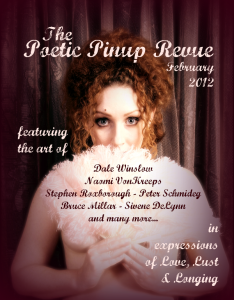
The current Revue: Love, Lust, and Longing

Next up: The Mathematics of Imagination
The theme this issue is “The Mathematics of Imagination,” which, if you ask me, is pretty cool. These days creativity and technology are pals, but through history math has influenced art (see also, ‘vanishing point’).
I once co-wrote a poem that rhymed ‘carrot’, with ‘pi, r, and square it’, though credit for that rhyme goes to my co-author on that epic effort. (Actually, thinking back, it may be that Edgar Pildrot (who is a fiction) was responsible for the entire work. I get no credit, but you have to admit it’s a pretty sweet rhyme.) I have not submitted that work for the magazine, but it just goes to show that you can put math into poetry.
What inspires you? The curve of the nautilus shell? Whether she loves you or loves you not? What happens in the space between the pixels? Think about it. Write about it, and let us know.
Post-Whoops! addendum:
The time has already passed for mathemagical submissions, but if the above inspired you and you write about it you can always put it in the comments here. In the meantime, I encourage you to ponder the themes for upcoming issues:

Bridges and Things that Burn Them

Contumulation & Carrying On
A little more than 100 years ago, there were a lot of physics guys who thought human intelligence had just about wrapped up the mysteries of the universe. There were just a couple of things yet to explain—the orbit of Mercury didn’t quite follow the math, for instance. Still, that was an edge case and for the most part we Knew How Nature Worked.
It turns out, we didn’t know squat. Newton did a damn fine job, but we started finding more and more places where his math didn’t work out, in the realms of the very fast and the very small. Once we got to subatomic particles things went completely wonky.
Newton! A hell of a smart guy. Was he wrong?
Short answer, yes, but let’s cut him some slack. He provided the mathematical framework needed to show that in extreme conditions he was wrong. He just didn’t have the extreme conditions to observe. It was not until centuries had passed that there came to be what I call the ‘Einstein fudge factor’, a little addition to Newton’s equations to take into account that pesky speed of light, and that helped a lot. With extremely small particles, however, the fudge factor was not enough.
Which brings us to the apparently-always-capitalized Standard Model. The Standard Model is mankind’s (current) leading attempt to bring order to the chaos we discovered when the universe refused to tie itself up in a neat bow way back when. It’s about particles — tiny dots of… ??? It’s not even stuff. Tiny dots of math. There’s a particle for everything.
NOTE: I’m Saganizing this article; simplifying to the point where it’s technically wrong, hoping to express the flavor of the mystery.
If there’s not a particle for everything, that’s a problem for the Standard Model. Out on the physics playground, the other theories are getting up in Standard Model’s grill. “Where’s your gravity particle, big shot?” they’re saying. “You math looks pretty but where’s the damn gravity particle?
Gravity, the first force to be measured (apples on heads, weights out of towers), is still a bitch to explain. Our elusive Higgs boson does some of the work.
Standard Model guys say, “The Higgs boson is real, but it’s going to take a crap-ton of energy to beak one loose to observe it running free. We need to build a ridiculously expensive piece of hardware to slam protons together at a minimum of 1.4 TeV (those protons are boogyin’) or better to bust one of these guys loose so we can measure it.”
So then we built one of those pieces of hardware. Probably the last hurrah of Big Physics for the next century, as biological sciences takes the fore. Bang-for-buck, I have to side with biology. But now we have this machine, delicate enough to be knocked out by a sandwich, powerful enough to explore the conditions of the universe when it was only a fraction of a second old. But mainly it was made to smack things into each other so hard that wacky shit comes out.
Let’s pause for perspective. The boys in charge say they want to find the Higgs Boson. While that’s not a lie, what they really want is to smash shit together so hard that the devil himself squirts out. They want to see some crazy particle coming out at energies we’ve only imagined before, that has some property that makes no sense at all.
Even the proponents of the Standard Model would like to be the ones to break it. Science is about breaking things. In any branch of science, not just physics, when an experiment comes up with an unexpected result, there is excitement. (Remember that next time you hear about a renegade scientist who is being suppressed by the Establishment, but who has something to sell you. That is simply bullshit. Rebels are welcome as long as they show their math.)
Word on the street is that there’s good evidence now of the Higgs Boson. We will not be treated to the compelling pictures of the trace of a particle through a bubble chamber this time around; there will be no curlycue in black and white that somehow makes the particle real.
The Higgs boson has been called “The God Particle” by shameless motherkissers out to cash in on shit like this. The people who say things like that are like the ones who a century ago thought we were about finished with physics. Even if we do nail this particle down, there are a few loose ends to tie up. Loose ends have been mighty squirrely in the past.
Is there a limit? Can we reach an energy so high that we get to the very bottom of the universe? Newton made sense until we got to higher energies.
But now perhaps we can see the floor. We have math that brings us the smallest distance, the smallest mass, even the shortest tick of time. Will that math break under extreme circumstances, the way Newton’s math has? Personally I’m rooting for something completely unexpected flying out of a direct hit between protons going ridiculously fast.
The translation I found of Galileo says “I do not feel obliged to believe that the same God who has endowed us with sense, reason, and intellect has intended us to forgo their use.” That was a political statement, but in that spirit I’d like to say, I hope to God we’re not done so soon.
