Christmas Time, Tool Time – Advice for Tool-Givers

I just saw an ad for a tool that didn’t interest me much, but I noticed that the neatly-bearded spokesman in his flannel shirt was standing in what was declared by the subtitles to be the “Tool Research Laboratory”, or something like that.

The set was clearly NOT a tool research laboratory, competing with CSI:Miami for “Least Practical Lighting for a Place Where People Use Their Eyes On the Job” award.

But… Somewhere there actually is a facility where people work hard to produce new, better tools. The people sitting at the workbenches aren’t necessarily wearing flannel; many of them likely have advanced degrees and spend their recreational hours reading about new alloys and fabrication techniques.

An example challenge: Make a better wrench. No biggie, it’s just a tool that has quietly matured over the centuries. But now, with math and engineering and gol-danged science, people are making better wrenches. Most of the emphasis in this new tool revolution is on convenience and one-size-does-more designs, which are all right, but then you get an ingenious device that puts the force on the flats of the bolt, rather than the corners, allowing you to apply a lot more force. A genuine improvement on an old standard*.

Christmas is the time these devices get to strut on the television, as women try to find gifts for men who don’t seem interested in things that are knitted. (Hint: many of those guys are looking forward to holiday leftovers more than they are to the gifts. Because there’s something magical about holiday leftovers. Just sayin’.)

You know, upon further review that last paragraph was pretty sexist. To the guy looking to buy tools for his husband, or the woman trying to figure out how to leave some hints as she cleans the grime from under her fingernails, I say rock on, and don’t forget the leftovers. Forgive me as I perpetuate the stereotype with my use of pronouns to follow.

Hey, remember the SnakeLight? It’s just a rechargeable flashlight with a bendy section, but many years ago when I got one for Christmas I was amazed at how useful it was. There’s a whole SnakeLight product category now. That’s a win.

Finally, the promised advice for tool-givers: beware the one magical wrench that’s as good as a whole set of traditional wrenches. It’s probably not quite as good, and your tool-appreciating gift target already has a whole wrench set and knows how to use it. When Tool User opens the package during your holiday ceremony, he will likely exclaim with happy surprise, but you will know he’s faking it.

But later, in the shop, on many occasions that every-wrench-in-one device is the one your beloved tool user will reach for rather than take the time to find the exact right wrench out of his set. Well, unless your tool user is like me. I’m a frightfully slow worker, and part of that is not just choosing the right wrench, but getting it positioned optimally. So give me a wrench that can reach a nut I couldn’t reach before. That is the one that will make he hairs on the back of my neck stand up — almost as much as a turkey sandwich with all the fixins.

Oh, and battery-powered tools are fundamentally inferior to ones you plug into the wall. The 120 seconds lost to laying the cord and coiling it up again dwarf the loss of power, the time lost messing with batteries, and the general better performance of the tool. Hippies and true craftsmen agree: batteries are no good.

Go Tool Research Laboratory! I’d apply for a job there, but I’m wretchedly unqualified.

* I’ve never seen sockets that embrace this innovation. Get on that, Tool Research Laboratory!

2

When Phones and Cars DO Mix

I’d heard whispers about it in the shadows, seen the knowing glances between those in the loop, and recently I’ve become one of them. I’m a Wazer.

I am required to be at an office during what we call ‘normal business hours’. That means I’m driving to my office in the morning and home from the office in the evening, along with all the other NBH drones. Some mornings, the 12-mile trip can take an hour. That’s not good.

Along my route are some key decision points. It’s shortest to turn left at Curtner, but that ramp onto the freeway can get massively backed up, to the tune of fifteen minutes. On those mornings it’s better to stay on the surface streets for an extra mile.

But which mornings? How can I tell in advance whether Curtner is a mess? Enter Waze, the social mapping service. Waze takes real-time data from drivers like me and finds the fastest route to work (and, perhaps more importantly, home again). Sometimes those routes use streets I never would have thought of, but I ignore the advice at my peril. (Monday, I thought I knew better than Waze. Boy was I wrong.)

Waze is a bit quirky; right now it tries to steer me around one intersection at all costs — including cutting through a cemetery as an alternative. I have no idea why it developed an allergy to that right turn, and I suppose a true Wazer would log in and fix the map. Even the maps themselves are crowdsourced. It’s pretty cool.

You should be aware, however, that Google just bought Waze for a cool 1.1 Billion, so as I drive I’m telling the Goog where I am. If you use Google maps you’re already doing that, however, and I think this is a case where a voluntary surrender of personal information (with a very short useful shelf-life) actually makes the world better. Perhaps I just think that way because I really hate traffic. I decline to advertise my location on Facebook, and I hope all you have more common sense than to do so.

Another very useful phone-related product I came across recently is actually a gadget/app combo. You may have read recently that I’ve been tinkering with my car so that it will pass the California emissions test. I made some repairs and pulled the fuse that powers the onboard computer and counted thirty seconds, which should reset it. Even if the Check Engine Light is off when I get to the smog place, if there are old error codes in the computer’s memory, I will fail. Again. I know this because that’s why I failed the first time. The Check Engine Light had been on, and that was enough.

So I cleared the computer. Probably. Maybe. After my first round of repairs the light came back on (I had broken a plastic bit during the first operation) so I made my second repair and pulled the fuse for 30 seconds. Once again, there was no way to tell if I had actually cleared the memory. Just in time, help arrived via the U.S. Mail.

You see, during this whole process I was frustrated that I couldn’t just check the damn computer myself. (Once you fail smog, all except a few specially-designated repair places aren’t even allowed to hook you up. Bah!) Then while reading a Miata forum I found a discussion of which OBD tools worked with 1999 Miatas. A light turned on over my head. I could buy my own damn code reader! That had quite truthfully never occurred to me. I went to Amazon and started looking around. There was one hitch that made me hesitate: Units were either a) really expensive; and/or b) not sure to work on my car. Although there is a standard connector, different cars communicate with different protocols. I didn’t want to spend a bunch of money for something that didn’t know my car’s dialect.

Then I came across one that was both cheaper than any of the others AND low-risk! BAM! For $21 bucks I bought the Elm327 WIFI OBD2 Car Scan Tool. There’s a cheaper BlueTooth version, but there was some indication that it might not work on all iOS devices. Why is this one more likely to work with my car? Here’s the thing: The gizmo doesn’t know diddle about protocols. That’s software. So if one phone or computer app can’t talk to my car, another will. And now the UI can be presented on a sophisticated touch-screen computing device, rather than a cryptic LCD readout with arrow buttons for controls.


When the ELM-327 arrived I splurged and got one of the most expensive apps available to talk to it, based on reviewers saying it worked no problem with their ELM-327’s. Ten bucks. For a total outlay of $31, I had a scan tool that not only worked far better than dedicated devices costing hundreds of dollars, it had a better UI, and could even display a host of real-time data as I drove around! Speed, rpm, air volume, battery voltage, and more. Some modern cars provide a ridiculous amount of information through the OBD port. The app I chose, OBD Fusion, can log data and even superimpose that info onto a map. Racers, apparently, love this stuff.

My smog guy was really impressed as well. He actually laughed when I revved my motor and the virtual tach needle swung upwards. He was excited that he could prescreen customers in the parking lot, quick and easy. I expect he owns one of these now.

And in fact I had not successfully cleared my computer by pulling the fuse, but with my gadget and my app I cleared the old codes and ran the car until all tests had come back green.

This tool is a game-changer for even an unsophisticated home mechanic like me. Knowing the code and being able to look up the repair on the Internet literally saved me hundreds of dollars. (I know because I once paid hundreds of dollars only to have the problem return a few months later.) It also confirmed that my speedometer is a wee bit off.

And next road trip I’m totally going to make a map of engine RPM along my route. Because the world needs to know stuff like that.

5

On the Subject of Tutorials, and Why the Internet is Awesome

A while back a buddy of mine had trouble with his washer. He was pinched for cash, so he tackled the problem himself, rather than call a repair man. He got some information off the Internet before he started, not all crystal-clear, but enough to dive in.

He fixed his washer. But along the way he did something else, as well: He carefully documented each step of the process, with commentary, lessons learned, and pictures. In the process not only did he save himself a hundred bucks or more, he helped a lot of other folks as well. It’s the most-hit page on his blog (last I heard), and for good reason. Here’s the tutorial, in case your washer’s not draining.

Sidebar: It’s a little frustrating for a blogger to create an episode that’s not the main focus of the blog and have that episode take off. In my case it was “New York Sucks”. But at least “How to Fix Your Washer” has some benefit to the world at large. Lately my tutorial about setting up a LAMP stack using MacPorts has become more popular, which makes me feel better.

Let’s take a moment more to understand why my friend’s blog episode was so effective. First, there was the voice: “I’m just Joe Homeowner with a couple of wrenches and a mysterious machine that’s not working right. But I fixed the bastard.” Second, the tutorial answered a specific need. Third, Joe Homeowner was there with you every step of the way, with pictures and the kind of observations that never appear in service manuals.

The most effective reference materials are almost never videos. When I’ve got both hands tied up with the task, I just want to be able to look at the screen and see what I need to know. I want a still image I can absorb at my pace, and look for reference points to reconcile with what’s in front of me. I want to read the instructions three times without having to rewind.

This is the sort of content ‘they’ were thinking about twenty years ago when they were trying to convince us that the Internet was a good thing.

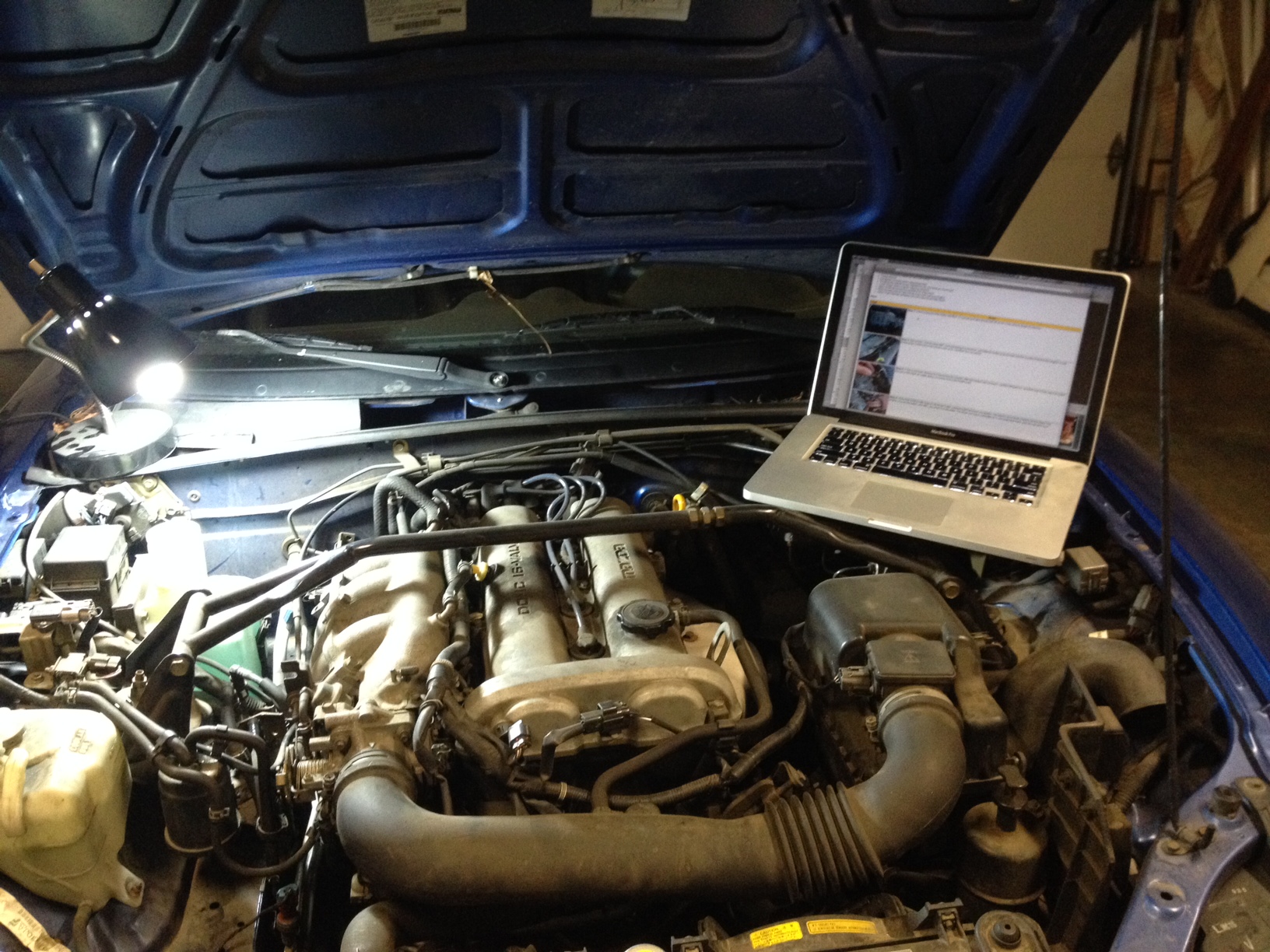
Last weekend I benefitted from a similar tutorial. Owners of 1999 and 2000 Miatas know code P0402: Excessive EGR flow. Usually a P0401 comes first. It’s a design flaw; there’s a narrow passage in the intake manifold that gets clogged. The killer is that the ol’ 402 suggests that a $200 part needs to be replaced. Actually, that’s almost never true in this car. All you have to do is remove the throttle body, take off the top part of the intake manifold, and clean that passage out.

Reference material close at hand, I'm ready to fix my car.

Reference material close at hand, I’m ready to fix my car.

The task is not difficult, but it can be intimidating. What you need is some guy like you who’s done it, who took pictures, who remembers the details, and isn’t afraid to admit he was a little frightened going in. You can feel his satisfaction as you read the how-to and you know you will feel that way too.

The ONE THING I wish he might have mentioned was “when you take the age-hardened hose off the top of the intake manifold, be careful not to break the PCV valve.” But that’s a topic for another episode.

There’s a tutorial out there for almost everything. Almost. Next time you’re facing a task, if you can’t find a good set of instructions on the Internet, do the Web a favor. Make the first tool you pick up a camera. Take a little longer on your repair, record each step, and remember your moments of uncertainty and how you dealt with them. Put it out there and make the world a better place.

2

How to Make a Geek Happy

I once explained in great detail why HTML is the worst thing that ever happened to the Internet. In that episode I was a bit disingenuous — I also snuck in flaws with the protocol that delivers most of that HTML rubbish to your computer: HTTP.

Finally, finally, twenty years later than necessary, the tools are available to make Web applications work like all the other apps on your computer. (If you’re willing to set down your browser, World of Warcraft and its predecessors have been doing this for a long time now. But finally we can have good application design through the browser as well.)

While the primary benefit of this revolution is for the engineers making the apps (whom you as a user have to pay eventually), there are tangible benefits for Joe Websurfer as well. Mainly, things will work better and be snappier. You will curse at your browser about 30% less. (That number brought to you courtesy of the dark place I pulled it from.)

I work in a blissful world where my stuff doesn’t have to work on older browsers, and especially not on Internet Explorer. That means what might be ‘bleeding edge’ for most Web developers is merely ‘leading edge’ for me. I’m starting a new Web application, and it won’t use HTTP. It won’t even use AJAX.

Quick description of HTTP:
Your browser asks the server for something. The server gives it to you, then forgets you ever existed. This is especially crazy when you want your connection to be secure (https), because you have to negotiate encryption keys every damn time. That’s huge overhead when all you want is the user’s middle initial.

And what if something changes on the server that the page showing in the browser should know about? Tough shit, pal. Unless the browser specifically asks for updates, it will never know. Say that item in your shopping cart isn’t available anymore — someone else snapped up the last one. You won’t know your order is obsolete until you hit the ‘check out’ button. The server cannot send messages to the page running in your browser when conditions warrant.

Lots of work has gone into mitigating what a pain in the ass that all is, but the most obvious solution is don’t do it that way. Keep your encrypted connection open, have each side listening for messages from the other, and off you go. The security layer in my new app is so much simpler (and therefore sturdier) that I’m going to save days of development. (Those days saved will go straight to the bottom line at my company, since I’m an operating expense. The effect of my app will also go straight to the bottom line, as I save other people time and energy. Better yet, the people who will be made more efficient are dedicated to making the company more efficient. Those days of development time saved go through three stages of gain. Shareholders, rejoice.)

So, that makes me happy. Web Sockets, event-driven servers, a chance to create the Missing Middleware to make the tools out there fly. Bindings over the wire.

Of course, I’m not building it all from scratch; I’m using and improving tools created by those who have gone before me into this ‘software working right’ revolution. It means picking up a whole toolbox at one time, from database to server to client library to extensions of all of the above. There are times while I’m trying to put it all together that it feels like my head is going to explode. In a good way.

But boy, the difference a good book can make. In technical writing, there are two kinds of documentation: tutorial and reference. Mostly I gravitate toward reference materials: I have a specific question and I want to get a specific answer. References are raw information, organized to allow you to get to the nugget you need. Tutorials are training documents; they take you through a sequence to help you build complete understanding of a system.

There are many technical documents that try to be both, or don’t know which they are. We call those docs “shitty”. Then there are videos. SPARE ME THE FUCKING VIDEOS. Videos as a reference: completely worthless; videos as a tutorial: rarely adequate – what was that again?

(I’d be interested to hear from my formally-trainied tech writer pals about my above assertions.)

Anyway, On the client side I’m using a library called Backbone, and on top of that Marionette. I like them, but I was starting to get lost in the weeds. The reference material is pretty good, but getting an overall understanding of how the pieces worked together was slow and frustrating. Too many new ideas at once.

So I found a book endorsed by The Guy Who Made Marionette (yeah, The Guy. One guy, having a huge impact on the next generation of Internet applications. Could have been anyone, but there had to be The Guy.) that not only puts the pieces together, but introduces best practices and the reasoning behind them along the way. It may well be the best tutorial-style documentation I’ve run across in this industry. So, hats off for Backbone.Marionette.js: A Gentle Introduction. This book really helped me get my ducks in a row. My fastest learning curve since Big Nerd Ranch oh so very long ago.

So all that makes me a pretty happy geek. Lots to learn, Web applications built right, a new project with lots of creative freedom. And while I’m coming up to speed on the new tools, I already see gaps — the tools are young — including a potentially ground-breaking idea, that I will get to explore.

Can you believe they pay me to do this?

1

The Ascendant Science

Medicine, it seems, is always the last science to the dance. While one guy was establishing the principles of electricity, one of his friends was being bled to death in the name of medicine. When radioactivity was discovered, health practitioners killed countless patients with it.

For most of the history of humanity, doctors were quacks. All of them. The discovery of tiny creatures that live inside us revolutionized the medical biz, but compared to the physics industry and its spinoffs, medicine was still mostly chanting and waving rattles.

Early in the last century, physical science went through a boom so loud our ears are still ringing today. The second half of the 20th century saw technology go nuts as those fundamental discoveries reached market.

That wave gave us the machines we needed to finally dig deep into how we work as organisms. Allow me to tell a rather long story to illustrate.

I have been working to lose weight. If you use the Internet, you’ve seen ads that read, “New scientific breakthrough can help you shed pounds!” and shit like that. I have long made a point of ignoring those ads, but I became curious about the scientific breakthrough. One night I clicked one of the ads.

I was presented with a video. Generally, when I want the answer to a specific question, I HATE video. But in this case, I understood that the video existed for the very reason I dislike them: the producer wants me to go through a lot of shit before providing me the nugget I want. From their point of view, video is perfect.

With the sound off, I watched as cartoon people were drawn and erased, showing a variety of body forms. Finally, a word came on the screen: Leptin. I stopped the video and fired up Wikipedia, where I was offered an explanation with lots of words I didn’t know. I knew enough of them, however, to understand that leptin was created by fat cells, and when leptin levels go up enough to be noticed by the brain, you feel full, and your metabolism cranks up. Injecting leptin into obese mice helps them lose weight; it doesn’t work so well in humans. Also, leptin was found in the 1990’s.

Then there’s Ghrelin, identified about ten years ago. Ghrelin makes you feel hungry, and slows your metabolism. The Wikipedia article about ghrelin identifies exactly which gene builds it, how it’s matched with a (perhaps unused) counterpart, and where it binds to receptors in the brain. There are drawings of the damn thing.

I trust the drawings, but it all seems vaguely magic.

I think this is just the beginning. The human organism is the most complex thing in the known universe, but we’re starting to figure out how it works. Next comes how to fix it when it’s broken; how to address the exact problem without mucking with other systems. We will move from drugs to viruses — those that attack specific bacteria and those that give the host the ability to produce a particular protein. It’s pretty cool.

That technology explosion? We’re starting to feel the biology echo, and it’s going to change everything.

A Very Good Colocation Deal

Just a quickie this morning to say that my hosting provider, macminicolo.net is having a special right now that’s pretty sweet — and lasts forever. Some of you may remember that I switched hosting providers a few times before finally deciding to get full control of my server. It turns out macminicolo.net is hands down, far and away, the cheapest colocation provider I found for the power of the hardware you get. There’s an up-front cost (you own the machine), but then it’s all yours.

Their facility is located where a couple of major transcontinental data trunks converge in Nevada, so no hurricanes or earthquakes will interrupt your service. And they seem like nice guys.

I have a mini there; you’re reading this page from it. I don’t really use it as a Mac, I installed a complete LAMP stack that only talks to the UNIX-like underpinnings of the machine. So even if you’re not a Mac guy, it’s easy enough to close your eyes and pretend it’s Linux (FreeBSD, actually).

So if you’re looking for cheap colo (and who isn’t?), this is a good time to jump in. I try not to be a shill too often, but I like this company and if they can keep offering (relatively) inexpensive colo service, I win.

iTelescope

I was reading up on the big-ass comet (who’s name is not actually ISON) heading our direction, and the article mentioned that the discovery had been confirmed by iTelescope (among others). (REAL QUICK digression: I really like the word “precovery” — Once the discoverers said, “hey, there’s a comet there!” other astronomers were able to use data gathered before the official “discovery” to confirm the finding. Precovery.) So anyway, Since I work at the company that invented put-an-i-on-it product naming, I had no choice but to look into this iTelescope thing. I had this idea that maybe there were a million webcams all pointed at the sky, and with the combined computing power of the participants a useful image could be inferred.

Of course, I was wrong. It was early in the morning and the caffeine hadn’t reached the critical parts of my brain — the parts that would have considered the logistical nightmare my “global fly-eye” idea would entail. Maybe in a few more years…

But what I did find is entirely cool, and has the benefit of actually working. iTelescope is a cooperative that has some 20 pretty-dang-good telescopes, and for a fee you (yes, you) can use them to take pictures of the sky. (The difference between ‘telescope’ and ‘camera’ is all in the lens.) iTelescope has three facilities around the globe (New Mexico, Spain, and Australia), so it’s always night somewhere. You control the telescope over the Internet and download your results. Oh, these times we live in. (In these times, it must also be said: you retain all rights to the photos.)

How much does it cost? That depends on the telescope you choose and the phase of the moon. Prices start in the neighborhood of seventeen bucks an hour and go up from there. That seems like a lot of money, until you consider what it would cost to get these images on your own. Eleven (at least) have even been honored as APOD.

It feels odd to think of it as ‘photography’ when you’re so disconnected from the camera – heck, you’ll probably never even see the telescope you’re using. Many of the other decisions one makes in terrestrial photography are moot as well — there’s no depth of focus to deal with, for instance. Someone else has set up the camera; all you have to do is point it. Except, when you look at the gallery, you see that there are many images that combine dozens of exposures, some with different filters, sometimes with different data coming from different telescopes. Dang. Seriously, how many photographers have access to such a vast array of gear? (Answer: now, we all do.)

There is still an art to getting that spectacular deep-space image, and just as a fashion photographer has assistants to handle the details, iTelescope users have the iTelescope staff and a helpful Web robot. Good times, my friends. Good times.

2

Our Kitchen, Filled With Treats

Our kitchen, filled with treats.

Our kitchen, filled with treats.


Here’s a panoramic view of our newly-reconstructed kitchen. It’s awesome! It’s kind of hard to tell when it’s wee small (click to biggerize it), but there’s about ten different kinds of yummy holiday goodies piled up in there.

Yeah, life is good.

1

A Wee Bit of Happy News

It was a tough day, overall. I’ll go into details later, maybe. But here’s a happy story, even if it’s a few years old. It’s the story of Popsicle, a puppy found wrapped in a plastic bag in a freezer.

Popsicle was saved, and went on to be awesome. So, yay, Popsicle!

2

Happy Holidays!

Why yes, that is six pounds of butter sitting on our kitchen counter.

That should be enough to get us through the day.

2

Pee Wee Hockey Practice!

I’m at Stanley’s right now. It’s a bar that sits high above three of the four rinks at Sharks Ice, where as you might guess the local NHL team would be practicing right now were it not busy not playing.

I came here to get some writing done, but that’s proven difficult. Below me the ice is filled with tykes in hockey gear, skating, falling, getting back up, and moving pucks around. It’s awesome!

Truth be told, those six-year-olds are better hockey players than I am. There’s an odd combination of clumsiness and grace, where a kid will lose the puck, spin, reach and collect the puck, and once on his way again fall over for no reason. Right now the bunch of kids directly below where I sit is running a drill that involves carrying the puck around obstacles, turning back and putting a shot on goal. The coaches provide very light resistance to those ready for it. One kid put a shot on goal, the coach deflected it, and that kid dove after the rebound like it was game seven of the Stanley Cup. Get that kid’s number — he’s going places!

A whistle just blew four times, and all the kids shifted to the next station. There’s a new guy below me who may be the smallest dude on the ice (assuming it’s not a dudette — no telling with all that gear). He is not graceful with the puck. But here’s the thing — Little Guy falls down a lot, but he gets back up. This is probably the best lesson Pee Wee Hockey teaches a kid. (As I typed that he had a harder time than usual getting up, and a coach came over and helped him until he was steady over his skates. His shot went just wide of the goal, which bummed me.)

But back to the falling down/getting up thing. I’m not a parent, but if I were I think this is a lesson I’d want to teach my kids. For my hypothetical daughters soccer would be an option (those kids are tough), but for the boys there’s no alternative at that age. Honestly, I’d prefer that my daughters played hockey as well; it’s safer. And none of the alternatives have ice. You might get knocked down in soccer, but in hockey you will fall, without any help from anyone, over and over. There’s no making excuses, no blaming someone else. Nothing to do but get back up. You’ll fall again, but that’s all right. You’ll get up again. That’s what I’d want my kids to learn.

2

Another Indication I Have it Pretty Good

When my sweetie asks, “would steak be all right tonight?”

1

The Little Comet that Could

Ah, the Internet, with its almost magical ability to give you what you’re looking for — even if you didn’t know you were looking for it. Through a series of links that started with a Web comic, I learned of a little comet that just played chicken with the sun and lived to tell about it.

The best summary is on this page, which at the top says “it’ll be interesting watching this comet flame out as it passes through the million-degree corona of the sun.” As it gets close the discussion talks about new and interesting things about this comet and what it can show us about the sun, then suddenly the author says (mildly paraphrasing here), “Holy shit! It came round the other side!” A decent video of the comet shooting out the other side is here.

The comet actually left its tail behind as it whipped around the sun, and there’s really cool footage of the comet streaking toward the sun, leaving a trail (probably) whipped around by magnetic storms. It’s all pretty cool.

Part of what’s interesting to me about all this is just how many devices were available to observe the course of comet Lovejoy. In the coming days, as more data comes in from other observers, we stand to learn a lot about our home star. You know I’ll be checking in.

[Edit] Let’s try embedding this youtube video, shall we? It’s a little wider than my format, but I think that will be all right this once.

http://www.youtube.com/watch?v=qPJ3Xbl9nZM

3

The New Magic

I don’t actually have any use for this device, but I can still marvel at the amazingness of it:

Magic!

This little puppy acts just like an ordinary storage chip for your camera, except it’s also a WiFi transmitter that automatically copies your pictures to your home computer or phone and clears the space for more pictures. With the WiFi you can also have the chip guess roughly where it is in the world, and tag your photos with the location. You can even have it upload to Picasa or whatever automatically. (Though anyone who posts every picture they take to Flikr without first editing is someone who’s photos I will never view.)

Remember when we had WiFi cards that we could stick in the side of a computer with the antenna poking out? That was pretty cool. Now this tiny chip does the same thing, only it integrates with your photo software. Holey Moley.

Technical quibbles: it only works with JPEGs (even sharing on your own network, which strikes me as odd), and the SD form factor doesn’t work in all cameras. There are adapters, however.

Back when they thought we’d have atom-powered flying cars, they didn’t think of this stuff.

Nice View They’ve Got

Astronomy Picture of the Day is one of my favorite sites, but yesterday’s edition was even better than most. I’ve always wanted to see the aurora borealis, and I will, dammit, but now I also want to see the northern lights from space.

Can someone hook me up?