Tweaking the Health Regimen

The light of my life and I bought a fancy elliptical trainer a couple of years ago. She has been very consistent with it, while I’ve been, well, streaky. There are times I come home from work and I’m just too wiped out to contemplate getting on the thing. (On days I do manage to get up on it, I’m glad I did, but that lesson is soon forgotten.) I’m definitely healthier, but I’m no skinnier. In fact, I’m bigger than ever.

The obvious answer, of course, is to climb up on that bad boy first thing in the morning, before I’ve had time to start making excuses. Alarm goes off (dreadfully early), I drag my sorry ass out of bed and grind out my time. So far, I’ve been very consistent with this approach, and I think I arrive at work more alert and cheerful. And hungry. Gotta love the oatmeal bar at the little coffee place in the building. More on the hunger shortly.

One thing I have observed about working out first thing in the morning: It’s much harder to meet my goals. I’m going into max energy burn after fasting for a few hours, and I hit the proverbial bottom of the tank way sooner that I do when I work out in the evening. I’ve had to adjust my expectations accordingly.

I did some research to see if there was some food I could eat only moments before exercising that could help me power through. Turns out, not so much. But I did learn another interesting thing: What I eat right after I exercise can make a big difference next time. There is a window after exercise in which the body grabs all the energy it can out of the blood stream to convert to store in muscles as glycogen. Get the carbs (and some protein) rolling during that window and things will be better the next day. Pretty sweet!

I started comparing different foods for the right carb-protein balance (nonfat chocolate milk apparently is about perfect and has nutrients the commercial sports recovery drinks lack). I was about three days into this process when I started to wonder:

Isn’t it good when I run out of gas while working out? Isn’t that kind of the goal of all this?

All the advice I’d read, you see, was targeted at athletes. For them, high output while exercising is the goal. Not so much for me. I want to create conditions where my body (reluctantly) chooses to break down some of that stored energy in my fat cells and use that to restore the glycogen in my muscles. This process is far less efficient, and the human body really is loath to give up its precious fat, but during that same window where the body will suck every carb out of the bloodstream, if there aren’t enough carbs, it will convert just enough fat to keep things running.

My muscles aren’t replenished as much, and the next morning’s workout will be tougher. But ideally the energy is coming from the right place.

By the time I get to work, that window has closed, and my insides have returned to business as usual. And I’m about ready to eat an entire pizza. Hooray for oatmeal! It’s carb-heavy, but low-fat and sticks to the ribs and by lunchtime I’m able to make more sensible choices as well.

So, with such a sensible system, the pounds must be flying off, right?

Well, not so much. Not yet, anyway. I’m absolutely certain that I’m on the right track, and like any long-term project, it’s best to keep expectations of instant and dramatic success tempered. But I have recently made one more change, a dramatic, desperate gesture of good health beyond all reason.

I have a target weight this month. Next month, the target weight goes down. Each morning as I prepare to exercise, I step on the scales. If I’m above the target, no alcohol that day. No beer after work, no wine with dinner. I like beer and wine. While cutting alcohol will definitely reduce my caloric intake, there is a second, even more powerful, indirect effect. When the alarm clock goes off in the morning and I just want to stay in bed, I remind myself that shirking on my exercise will only delay my next sip of sweet beer. On days I don’t bring lunch from home I think about the consequences of eating the wrong thing: Another meal with my sweetie, with no wine for me.

A coworker laughed when I told him this story, imagining me on a treadmill running full-speed for a beer hanging just out of reach. That’s not far from the truth. But if it works, that’s all right with me.

3

A Couple of Nature Shots

It is spring here in my little slice of heaven, and recently I’ve pointed my camera at flowers and stuff. Here is a shot or three of the results. There are things I’d like to change in each, but it’s a lazy Saturday and putting up pictures on a blog is easier than many of the other things I’m supposed to be getting done. For whatever reason, these look a lot better when you click on them to biggerize.

I forget what this flower is called, but it's nice.

I forget what this flower is called, but it’s nice.

I’m tempted to monkey with this photo more to make the flower pop better, but that’s really not how this plant rolls. It’s not a popper. I wish I’d stopped down a bit more to get the fungus on the log a little more in focus.

Apparently these are very bad to eat.

Apparently these are very bad to eat.

I really like this one, except for one frustration: the one point in the entire picture that the eye is first drawn, the little bit of grot on the mushroom cap, is just the tiniest bit out of focus (105mm lens very close to the mushroom means very shallow depth of field even at f/4). It’s hard to get the focus just right when you’re holding the camera at arm’s length. The focus is close enough that my eyes try to adjust, which of course doesn’t work and merely annoys them. Still and all, I’m pretty happy with it.

Not sure the tree, either.

Not sure the tree, either.

This is a cropped section of a set of pics I took this afternoon to feed a larger episode about photo composition, depth of focus, and bokeh (and when bokeh isn’t all it’s cracked up to be). That’s the episode I should be working on right now. There are a couple of nice bright-pink-on-deep-blue-sky shots in the batch I look forward to sharing.

1

Christian Mingle, Random Numbers, and Prayer

I typed the above title into my bloggotool a few days ago, thinking I’d get back to it when I had time. I vaguely remember the point I was going to make. Let’s see how this goes.

Christian Mingle is an online matchmaking service for Christian folks. It makes sense; there are a lot of people for whom a partner must be of the same religion, and it wouldn’t surprise me if same-faith relationships tend to last longer (though there is likely precious little in the way of unbiased data on the subject — it’s one of those simple-sounding propositions that turns out to be a bitch to measure. But I digress…).

Anyway, my memory of the site’s tagline is fuzzy, but it’s something like, “find God’s match for you.” So you see, they are presenting themselves as an agent of God, a conduit that allows the Big Guy to work his subtle magic. I’ve heard crazier things. But then I thought some more (perhaps too much), and I realized that most likely they apply mathematical comparison algorithms to find the best matches, as do the rest of the matchmaking sites. In fact, they are probably a branded front end on one of the other major services. It’s all math, and it’s deterministic. The same data in will produce the same result. If God wants Sally to be with Jorge, but the numbers say she should be with Marcel, what’s He gonna do?

Although random numbers in computers aren’t truly random, they’re unpredictable enough that a deity could jigger them now and then and no one would be the wiser. If Christian Mingle threw a lot of entropy at the problem, they could create the wiggle room God needs to work His will. Clients would fill out a detailed questionnaire, send it in, and Christian Mingle could match them up randomly and bickety-bam, God’s will is done. Sally’s with Jorge.

(Note that God’s will does not necessarily translate to what’s best for the individuals involved.)

Generating the random number is much like prayer, except that now we have a machine to perform that tedious task for us. We are appealing to a higher power for guidance, trusting ourselves to His plan. For marketing, I would suggest to Christian Mingle that they substitute the phrase “Divine Guidance” for “Random Number” in their brochures.

Meanwhile, I’m going to go home and whip up a quick “pray for my soul” script. I have a feeling I’m going to need it.

The Phoenix Conspiracy

“You were up late last night,” the light of my life said on Sunday.

“Really?” I said around a yawn. I had been reading, you see, and kind of lost track of time. I’d got caught up in a space opera called The Phoenix Conspiracy, and I wanted to see how it played out.

Space Opera, for the uninitiated, is what you get when you put Horatio Hornblower into space (where he goes by the alias James T. Kirk). They are pulp romance novels wrapped with that old-west feel that Out There it doesn’t matter where you come from; if you kick enough ass you will rise to the top.

The knock against space opera (he says like there’s only one) is that usually the conflict is between the hero and some totally bad guy. Black and white. Why is the bad guy doing all those evil things? Because he’s evil! To roughly quote a member of the Kansas Bunch: Why would he destroy the world? It’s where he keeps all his stuff!

I am happy to report that, despite other warts, the primary driver of conflict in The Phoenix Conspiracy by Richard Sanders was between two people on the same side who have a very different take on events. The hero, Calvin, is commander of a super-high-tech spy ship. He’s not a disciplinarian, rather he uses his personal relationships with his crew to get the most out of them. He has had some notable successes. Then he gets a new Executive Officer, a Totally Hot woman who technically outranks him. She’s from the regular navy, and she’s totally smokin’ hot. In management style, Summers is the polar opposite of Calvin. And hot.

They probably could have worked through the style differences, with time, but there is no time and Calvin almost instantly is compelled to keep secrets from her. Her last commander lied to her, almost implicating her in treason, and she’s not going down that road again. (Her former commander did notice, however, that she was very attractive.)

Have you gotten tired of hearing how hot Summers is? Yeah, I did too, during the third lengthy description of her, which came somewhere around chapter two. She’s also good at chess and is an excellent tactician, and knows how to run a tight ship. Did I mention she’s hot? ‘Cause dude, she’s really hot.

Another thing I liked about this book: None of the classic bad-guy mistakes. No “Leave this one for me.” No “Since you cannot escape I’ll tell you my whole plan.” No “I want this to be poetic.” The conflict escalates, Calvin’s weaknesses are exploited (a hero with weaknesses!), stakes rise. No one makes The Blunder that lets the other succeed. At the end of the conflict between the two, the stakes are very high indeed, though how the stakes are perceived by the two could not be more different. They both do things they’re going to have to live with later.

Meanwhile, of course, there’s a threat against the Empire, and both Navy and Intelligence Wing are likely infiltrated. Enemies are deep inside human space. And so forth. It’s satisfyingly complex. The story is set in the happy FTL≠TT (Faster-than-light ≠ time travel) alternate physics that we all love, and there’s just enough talk of ‘depth into alterdspace’ and ‘eighty percent potential’ to make it sound like they know exactly how things work, even if we don’t.

So, as space opera goes, this is a pretty good example. There are some things that bugged the heck out of me, however. ‘Port’ and ‘starboard’ in space. Multi-Terabyte thumb drives but no mobile phones. Being able to dock in an Intelligence Wing ship and somehow walk down the jetway (yes, jetway) and having no one suspect you’re in Intelligence Wing. For all the windows in these space ships, you’d think there’d be one that could allow the people on the space station to look at the boat that just docked.

There were multiple cases of computer hacking, some silly, one realistic. They got a dumbass to type his password for them. That’s how real hackers work.

And then there’s on-board romance. It seems to be par for the course in this military, to the point where it’s not even considered whether a relationship might affect performance (even when it demonstrably did). Sure, if your whole life is in the military, you’re going to find your life-partner there, too. And that’s OK. But in this navy you don’t get the sense that they have any rules about that stuff at all. The regulations would even help increase tension in some cases. Better tell her how you feel, Shen, before she’s promoted above you.

But that gets to my root complaint. Despite the relaxed command style of Calvin, there were several characters here who I just couldn’t picture in a uniform at all. Even a lenient commander will have come up through the ranks and will have been given a dressing-down over trifling details. If he doesn’t take those to heart, he’s not going to find himself in command. Here we have naval officers (well, Intelligence Wing officers — the connection is ambiguous) who are slobs.

You could argue that they are there for their intelligence and their ability to analyze data and reach surprising conclusions. You could argue that this is where the navy puts bright kids who don’t fit the mold. I’ll follow you down that road. It would have taken only one sentence somewhere in the early chapters to establish that. It would have made it all the more perplexing that Summers was put on this boat.

Which reminds me. The Nighthawk has special powers even the Navy doesn’t know about. How the heck does Summers end up there? I mean, sure, she has a ‘spectacular figure’, but she’s also navy. How does Intel Wing agree to that?

But slack must be cut here. It’s a story that happily embraces its genre, one I like, and it does a pretty good job of it. It shines just where most pulp fiction fails — it makes the conflict grounded, human, and sympathetic on both sides. You know Calvin has to prevail, but you don’t want Summers to get hurt when he does. Honestly, not too many worries on that score, but the fact I cared tells you what you need to know. That and the book-readin-machine glowing well into the wee hours of the night. If you like the genre, I heartily encourage you to give this one a try.

Note: Normally down here I mention that if you buy the book I reviewed by using the link in this episode I get a kickback. It’s part of my journalistic integrity (snerk). This time, however, you couldn’t pay for the book if you wanted to (as far as I can tell). It’s free. So maybe you should consider this Classic Flame 26MM8404E451 Captiva Electric Fireplace and Media Console With Included Glowing Ember Bed Realistic Resin Logs, which costs only… wait for it… $1.15 billion. With a ‘b’.

Wardrobe Malfunction

As a dude, I find myself standing in front of a urinal now and then. Once one takes position in front of the porcelain, messages are sent down the spinal cord that relief is imminent. Wheels start turning, muscles relax.

This is not the time to discover that in the bleary morning you put your boxers on backwards.

An Email I Just Sent – Updated!

An email I just sent:

You guys left comment spam on my blog! Not the sort of behavior I expect from a hosting provider — probably against your own terms of service (which I suspect you don’t enforce). Ironically, since the topic of my blog episode was colocation, you could have left an honest message about your services, something like “we can beat the price of the company you endorsed.” (You can’t, though. Not even close.) Or maybe, “One thing your readers might want to consider is…” I would have welcomed that. All you had to do was be honest about who you were.

But you didn’t, so, stop it. If it happens again I shall shake my tiny fist in public, and have no negative impact on your business whatsoever because I’m just some obscure back-water blogger to whom exactly no one turns for colocation advice. But the next guy you annoy may not be.

Jerry Seeger
muddledramblings.com

So, yeah, I said I would shake my tiny fist if they did it again, and here I am tiny-fist-shaking anyway. I decided that by not giving the name of the hosting company I’m still within the spirit of the threat. (‘Threat’ used in the broadest sense of the word.)

UPDATE:

I find that when I complain to companies about their spamming practices, I get one of two responses. Either I’m ignored, or I get a request for more information. Then there’s these guys, who both took my tiny-fist-shaking seriously, and flattered me in the process. Here’s the message I got in return for my above rant, in its entirety except for contact info redacted at the request of Mr. Welbourn:

Jerry,

Thank you so much for bringing this to my attention. It was not I who “comment spammed” your blog but I suspect it was a company hired by me to provide search engine optimization services.

If possible, it would be greatly appreciated if you could forward me the comment. .

This is my first foray into the realm of SEO companies. In the past, I have been very hesitant to engage with these firms as they all claim to have some “secret sauce” and are reluctant to share their strategies and tactics. Unfortunately, while we are an extremely high quality colo provider in the Chicago area, we are somewhat of a well-kept secret amongst the Ubergeeks of the world and I really need to boost my web traffic. After some extensive research, follow up with several references and completing what I felt was substantial due-diligence, I entered into an agreement with a vendor who will remain nameless until I am able to get to the bottom of this.

Their services were described to me as a combination of on-site and off-site components. The on-site modifications were pretty simple text revisions to make the key words I am targeting more prevalent in the copy of our website. The off-site component, which is handled 100% by the vendor, consists of establishing external links to our website.

I assume this is where muddleramblings.com became involved.

If their off-site methodology includes “comment spamming” blogs then I imagine our relationship will be a short one. I spent an enormous amount of time with them explaining what we do, how we do it and how we would like to be represented. While I have not yet seen the content of the comment, since it annoyed you and prompted you to shake your fist, I am sure it must be obvious spam and the sort of thing I would not want to be associated with.

Any additional information you can provide would be helpful.

By the way, I spent some time reading some of the muddled ramblings. I like your style.

Regards,

Don Welbourn

Director of Sales / Account Relations
360 Technology Center Solutions

It’s interesting on a lot of levels. First, even people who try really hard to do the right thing have to trust the companies marketing their product. In his letter giving me permission to publish the above, Mr. Welbourn said he had clarified with his marketing company what was and was not acceptable. He also said that Munchies would make a great movie.

Pardon me while I pat myself on the back with my tiny fist — I helped a company maintain its ethics and microscopically reduced the amount of spam in the world. And hats off to Mr. Welbourn, for taking the issue so seriously. I like the way those guys conduct business. If you’re in the market for enterprise-level colocation services (and who isn’t?), maybe you should drop by 360tcs.com.

Munchies Update

So there’s this novel I’m working on, called Munchies. It’s about a weed-smoking, mom’s-basement-dwelling, motivationally-deficient young man named Deek who finds himself dealing with immortal humanoid monsters that hunt and eat people. (They are not vampires. Just ask them.)

It’s a comedy, with dismemberment, cannibalism, and hot vamposters of every gender.

One of the key things about this story, a facet that will likely lead a small few to love it while others use it as a shining example of the decline of western civilization is that, every once in a while, I go there. I cross the line. (The line, it seems, is the border between “here” and “there”.) I know I’ve got the scene right when a reader laughs with a hand over her mouth.

So I was tightening up the first act, getting things shipshape for my final assault on the end, when I got an Idea. Yep, a big ol’ capital-I Idea. A you-can’t-even-see-the-line-in-the-rearview-mirror idea. It turns out we’re not done with Bill’s penis yet. Oh, no. It has work to do.

This sequence must be in the story. Simply no choice. The only problem is, it’s a major change to act two. There’s the big everyone-in-the-room scene that puts the good guys on the run. After discussion with my wise and noble friends in the Kansas Bunch, I concluded that the good guys could not return to the scene. I wrote the novel accordingly. Now Advika and Deek will go back to the basement. It’s a pretty big change.

I thought I was on the home stretch with this adventure. I’ve been planning what next I might inflict on the Kansas Bunch when it comes time for summer camp, but now I’m not nearly as close to done with this draft as I thought. But damn, it’s going to be funny when I get it right.

A Very Good Colocation Deal

Just a quickie this morning to say that my hosting provider, macminicolo.net is having a special right now that’s pretty sweet — and lasts forever. Some of you may remember that I switched hosting providers a few times before finally deciding to get full control of my server. It turns out macminicolo.net is hands down, far and away, the cheapest colocation provider I found for the power of the hardware you get. There’s an up-front cost (you own the machine), but then it’s all yours.

Their facility is located where a couple of major transcontinental data trunks converge in Nevada, so no hurricanes or earthquakes will interrupt your service. And they seem like nice guys.

I have a mini there; you’re reading this page from it. I don’t really use it as a Mac, I installed a complete LAMP stack that only talks to the UNIX-like underpinnings of the machine. So even if you’re not a Mac guy, it’s easy enough to close your eyes and pretend it’s Linux (FreeBSD, actually).

So if you’re looking for cheap colo (and who isn’t?), this is a good time to jump in. I try not to be a shill too often, but I like this company and if they can keep offering (relatively) inexpensive colo service, I win.

Glamour

Close your eyes and imagine yourself in a terrible future. Technology has been rolled back centuries; the ability to make men’s shirts has been completely lost. Mankind is on the ropes, reduced to a few scattered enclaves of hungry people, cowering behind their walls while demons roam without. It is a world of stressed jeans and tattoos, school uniforms modified by the students without comment from the elders, and bare male chests. It is a world of madness.

[Apparently my Fantasy Novelists’ Exam section is broken. I’ll get right on that.]

Perhaps I am not the target demographic for this particular novel. I’m going to point out some ridiculous aspects of the story, but keep in mind as you read this that I read it to the end and was satisfied. There were some descriptions that were particularly well done, little slices of prose that I admired as a fellow craftsman.

Before I address the story directly, I want to tell you the full title of the book I downloaded. In the iBookstore (iBook Store?) the title is Glamour (Rae Wilder #1). First, points for honesty. This is the first of a series. Now, If you’ve read any of my other commentaries about fantasy series, you know I hate when Book One is really the first few hundred pages of a longer story that just didn’t fit between the covers (or, more likely, needed editing). I am happy to report that this book contains exactly one story, complete with beginning, middle, and end. Ms. Fletcher has another series, I have learned, that includes titles ending with “Book One, Volume One” and “Book One, Volume Two.”

Note to Penelope Fletcher, if you are reading this: I am going to say some less-than-positive things about Glamour in the coming paragraphs, but I will help fund your world tour to ring fantasy author’s doorbells, smack whoever answers the door and explain what a “novel” is, what a “book” is, and what a “story” is. I think you could do a good job of it.

So let’s get to it. Meet Rae, kick-ass teenager. And selectively stupid. She’s training at the Temple, to one day become a guardian of what’s left of humanity. Her most immediate goal, however, is to get by without attracting too much attention. She is a solitary creature. She just wants to be.

She likes to run through the forest (in her stressed blue jeans; apparently the technology of ‘sweats’ has also been lost). She particularly likes running in the forest Outside — the forest beyond the Wall that protects the humans from the wacky shit out there. The Wall is a magic-electric fence that raises alarms when breached. It turns out Rae can pass through it undetected. This is the first example of selective stupidity — she is thankful enough to be able to get out into the forest that she doesn’t question how she came by the ability.

There are two big flaws in this book, and selective stupidity is the first. Ms. Fletcher tries to anticipate my reaction to Rae’s lapses of intelligence, having her say things like “I knew the answer was right there in front of me, but…” Bzzzt. What does this nonsense accomplish? The writer is trying to time a big reveal, but the moment is ruined anyway, because even if Rae hasn’t figured out what’s going on, we have. When Rae finally figures it out, all the reader has left to say is, “no shit, Sherlock.”

Characters we’re supposed to like should not be stupid (even if it’s selective). If that means the big reveal comes sooner, well, twist it, or make the heavy thinking about the consequences of the reveal. That dude’s a demon? But he’s been here for weeks! Is someone in the Temple helping him? I suspect that subsequent books may reveal that to be the case. Once again, the protagonist is being dumbed down to protect later surprises.

We see here a fundamental limit of a first-person story. There’s a reason Sherlock has his Watson; the clever one can keep secrets from the narrator, and therefore from the reader. Holmes suspects a conspiracy and we readers know nothing. Rae must be selectively stupid, because we’re inside her head. If you want your story to be a series of surprises, reconsider first person narrative.

Or maybe surprises aren’t the driver of your story. Maybe you’re writing a story about a survival-oriented girl suddenly having to deal with a lot of shit. Maybe you don’t need to be coy in a story like that.

The overwhelming desire to surprise readers also leads to the second sin of this book: “I’ll tell you later.” Simple nuggets of information that would have helped Rae are withheld on the flimsiest of excuses. “You’re not ready.” “There’s no time.” At one point, Good-Guy-Demon must leave Rae in the company of Bad-Guy-Demon. “Don’t give him anything,” GGD says in parting. Now, expending perhaps two extra seconds, he could have said, “He wants your amulet. He will promise anything to get it, but he can’t take it without your permission.” Alas, it seems there wasn’t time for details like that. (Later, she takes someone else’s amulet without permission. Huh.)

One last beef and I promise I’ll have some very nice things to say. Time and blocking. They’re a mess. The classroom scene has people teleporting about the room (for an essentially military order, the clerics sure are lax), and the afternoon simply failed to happen, while twilight stretched for eternity. The setting of the sun started with a really interesting ticking clock (vampire in the wardrobe – hate when that happens), but just when the timer’s about to expire Rae and pals take off to somewhere more important.

So, the story is flawed. Yet several times I had the choice between Glamour and another book I’m halfway through. I’m enjoying the other book, quite a lot. Yet, I kept picking up this one. Thing is, when Rae wasn’t being stupid, I liked her. And I really liked the world she was operating in. Occasional sentences made me jealous I hadn’t written them. It’s difficult to quantify, but the pace was very good.

When we find ourselves at the ending and Rae is completely helpless to stop a horror that threatens all she has ever dared love, I was there with her. She became human at that moment. The payoff, well done, almost tangential to the action.

There were two very important qualities to the ending that I liked. The thing that almost always happens didn’t (not until after the terrible loss, anyway), and good guys do bad things out of loyalty. That, I hope, is the emerging theme of the series. There were also two very important qualities to the ending I didn’t like. A dude disappeared and allowed his pals to be slaughtered, when all evidence to that point had him in total control. Meanwhile, an entirely new occult tradition came out of nowhere. Blam!

Rae is in the middle of a gigantic struggle, loyal only to her beliefs, to her own sense of rightness. She’s going to take that to the grave, if it comes to that. Hell yeah, Rae!

I haven’t talked much about the romance angle of this story. It is a big part of the narrative. In the space of twenty-four hours Rae goes from lone wolf to loving two guys, attached to each by powerful mystical bonds. The two guys don’t get along. Yep, our spunky fantasy heroine has two awesome suitors, and she can’t decide. There are some complications that make the (let’s face it) obligatory situation more interesting, but it still comes down to Team Edward and Team… um… other guy. Like I said above, I may not be the target demographic for this story.

But I am the target audience for any well-told tale. I can roll my eyes at the required parts (two hot boyfriends, no shirts) and still have fun if the story is compelling. This was a good tale, but not particularly well-told. Yet still I read it, and still I smiled. If Ms. Fletcher puts her mind to it and develops her craft, she’s going to write something I really like.

Note: if you use the above link to buy this book (or a Leica S2-P 37.5MP Camera Body with 3-Inch LCD with Sapphire LCD Cover [BODY ONLY]), I get a kickback.

1

Make Your Own Tilt Lens!

I first became aware of tilt lenses when I stumbled across the site for a company called Lensbaby. They have a whole bunch of specialty lenses, but they got their start making an inexpensive lens that you could tilt as you composed your shot.

Why in God’s Green Acres would anyone want to do that? Well, normally, one keeps the plane of the lens exactly parallel to the plane of the sensor, and out in front, everything at a particular distance is in focus. You can think of the volume of space that’s in focus as a rectangular solid with one face parallel to the sensor.

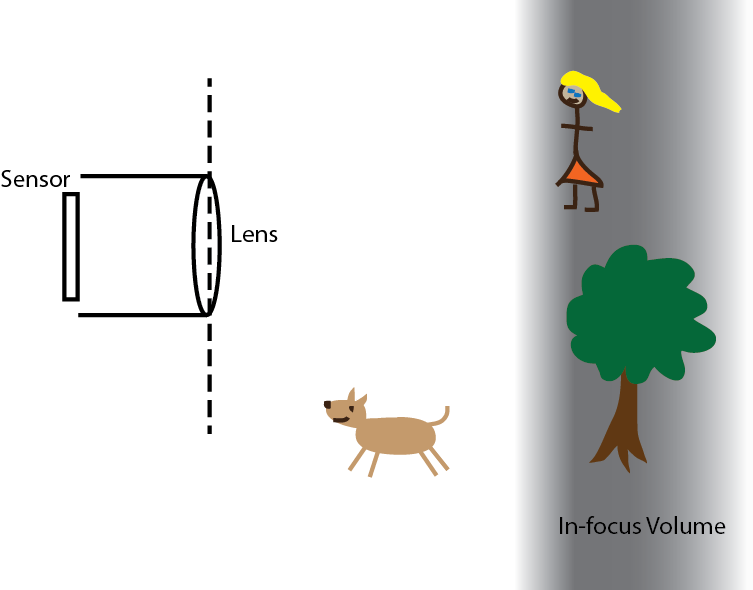
When you tilt the lens, the rules change. The volume of space that’s in focus tilts too (there’s a rough formula, but the math’s not important here). To illustrate, let’s take a look at figure 1. In this diagram, the lens and the sensor are parallel, and the zone in front of the lens that is in focus is parallel to them as well. The girl and the tree are in focus, but the dog is not.

Figure 1: diagram of a photo shoot in a park. The girl and the tree are in focus.

Figure 1: diagram of a photo shoot in a park. The girl and the tree are in focus.

Of course, dogs and girls are much more interesting than trees. How can we get them in focus, and get the tree out of focus so the shot doesn’t seem as cluttered? One way is to tilt the lens.

Figure 2: The same setup, but with a tilted lens.

Figure 2: The same setup, but with a tilted lens.

Lensbaby’s products cost substantially less than high-end lens systems, in part because they’re optically pretty low-grade. Still, a few hundred bucks for a set of flawed lenses (even if the flaws are embraced – more on that later), seems a little steep. After poking around a bit, I found sites for people who made their own tilt/shift lenses for just a few bucks. (There are plenty of other links where that one came from.) I decided to try my hand.

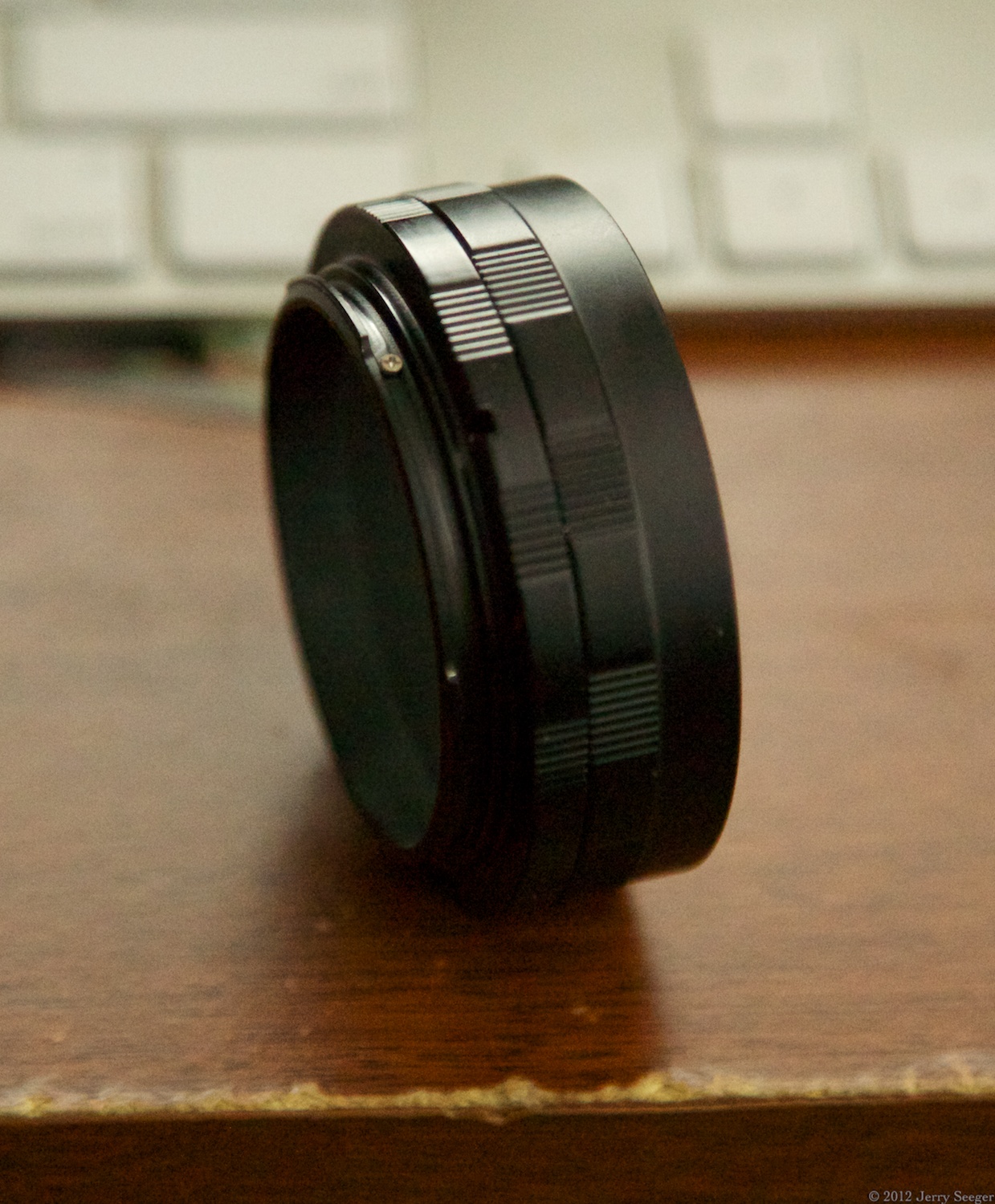
Medium-length section of macro extender tube set

Medium-length section of macro extender tube set

After considerable pondering, I realized that there were a couple of ways I could improve on the designs illustrated, at the sacrifice of a couple more bucks. All those designs involved drilling out a camera body cap to provide the attachment point to the camera. I opted for a cheap Chinese extender tube ($6) to give a much larger surface for mounting the bellows.

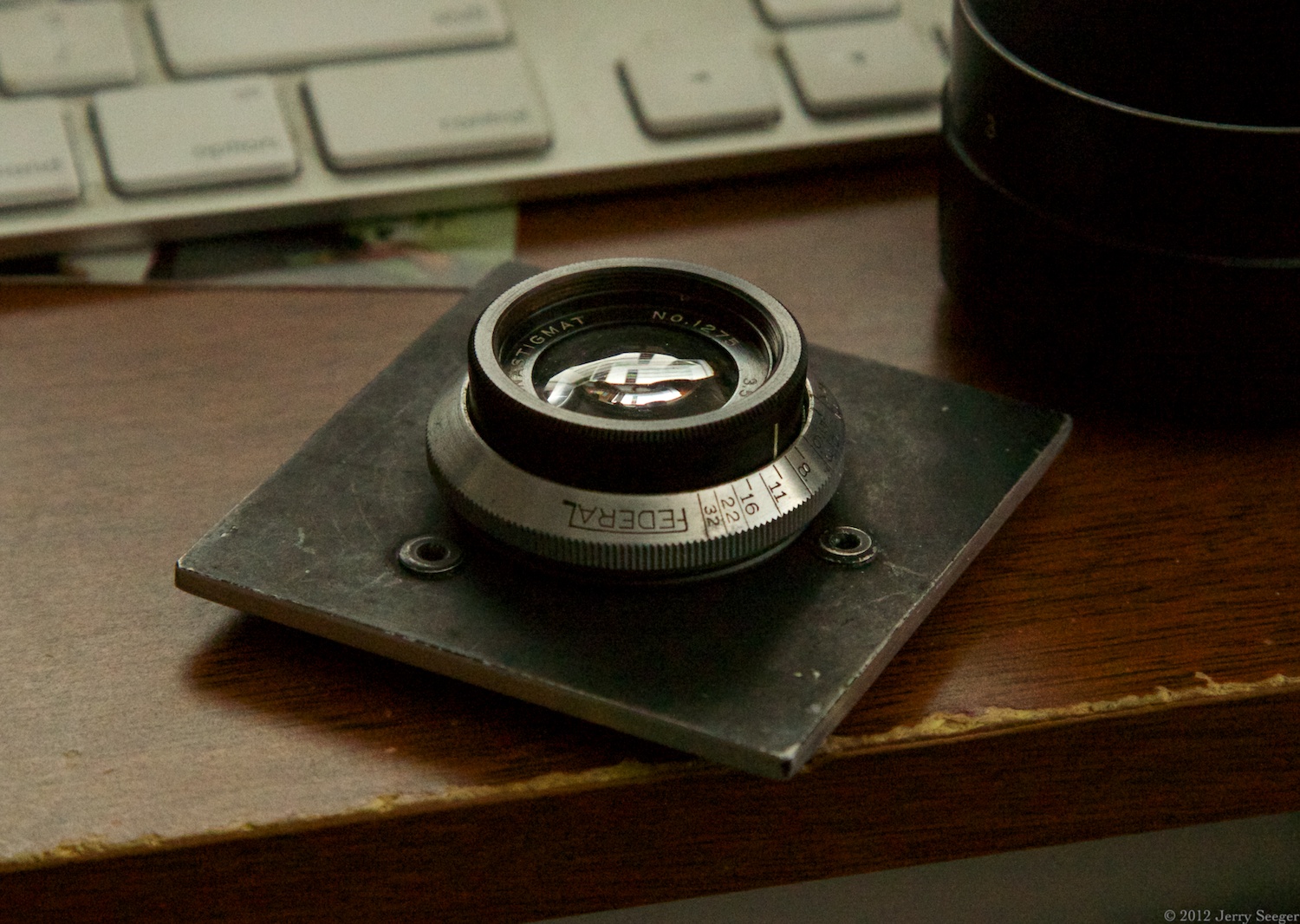
Next came the hunt for an appropriate lens. Many of the people who build these buy old, crappy lenses for SLR’s and partially disassemble them to allow clearance between the bellows and the camera body. Others use medium-format lenses, which generally are designed to be mounted farther from the film. Despite reports that these could be found on the cheap, I was not successful in my search. Eventually I stumbled on a Federal Anastigmat lens for $20 and decided that was an acceptable amount to risk.

I got really lucky.

The big investment - the lens.

The big investment – the lens.

I’m pretty sure the lens was originally intended for a photo enlarger rather than a camera, but hey, you need quality optics on that end of the processing, too. Where I really got lucky was with the focal length. I hadn’t given it much thought, but it turns out that lenses like this come in a pretty wide range, and 3.5″ turns out to be close to ideal for my lens design. See the end of the article for tips on how to find a similar lens.

Mini-plunger with bellows construction.

Mini-plunger with bellows construction.

The lens sat on my desk for a few weeks, but recently I decided it was time to get this puppy made. I went down to Home Depot and after a period of wandering found the plunger section. I wanted one that had a bellows style of construction, rather than the typical rubber dome. Happily I hit pay dirt (with a caveat).

I brought the plunger home and after considerable time pondering how best to attach all the pieces together, decided to stop thinking so much and just see what I could come up with. It was time for action!

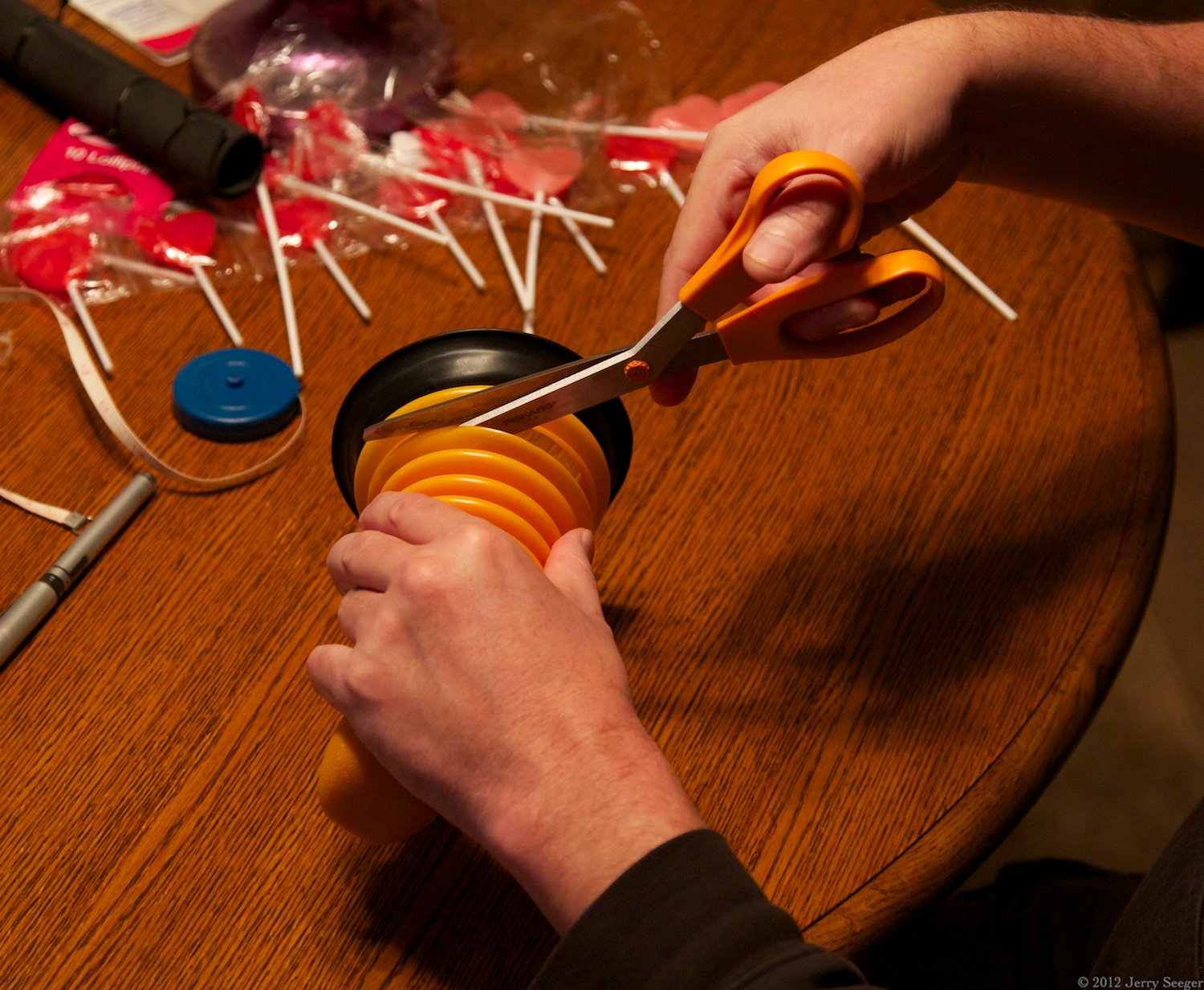
I started by trimming off the part of the plunger bellows that was clearly too wide.

Trimming the plunger

Trimming the plunger


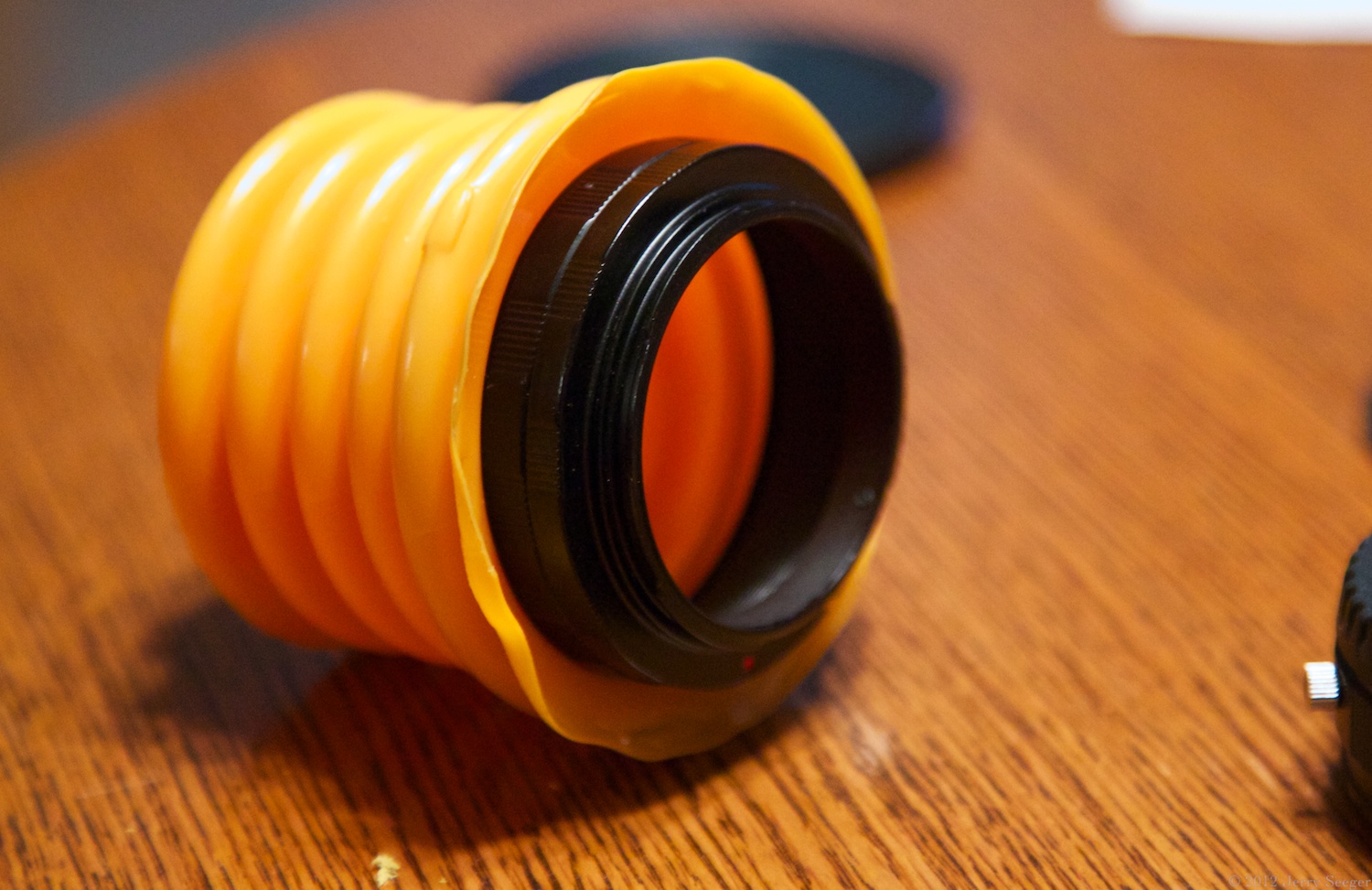
It turns out that that particular extender tube and that particular plunger fit together perfectly, though it took me quite a bit of fussing before I discovered the proper technique for mating the two. After futzing with screwdrivers and pliers (whose scars you can see in the final photos), I just put my weight into it and mashed the thing home.
The macro tube and the bellows mated.

The macro tube and the bellows mated.
You can see how much light comes through the plastic.


To attach the lens to the bellows I used a roto-tool and gradually enlarged a hole in the handle end of the plunger until the threads of the lens could bite and I just screwed the thing straight onto the plastic. It’s a lot more secure than I expected it to be.
The finished product!

The finished product!


And… that was all there was to it. But, alas, there is a problem. A lot of light gets through the plastic. The first pictures I took had low contrast and a decidedly orange cast to them.

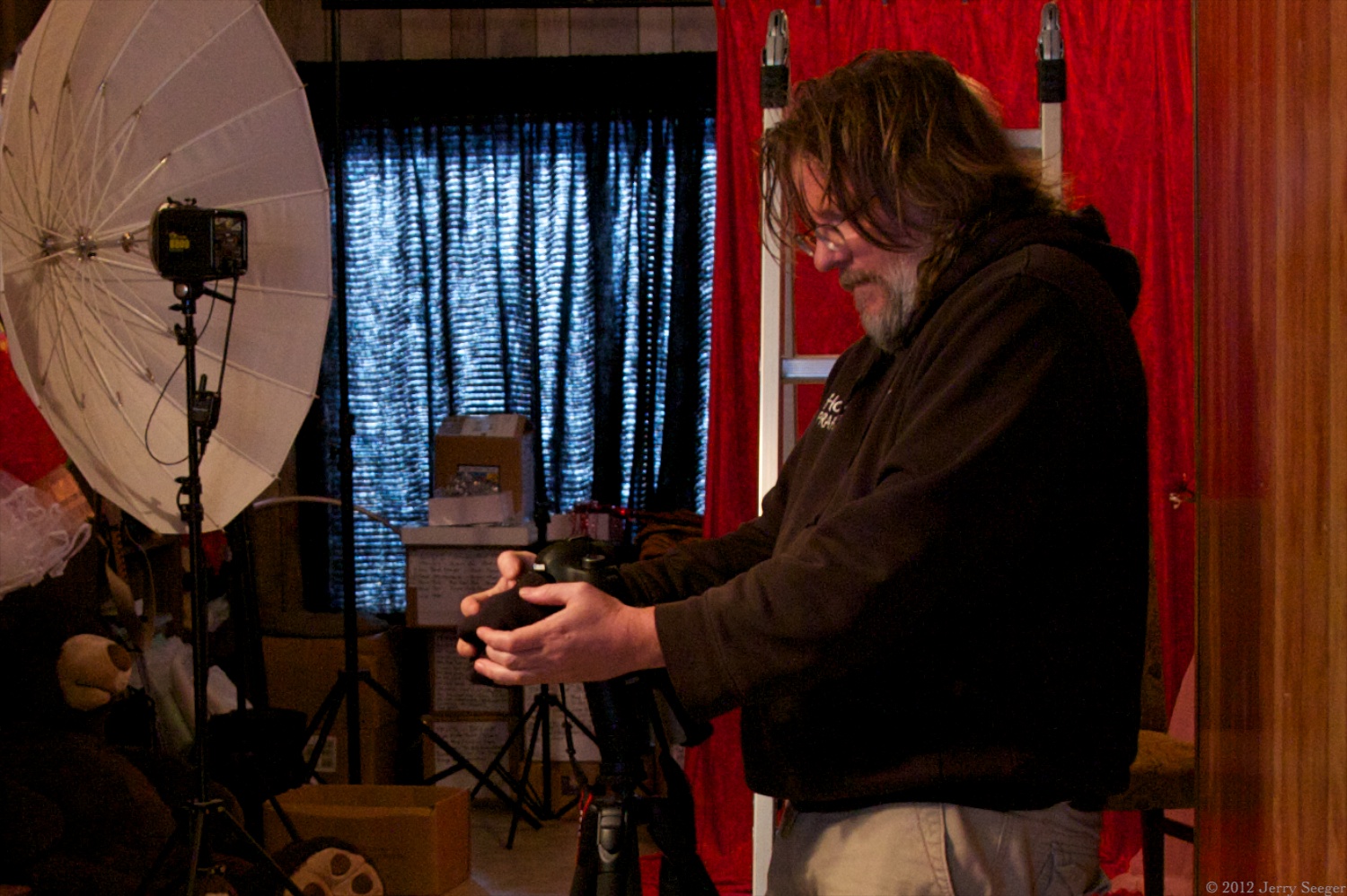
Wrapping something dark around the bellows helped immensely. Here I am taking a tilt-shot with my neoprene knee brace pulled over the lens. Some orange still leaks in through the front plastic, but contrast was improved dramatically.

Taking a tilt-lens shot

Taking a tilt-lens shot


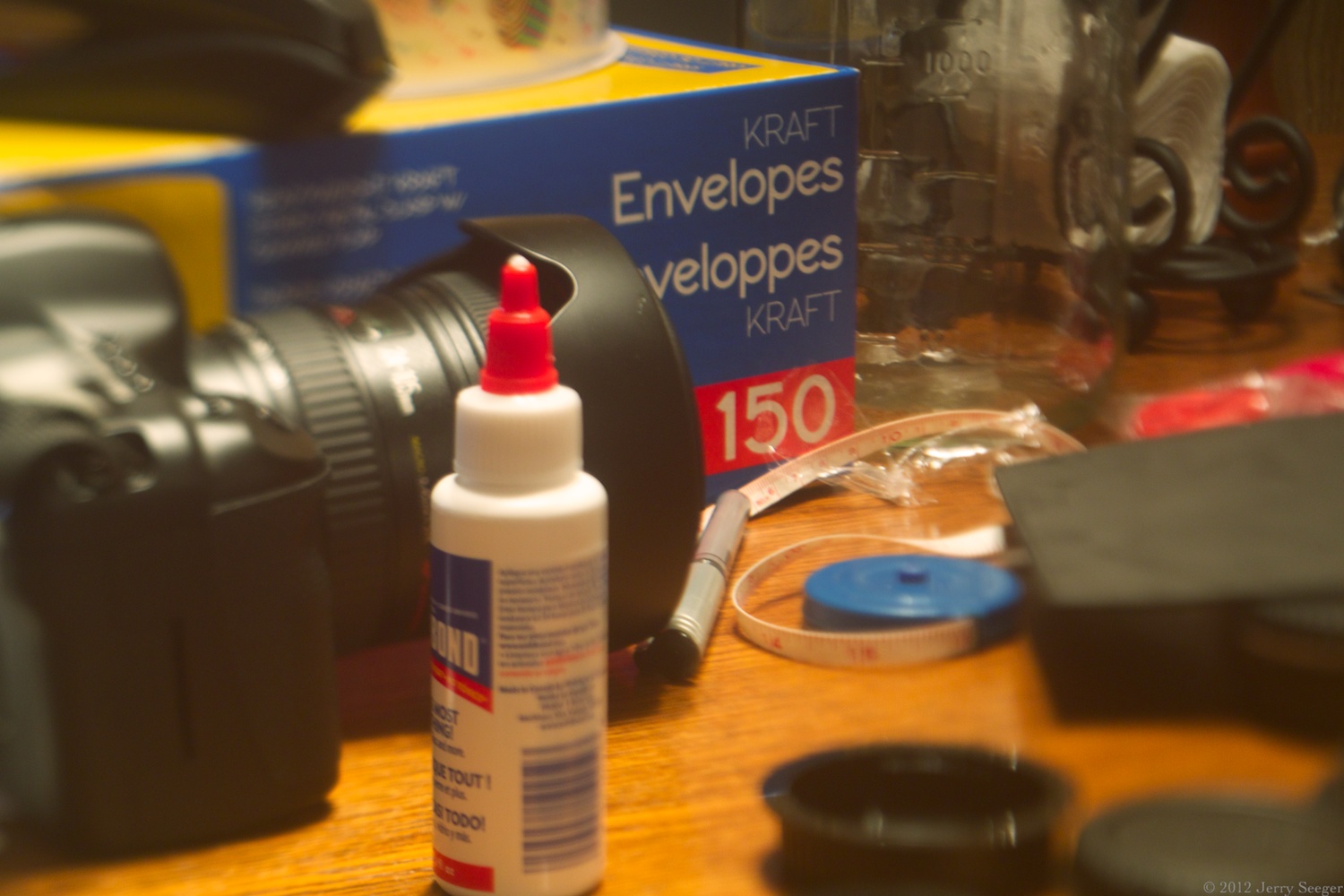
Once color-adjusted, the results are pretty interesting. In the following photo you can trace the volume of focus from the lower-left right back to the napkin holder in the upper right. One side of the glue bottle is in focus, while the other isn’t.
Tilt-lens photo with skewed focal plane

Tilt-lens photo with skewed focal plane

To be honest, I’m not sure exactly what I’m going to do with this thing now that I have it, but the first step is to take a whole ton of practice photos, so when the time is right I’ll be ready.

The biggest disadvantage to this setup is that it takes three hands to take a picture, and since you’re holding the lens steady with your fingers, fast shutter speeds are advised. Some of the lenses in the article I linked to lock down the lens at the desired angle, which would be handy. Lensbaby’s design is structurally pretty similar to mine; they have a version with screws that hold the lens in position.

Another thing about the “anastigmat” lens I used and the offerings of Lensbaby: My little lens is optically quite a bit better than Lensbaby offerings, for better or worse. Anastigmat was a name many lens manufacturers applied when they came up with ways to reduce the spherical aberration and astigmatism of early lenses. Lensbaby, on the other hand, embraces spherical aberration with gusto. This causes the focal zone in the illustrations above to be curved and the edges to be distorted, which can also be fun, and can really pin interest on your subject. The rear elements of my Federal lens can be removed, which I think will give me some pretty major spherical aberration as well. We’ll see. Lensbaby also has a variety of other ways to introduce distortion into photographs, but I’m not going to start experimenting with that until I get the tilting business well under control.

“Anastigmat” is also your key to finding the right glass if you want to follow in my footsteps. Just type that into eBay’s search and you will find a host of old lenses, some quite cheap. (At this writing there’s a nice-looking Rival for $22 and a sort-of-slow Federal for $10.) Choose a focal length in the 90mm range and away you go! (You can use longer macro tubes if you get a longer focal length. $6 gets you a set of three different lengths that can be screwed together.) Some lenses look like they’re only the front element (just one piece of glass); you should stay away from those.

Total cost: $30. When I got down to doing it, it was pretty easy. If you like to tinker, this would make a great Saturday project that could pay dividends with interesting photos for a long time to come. Give it a try!

4

My New Hero

My brother threw me a link today. I clicked, and found myself looking at some pretty amazing rock sculptures. No, not just pretty amazing, downright stunning. There are quotes there, about finding the ‘tripod’ (which I call the three points of contact — always remembering that three points define a plane), and about finding that inner, most steady self.

His site, Gravity Glue, has more examples both of his ability to refute gravity and his skill as a photographer.

I hate the guy. Seriously. Tangentially and completely unrelated, I need to start balancing rocks again, and I need to go back in time and photograph my earlier efforts properly.

1

Performance-Enhancing Drugs in Sports

I’m not a good skier, but I’ve got my planks* on and I’m starting to slide down the slippery slope.

A week ago, the Sports Yak World was abuzz: Ray Lewis, football icon, about to play his last game, was implicated for using illegal performance-enhancing drugs.

Wait, no, that’s not quite it. The drugs are perfectly legal for you and me. They are against NFL rules, however.

There had already been whispers and speculation about Lewis. He’d had a severe injury, one that even his younger peers take months to recover from, and he was back on the field in a few weeks. Folks were looking at him with suspicious eyes even before a guy came out and said he’d sold Ray-Ray the stuff. The guy even has a tape of a phone conversation where Lewis asks for the substance.

The restricted product? Deer antler spray. Yep.

Quick chemistry lesson as I understand it (don’t be basing a thesis on this): Human Growth Hormone (HGH) is a chemical that is proving a valuable therapy for overcoming injuries, particularly in the elderly. In the body, HGH becomes IGF-1. Deer antler spray contains IGF-1. Snake oil salesmen have started selling deer antler spray to suckers and athletes. There’s no actual evidence that it works. (Ray-Ray also bought requested magic stickers. Seriously.) [Edit: I’m pretty sure Lewis got the stuff for free — the snake-oil salesman was hoping for an endorsement.]

But, given the slice of evidence presented to me, it’s pretty clear Ray Lewis (who denies everything) knowingly used a chemical specifically banned by the NFL to hasten his healing. That was cheating. Ray Lewis cheated, and he just won a Super Bowl.

Now, I’m not a Ray Lewis fan. Not at all. Weaseling out of a double-murder charge by testifying against your friends is not going to win your way into my heart. (He has been, since, a publicly stellar dude. If that’s the real Ray-Ray, if he really did learn from his past, then the God he talks about will welcome him.) I’m not a Ray Lewis fan, but I have to ask: Whom did he cheat?

He sure as hell didn’t cheat his fans. Remember, what we’re talking about here is that he used a safe method (well, a derivative of a safe method) to heal faster. Whom did he cheat?

I think we need to step back and look at why performance-enhancing drugs were banned in the first place. There are two arguments in favor of banning the use of PED’s: fairness and safety.

Let’s tackle the easy one first. Kids were (are) hurting themselves taking steroids. Athletes were (are) putting dangerous amounts of stuff into their bodies and paying for a couple of years of excellence with a lifetime of kidney failure. This is a very bad thing. For that reason I agree that anabolic steroids should be kept out of sports.

But what if the drug is safe? What if there’s no benefit to taking a crap-ton, but a little in the right place helps you heal faster? Isn’t healing good?

So then we get to fairness. In the cycling world there was (is) a practice of drawing blood from an athlete, spinning out the red cells, and on race day pumping that super-concentrate back into the rider’s system. This is quite obviously not something we have to worry about high school kids doing to get an edge at Saturday’s track meet. At least not yet. But safety isn’t an issue here (assuming proper procedures). The practice is banned on the grounds of fairness.

Presumably the fairness argument is based on finances; less-affluent bike riders can’t afford the expensive treatment. But I’ll tell you this, kids: in the races where blood doping happens, ALL the riders have the money to do it. And, probably, they all do it.

So, overall, I’m not buying the fairness argument, and that undercuts a lot of the current policies. An athlete should be able (encouraged!) to use all that science has to offer to recover from an injury faster, as long as the kids watching in the stands won’t be hurt trying to follow the example.

Free the Antlers!

One prominent athlete failed a steroid test after taking deer antler spray. Turns out his spray had methyltestosterone (or something like that) in there. My guess: the deer antler potion salesman decided to add a little something that actually worked into his version of the spray. If we free the antlers, athletes won’t have to buy the stuff from shady guys selling the antler juice out of the back of a van. They’ll be able to buy refined antlers from reputable sources. Sources with something to lose if their spray turns out to be tainted.

It’s a slippery slope, but here’s the thing: I WANT my favorite athletes to enhance their performance. I want them to practice, I want them to drill, and I want them to be in the best possible physical form. When they’re hurt, I want them to heal quickly, and if they use a therapy that is safe and legal for you and me, then I say go for it. It’s not FAIR to ask them to endure recovery times longer than necessary.

Ray Lewis broke the rules, but I don’t feel cheated.

—————
* Considering that skiers speak a different language, you’d think there’d be more ways to say ‘skis’.

Mullets and Hockey

I learned on an NPR quiz show long ago, that according to some book mullets came into fashion in medieval times so peasants working in the field could keep the elements off their necks while not impairing peripheral vision — so they could spot bandits and raiders. It makes sense, I guess, as far as it goes.

Tonight I was watching clips of hockey games before the helmet was required, and it was a mullet-fest. And you know? It makes sense, for exactly the same reason. It’s cold on the ice, but a hockey player without peripheral vision is going to have a hard time of it. In that environment a mullet is… sensible. There, I said it.

1

A Staggering Number of 1’s and 0’s

The other day, Apple published an update to iOS, the software that runs iPhones, iPads, and iWhatnot. I updated my two devices last night; the download was about 1GB for each.

Not that long ago, a gigabyte was a lot of data. Even these days, a gigabyte here, a gigabyte there, pretty soon you’re talking about a crap-ton of information.

How much? Today I spent a full ten minutes doing research for this blog episode, hoping to come up with some sort of estimate for the number of iGadgets updated over the last couple of days. I found one fairly recent article that said there were 400 million iOS devices in the wild, but that report was published before Apple sold two million iPhones in China — in a single weekend.

I’m going to throw the number 500 million out there, because it’s nice and round and makes the math easier. We have to figure in the percentage of iDevices that are sitting in drawers gathering dust; those will not likely be updated the moment a new iOS version is available. What percentage is this? It’s really hard to tell. Apple loves to point out, however, that even taking into account the huge market share they enjoy, the amount of Web traffic generated by their devices is even higher, suggesting a significantly higher usage rate than their Android cousins. I will make the logical leap that higher usage rate implies higher demand for updates to the new iOS.

So, let’s say that half of all iOS owners upgraded their gear in the last two days. Apple considers it a HUGE competitive advantage that they can provide infrastructure to update all iOS devices. Android providers simply don’t have that (Google has might, but Android updates go through the telephone companies, so the telcos can limit features and add nefarious supplements). As a result, soon 80% of all iOS users will be on the latest version. Nirvana for software developers.

But let’s think about that infrastructure. Over the last two days, by my wild-ass estimates, Apple delivered 250 million gigabytes of data to their iOS customers. 250 petabytes, on top of the regular daily traffic. I’ve been told by unreliable sources that after the Great iTunes Christmas Crush of ’09 (or was it ’10? Thanksgiving?) work was done to allow server capacity to be reallocated in anticipation of massive crunch times. If the network performance in my office is an indicator, that happened this week.

Side thought: is it possible to store more bits of data than there are particles in the universe? Not in binary, I suspect. Side side thought: I learned on a British educational TV show in roughly 1981 that the universe holds something like 1083 particles, but what with all the dark matter and so forth coming down the pike since, it wouldn’t surprise me if the estimate had moved up to 1084 particles by now. Of course, the definition of “particle” itself can be squirrelly, translated from the 1980’s, and I may just remember wrong. ANYWAY, the iOS update was only on the order of 1017 bits. Chump change when scaled against the entire universe.

But down here on planet Earth, that’s a lot of ones, and roughly the same number of zeroes, each where it belongs.

1

Bought a New Lens

It was love at first sight. I saw the lens, and had to make her mine.

I’d guess that I take more than 80% of my shots with my 24-105mm zoom. It’s an incredible piece of technology, combining versatility and really impressive image quality. In second place is my beloved 85mm, a lens that totally changes the rules when it comes to lighting, that I’m only just starting to master. My fishy-fisheye isn’t getting a lot of work these days, nor is my big ol’ 100-400 zoom.

I shudder to think how much money I’ve dumped into this hobby. (I have not done the math, nor will I.)

Since buying the new camera, I’ve bought two lenses. The first I will not describe now; that is for another episode. Today we’re discussing my new 135mm portrait lens, which is in the hands of the United States Postal Service and heading my direction from Baker City, Oregon as I type this.

Of course I did my due diligence before I bought the lens. I looked to see what other lenses with similar characteristics were going for. On ebay, there was one for less that had better numbers. The auction was young, however, and I wasn’t interested in hanging out to see what it finally went for. I was already in love, and it was purely physical.

I bought the 135mm prime f/3.5. I also bought an adapter to mount it on my camera. Total cost, including shipping: $46.

Yeah, baby.

The funny thing about my new, super-expensive camera: it’s manual-focus friendly. That means, within certain limits, I can mount a host of old glass in front of the state-of-the-art sensor. Ironically, old Canon lenses are not easily adapted on new Canon bodies. But ancient Pentax? Piece of cake. My new lens is by Vivitar. Here’s the link to the ebay listing: [Alas, the link didn’t work for the general public]. (I didn’t want to post the picture here, lest it undermine the drama in the previous scene.)

I have read (though I have yet to discern), that modern Canon lenses on modern Canon bodies create a look that can be distinguished by the trained eye. Same with Nikon and Sony. Not sure I buy that (there’s software between camera and viewer), but there’s a handful of photographers out there looking to bust loose by using old glass. Brand aside, the flaws in lenses before robots made them and lasers measured them adds a certain character to a shot. I like character, but to be honest, that’s not what motivated me. $46 for a 135mm prime lens (a lens I honestly think I can use to good effect) was only part of the story (but a meaningful part). It had to be this 135. Look at the picture in the listing and you’ll understand why.

OK, the link above seems to only work for me. Here’s the lens (click to biggerize):

My New Lens

My New Lens

1