ESPN.com has completely gone to hell; si.com’s not much better. Grantland has ceased to be. Where does one go to read sports journalism any more? Does it even exist?
Whither the Sports Columnist?
Reply

Most of us now can become energy producers. We might not produce as much as we consume, but we can put solar panels on our roofs and reduce our energy bills. And if our panels produce more energy than we’re using at the moment, it seems like a good idea to put that energy back on the grid for others to use. Energy storage is inefficient. The burning question: how much do we get paid for that power?
The law differs everywhere but where I live right now, People can sell electricity back onto the grid at the same price they pay for it. While that is great for those with rooftop solar, I’m not so sure it’s great for all of us. The question is: Why is the electricity I sell back to the grid worth twice as much as the electricity utilities buy from other power generators? The utility is forced to pay way more for electricity homeowners produce than they pay anyone else.
The power companies are fighting back by imposing huge fees on solar homes. In some states now, like Arizona (which… solar… duh), if you put in a solar installation you’re slapped with a huge tax to pay for “your share” of the old-world electricity infrastructure. That is also ridiculous. The message in those states: if you go solar, go big enough to get off the grid. A total lose-lose scenario, since the surplus generated by homeowners goes to waste.
And in that battle, I am the biggest loser of all. My euphemistically-named ‘manufactured home’ can’t support the panels. Next-gen solar panels might be light enough. I hope so. But in the meantime, my rates are inflated because some of the electricity I’m buying was bought by my power company at a ridiculously high price.
If I make more electricity than I need, the price I sell that power back to the grid should reflect the cost to the power company to get that energy to its destination. Right now in my neighborhood the power company is required to buy electricity at a loss from schmoes like me. While I have no sympathy whatsoever for the assholes who run the power companies, assholes who endangered public safety to bilk Californians out of billions of dollars and then hid the money behind bogus bankruptcies, I still have to move forward on principles of fairness.
Brief aside: Documents sealed in the Enron trials could get a lot of energy executives serious jail time.
Back to the small. If I produce electricity I don’t need at the moment, I should be able to sell it. The value of that power should be a contract between me (or a collective of people like me) and the power company I’m selling to. The price could change minute-by-minute, based on demand. But it shouldn’t be retail. Sorry, my hippie friends, when I’m producing electricity I am just another power plant; I shouldn’t have an unfair advantage over any other electricity producer.
BUT! While I accept that I should sell my electricity at wholesale, that doesn’t mean I accept the ridiculous taxes on energy-producing households to maintain the grid. The power company can profit from the power I generate the same way it does with power it purchases from big producers.
Power companies across this great nation wish to punish the small producer. They have brought forth taxes to combat the little-guy-friendly laws in many states. Solar power is starting to make real economic sense, even with the government underwriting of fossil fuels.
I think the key was in a parenthetical a couple of paragraphs back: millions of rooftop solar owners combining to form a collective — a single power company that negotiates its rates with the power companies the same way all the other generators do. As solar technology improves, the cost of generation goes down, where the cost of the fossil competitors may enjoy periodic drops, but ultimately must move upward.
If our nation were to say in the meantime that poisoning our water and killing our children is illegal again, even for frackers, that would dramatically increase the leverage of alternative power generators.
Let’s make solar power officially just another source of electricity. Solar is ready to compete on its own merits, without price controls, and despite the staggering portion of our taxes that is spent to maintain the oil industry. PG&E is not going to impose wacky grid taxes on its most cost-competitive supplier. But it’s the people making the electricity who need to speak, not governments. It’s time to take the training wheels off and let solar ride.
Today as I was driving to work (really had planned to bike today, but…) I was in stop-and-go next to a Maserati. “That’s a handsome automobile,” I thought. About then I caught a whiff of the oil going out my tailpipe and that brought to mind the mortality of all useful machines. I stopped to look at one of the Maseratis that parks in my structure. It is indeed handsome, even on extended inspection. “I wonder of there’s a Maserati convertible?” I pondered.
There is a Maserati convertible, it turns out. And it’s also a handsome automobile. And… it’s pricey.
Ha. “Pricey.” OK, I know a prestige marque commands a premium, but I wasn’t ready for a price tag that’s damn near twice the Jaguar F-type. That’s the competition, I figure. And while I find the Jag a little butt-heavy (I have heard that the trunk had to be expanded to meet the marketing requirement that it could hold a big-ass set of golf clubs – but if it can only hold one set, that’s what the passenger seat is for), and the Maserati is allegedly a four-seater, there’s just no way to justify spending absurdly too much for the Maserati (assuming you are already reconciled to spending far too much for the Jaguar).
Unless, unless, the Maserati has fewer stupid gizmos. There’s stuff on most modern cars I’d pay to not have. It would take a lot of not-having to justify that price, however.
Fortunately I planned ahead and started stretching the Miata’s top last night — it had been down so long that it had forgotten what up was like. Then on the commute this morning: Thunder! Lightning! (Not necessarily in that order!)
California freeway in the rain? This isn’t So-Cal but the rain still makes already-awful traffic awfuller. Except this morning was the lightest traffic I’ve experienced in weeks, with drivers showing a little extra courtesy I’ve long since given up expecting. Go figure.
Tomorrow back on the bike, but welcome, rain. Don’t be a stranger.
Let’s pretend for a moment that the brain is an organ. Of course that’s a silly proposition, the brain is simply who we are. But indulge me for a moment and pretend.
If the brain were an organ, jesus what a complex mofo it would have to be to house our identities.
Now, if you follow me so far with this silly conceit, you have to accept that, just like any other organ, in some people the brain may not function in an ideal fashion. But for something as complex as an organ that defines out identities, “improper function” is hard to pin down. We accept a wide range of functionality and celebrate individuality. I know some messed-up, awesome people.
If we accept the idea that the brain is an organ, we are forced to accept that the brain might have well-documented weaknesses. After all, all the other organs in our bodies fail in well-documented ways. The most complex and mysterious organ in our bodies will naturally be the root of the most complex and mysterious troubles. We need to stop saying “mental illness” and start saying “brain malfunction”.
Hoo – even using the word malfunction rubs against the grain, even though it describes the situation exactly. I invite all out there to come up with a gentler phrase.
I get depressed now and then. I get the feeling that there’s no point in pushing forward. Shit don’t matter anyway. What I feel is a low. We all have lows. Since we all feel some version of the emotion, it is easier to diminish people who have lows lower than any low you will ever know. “I’ve been there,” you think. “I understand.” And implicitly because you survived your low, anyone else should survive theirs. But you don’t know low. Honestly, I don’t know low either. Not that low. For me, a trip into true organic sadness is something to savor, to milk for the characters it informs in my writing. It is not a song of self-destruction coming from somewhere behind my left ear.
There seems to be a chunk of folks (and insurance companies) that would like to pretend that brain malfunction is some invented discomfort designed to bilk you and me out of our hard-earned money. Insurance companies cover every organ except the most important of all. That, my friends, is bullshit.
I have been remiss in reminding you all, faithful viewers, that the definitive (and well-written) article for best pairings of alcohol and halloween candy can be found here: The Most Comprehensive List of Halloween Candy & Alcohol Pairings Ever Written.
You can get a little more background on the process here on MR&HBI at All in the Name of Science.
Enjoy!
For a couple of years she beat her little sister, but now Serena gets all the big wins. Time is separating the two, now Venus is “only” the 23rd top player in the world. Tonight’s match may be the last meaningful showdown between the sisters.
First set: Serena.
Second set: Venus — decisively.
Third set: still early, leaning Serena. I’m kind of pulling for big sister Venus. I gotta think it will matter around the table at Thanksgiving.
In part 1 of what is almost certain to be a series, we look at a simple, step-by-step guide on how to turn your misplaced anger into a moment of fame at the expense of an innocent third party.


GREAT JOB, SHRILL VICTIM!
This is a big technical discourse that ends with a restaurant endorsement. Because Agave in San Jose is a good place to be.
Today pretty much sucked. It started last night, when I ran a routine software update on the heroic little computer that brings you these ramblings. It is a Mac Mini tucked away on a shelf in a climate-controlled facility in Henderson, NV; a little machine that just plugs along year after year.
As a primer before I dive into that part of my hardship, let me take a moment to describe the UNIX world. UNIX is a computer operating system that has been copied and recopied into different kinds of Linux and BSD, as well as Apple’s Darwin, but philosophically the different flavors have much in common and share a lot of little programs. In fact, it’s all about the little programs. Each little app is designed to solve one problem perfectly, and larger applications use these underlying facilities. A graphics program could depend on dozens of underlying libraries.
So when you install one of these programs, how can you be sure all the parts it depends on exist on your system? It’s a huge chore, made much simpler by package managers. Package managers are special programs that maintain a database of who-needs-what so when you install SuperGameMachine it will automatically install CleverGraphicsLibrary, and that in turn will require StupidGraphicsLibrary, and that will require something called gl (actually the names of all these things are criminally terse, so you can never deduce the purpose from the name — CleverGraphicsLibrary would be named cgl).
Anyway, a major upgrade of ncurses just came out, and it gave me a hellish few hours. That database of who depends on what? Well, it turns out is wasn’t so complete, in the MacPorts world. ncurses had been so stable for so long that many program maintainers didn’t even realize they depended on it. The update came along and those programs were still looking for the old version. One of those programs was bash. bash is part of mac OS, but there was a massive (MASSIVE!) security hole in bash and I went to MacPorts to get the new version faster.
When you watch hackers on TV, when they’re typing cryptic symbols into their black screens, mostly they’re giving instructions to bash. Bash is a shell, which is a name for a program that takes stuff you type and does stuff as a result. For veracity, hackers in movies might compare the merits of bash and zch or tsch, but at this time bash is boss.
So when you open up a window to type those cryptic commands, it will launch your chosen shell. If you set your preferred shell to be bash, and then bash is broken, you are screwed. You are especially screwed if you don’t have physical access to the box. You try to log in, bash fails, and you sit at your terminal in helpless frustration, shouting to the uncaring gods of the night. Even if the package manager eventually sorts out the problem, you can’t get in to run the repair.
OK, this is getting long. I got through that, but there wasn’t a lot of sleeping involved. (Two bug tickets at MacPorts now closed.)
Then, today, after a rather frustrating meeting at work, I was betrayed by my bar. By my BAR! By my quiet haven in this noisy world. We had a contract — I paid a chunk in advance and got a discount on my first frosty mug of happiness on each visit for the rest of my life. I am not dead yet, but new(ish) ownership of Rookies Sports Lodge says it will no longer honor the deal. Should I shout? Threaten? Walk away?
It’s going to take some doing to make today come out right.
So here I am at Agave, the neighborhood cantina, and things are starting to feel better. I am working up the vocabulary to make sure that the official Muddled Sweetie gets her chicken burrito smothered with lots of good stuff. None of the English-speaking staff seems to be on tonight.
But make no mistake, these guys here make good food, for a good price. The menu now has many prices lined out and raised with a ball-point pen, but those big-ass burritos still hold the price line. And even the new ball-point prices are a steal. There aren’t many places in this town where my internal cheap bastard and my internal gourmand can party together, but this is one.
Waiting for the food, sippig Negra Modelo, listening to music with bright trumpets and tight vocal harmony, things are starting to feel better. I’m gonna be all right.
I read an article today idolizing Larry Page, head honcho at Google. I have to confess, reading Larry’s quotes, I was pretty damn impressed. Some of his goals are downright “holy fuck, that’s awesome”. If even a small percentage work out lots of people will be helped. Larry calls them his billion-person problems. But…
Can you solve billion-person problems while exploiting a billion individuals?
 Put another way: here’s a billion-person problem that Google is central to: the erosion of privacy in the modern age. For instance, Google has taken very seriously securing your information as it travels from your computer to their servers. But once that email hits their hard drives, it’s fair game! As long as no one else can get at your info (well, except governments with leverage over the Goog), all is well with the world.
Before I get too deep in this rant, let me say that the Internet would suck a lot more without Google’s search engine. I use Duck-Duck-Go to exploit the power of the search without yielding up my personal info. I realize that’s kind of like getting sushi and not paying; if everyone did that, search engines would have to start charging for their services and people would be faced with putting a monetary value on their privacy.
And, I think there’s a lot to be said for the way Google runs their company, they way they commit to their managers rather than just making the best engineers the bosses of other engineers. I give them big props for that. That comes from the very top and Larry Page deserves credit.
But now, on with the rant!
What Google knows when you use their payment system (Google Wallet):
Google Wallet records information about your purchases, such as merchant, amount, date and time, method of payment, and, optionally, geolocation.
What Apple (my employer) knows when you use their payment system (Apple Pay): Nothing.
Apple Pay was designed from the ground up so that Apple could not get your personal information. This made it way more complicated to implement and added hardship for banks as well, but it was a fundamental tenet of the system. Apple gets enough aggregate information back from the banks so they can get their fees, but none of your personal information is in that data. In contrast, Google (not just their wallet) has been built from the ground up to collect and sell your personal information.
Of course, the banks still know, and the merchant still knows, and Amazon tells advertisers what’s in your wish list… So it’s not just Google here. But Google has access to information you never intended to be known — a lot of it — and they have a unique opportunity to make meaningful change on this front.
Nest, the hot-spit thermostat/smoke detector company was bought by Google. I was discussing it the other day with a co-worker who is a (mostly) satisfied customer. It sounds like a pretty cool system, but I mentioned there was no reason for the damn thing to be in the cloud just to be operated from my phone — it just needed to be part of a personal network that could talk to all my devices. My friend, who has a buddy who works at Nest, shrugged and said, “they have to collect and aggregate data to make the service work right” (or something like that). I accepted that at the moment, but later I realized: NO THEY DON’T. I want my home automation to be based on ME, not some aggregate of other people. And, if they made the data collection voluntary, I might even opt in if it looked like it would help the collective good. It’s something I do.
I voluntarily share personal information all the time. I share my bike rides (but suppress the exact location of my house). I share my image on Facebook. I share biographical data right here on this blog. I probably share more personal information than I should, but I make a big distinction between voluntary sharing (Facebook) and involuntary sharing (having my emails read by a corporation). Even though I don’t use a gmail account, my emails are still read every time I send a message to a gmail user. Does it matter if I’ve agreed to their terms of service or not? No. No, it doesn’t.
Microsoft took a couple of shots at Google a while back, promoting their email and search services as being more privacy-friendly than Google’s. But, amazingly, Microsoft kind of half-assed it (they had a produced-by-local-TV-station look) and they failed to deliver the message effectively, the way Microsoft is wont to do. Still, at least they tried.
If Google would do one thing, a thing that is in their power to do, I will take back everything else I have said about them. If they provide real encryption for their emails — encryption all the way to their servers, encryption they won’t have a key to unlock, so only the intended recipients can read it, I’ll believe that they care about me, and the other billions of people in the world. And it would be a hell of a selling point for gmail.
My sweetie and I binged our way through Breaking Bad. The series was over before we even started, and we chewed through that mother in record time. During intermissions for work and sleep we talked about what was going on, and looked forward to more time with the series.
And then it ended. A you-saw-it-coming-from-a-mile-away-but-were-still-blown-away ending. An ending so complete and poetic that I have to sit back and admire it. I don’t hope for more tack-on seasons or spinoffs (though the prequel Better Call Saul, which we started watching before we dove into Breaking Bad, is mighty fine).
But Breaking Bad is over. It finished when it was right to finish, and if maybe some characters found redemption is was not the sort of redemption that carries them forward.
I miss the show. But I don’t want more.
Many, many years ago, in a time called the 1980’s, my roommates and I were sitting in our little house in Cardiff-by-the-Sea, California, talking about this and that. There may have been beer present. The conversation stumbled upon this question:
If you bounce a ball bearing off a steel plate and measure the height of the bounce, will it bounce higher or lower if you cool down the plate?
Before skipping to the end of this episode to see the answer, think about that question for a minute. On the one hand, you could imagine that the warmer plate is squishier, and would absorb more of the kinetic energy of the ball. Or would it be springier, and act like a trampoline? Does the fact that there is more energy in the overall system when the ball and the plate are warm mean more energy for bouncing?
We were stumped, and at the time there was no Internet. We did have one ace in the hole, however, because my good friend and former college roommate was an expert in… material science! So we called him up, fully aware that he was three time zones ahead of us and it was pretty late even in California.
That night, our Science Expert didn’t seem that enthusiastic about the mysteries facing mankind. It was a pretty short conversation.
I began to look like we might never find the answer to this burning question. Little did I know, but NASA engineers were also curious about the bounciness of steel balls as a function of temperature, and ’round about 1994 they built this gizmo to run some tests:
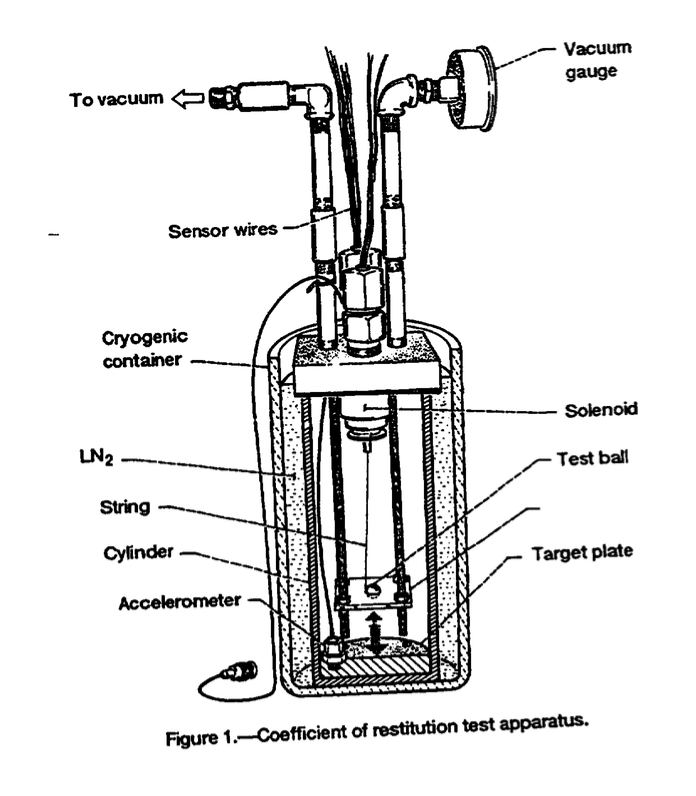
Device to bounce metal things on other metal things.
Source (crooked and everything)
To be honest, the paper is more an Engineering exercise than a real scientific paper (I’ll discuss another NASA ‘research’ project at a later date), but it does have graphs and whatnot, and here is the conclusion: metal balls bounce higher when they are colder, except for the occasional case where they do not. But MOSTLY, colder metal means higher bounce.
Whew. That’s a hell of a load off my mind.
It was on another road trip to Kansas that I first dubbed my blue aloha shirt my Official Travel Shirt. I was wearing it for the second straight day (no sense sweating up another shirt), and I tore the breast pocket just a bit while stuffing in change from a drive-through, limiting the other occasions I could wear it.
But for driving across the United States in a convertible, it was pretty close to ideal. Light and breathable, the cotton fabric was quick to wick the sweat away from my back and provide cooling. When I put my elbow up on the door frame, the shirt would balloon up, creating a cyclone of joy across my torso. Good times.
Good times that finally came to an end on this trip. The ravages of sun, sweat, suds, and more sun began to undermine the integrity of the fabric. The dye faded and the fabric got thinner where the sun hit it most directly—on the shoulders and (rather embarrassingly) on the gut.
When packing for my latest road trip, I realized the shirt’s days were numbered. The pocket was really starting to flap in the breeze and the fabric was giving out along the shoulder seams. This was to be the shirt’s last ride. In retrospect, I should have given the shirt a dignified retirement before the trip even started; it just wasn’t fair to ask it to get me across the Nevada desert in its condition.
The first night, in Wells, Nevada, I took off the shirt to discover two bright-red patches on my shoulders:

Sunburn on my shoulders makes me cry
By the next night in Vernal, Utah, blisters had formed, and while I waited for my car to be repaired I also tried not to ooze into my sheets too much while I slept at night.
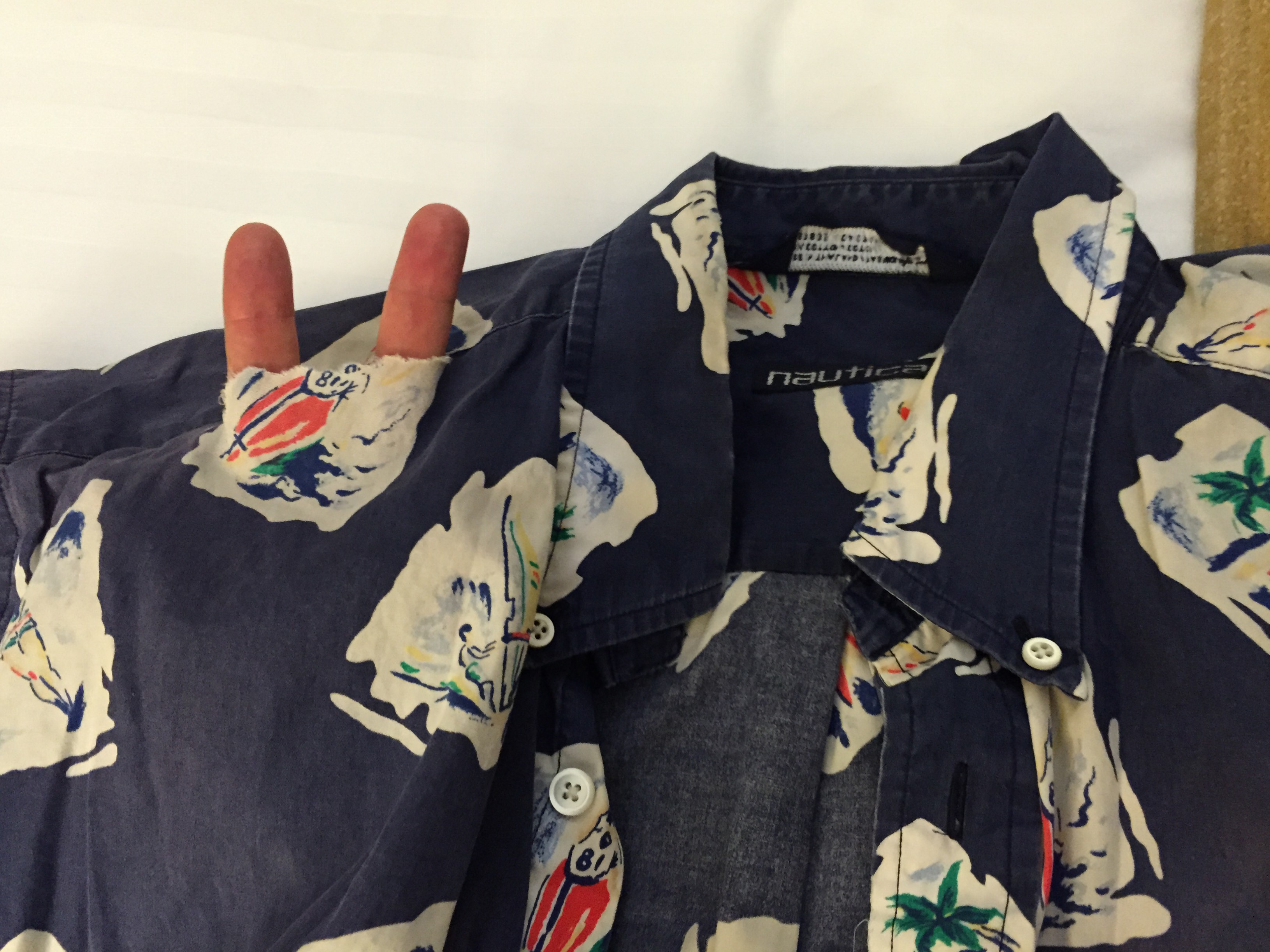
My travel shirt, after one too many days on the road.
The shirt had given its last, and while I had other shirts along for the ride that were adequate, they were all too new and too nice to dedicate to being the new Travel Shirt (though one had good Cyclone of Joy™ action—I might have considered it were it not so dark-colored).
So the search begins, but clothing like this isn’t just found on a shelf, it’s discovered through adversity. It is the product of miles, and the grace with which it handles them. It is sun, and sunscreen, and sweat and wind and time and groping in the pocket for the toll ticket. It is the stop at a rest area with a gentle pit bull going to her new home. It is the discovery of a new road, the onset of a sudden rainstorm, the knowing glance from another convertible driver, the pause on a deserted road at night to hear the chirping of the crickets.
It is the stories. The new shirt will have a lot of catching up to do.