Rough Cut

Today I got my first look at Moonlight Sonata footage, a rough cut that gives a general feel for how the thing will look, but also demonstrates that we have a long way to go to get to the finished product. We had planned to have the opening shot be a long, continuous steady-cam shot, but as fuego has combed through the takes it seems we don’t have one that really works from start to end. That’s not a disaster; there is plenty of footage to make Paul’s entrance into the café a nervous and disorienting time. Not all the takes in this cut are the ones I remember most fondly from shooting, but it’s about making all the parts work together.

Man, I sure wish we’d had more extras.

The cut did not even include the concert scene, so I don’t know how that is going to work, and the voiceovers aren’t there and the walking through Prague and all the audio post, so at this point all I can really report is that there are shots that look fantastic. The voiceover raw files are on their way to me; and I will be going through them and picking out the best takes over the next few days, and putting the bits together into seamless delivery. It’s a job that can take as much time as I’m willing to give it.

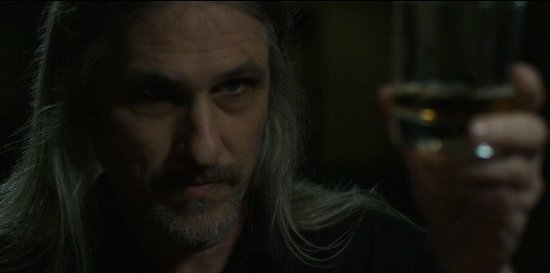
Cowboy Bob reflects on the contents of his glass

Cowboy Bob reflects on the contents of his glass

The underground bar looks great. Really really great. I was worried about the video noise I was seeing but at least on the version I have (far from big-screen quality but pretty good for a computer monitor) the noise is not a problem. Using the real audio and getting the music in comes much later, so I’m trying to not worry about that too much (yet).

A long way to go, but so far, so good!

2

The Three Books I’ve Read Written by Dan Brown

As another big-budget movie based on a Dan Brown novel rolls out, supported by a massive marketing push, I’d like to share my thoughts on the three Dan Brown novels I’ve read, in the order I read them. I’m a bit surprised I’ve not mentioned them in this blog before.

I first encountered Dan Brown in a cluttered living room in San Diego. Angels & Demons was the title of the book, and my friend recommended it highly. I had free time, and reading is part of my job, so I sat down to consume it.

I’ll say this for the story: It was paced well. Events happened and knowledge was gained at a rapid pace but there was time for characters to reflect and for readers to catch up. It’s why I finished the book. The two main characters weren’t bad. And… that’s about it.

On the other hand, the science the entire story was based on was preposterous. The whole plot is driven by a battery that lasts twenty-four hours to the second, and it never seems to occur to anyone that a) battery life is not that predictable and b) even if it were possible to create a battery with a charge that lasted an extremely precise amount of time, there was no motivation here for the people who created the battery to worry about stuff like that.

That’s really a minor quibble, but everything else depended on it. People base decisions that could lead to the destruction of Rome and the death of millions of people to a blind faith on the 24-hour timer. It was the clock that drove the plot.

If that one seems ticky-tack, there were many worse errors in the grand parade of downright stupidity as far as science and scientists were concerned, creating an overwhelming wrongness that ruined the story. Things start off with a ride in a jet that can’t take off and go downhill from there. Then there was the tension between religion and science, which certainly exists, but the ability to create antimatter (which has been going on for decades now) certainly hasn’t created new rifts between science and religion. Unfortunately, this rift is another key plot driver. And the location of the secret lab at CERN? Nope. Antimatter as a world-changing power source? Sure, until you consider the ungodly amount of energy it took to create it. I could go on and on.

There was lots of information about some of the great works of art around Rome and the men who created them, and I found some of it fascinating. (Or was that stuff in the Da Vinci code? It’s a blur, now.) But was Brown’s research on art history any better than his science? I don’t know, but his credibility was shot long before the story even reached Rome. I just hope I’ve forgotten all those facts, in case they’re wrong.

And as far as the process for selecting a new Pope, I’m pretty skeptical that what is portrayed here – even if we allow that a bunch of senior church officials could be so utterly stupid – would be legit.

The ending is simply preposterous. Ridiculous. Eye-rolling, head-slapping stupid. But it’s dramatic, I’ll give Mr. Brown that.

Fool me once, shame on you. Fool me twice, shame on me. I don’t remember who convinced me that The Da Vinci Code would make up for my disappointment with the previous read, but I was reasonably optimistic as I started in on the most famous of Mr. Brown’s novels.

To be honest, I don’t remember that much about the book anymore. It just didn’t stick. I remember rolling my eyes a few times, and thinking “that would never, ever, happen,” but overall I was not as annoyed by this book as I was by the other. How’s that for a ringing endorsement? “Dan Brown’s least annoying work to date!” Some of the characters are reasonably credible, but others are cartoons at best.

This book was controversial, which ironically is probably why we’re being treated to multiple major films based on Mr. Brown’s work. Remind me to write an otherwise innocuous novel that says Jesus had children. (I think that was the controversy – I suppose I’ll have to come up with my own.) There is a “huge” revelation in the story that begs a large question for anyone who can count past thirteen.

Still, I read the book, and once again I think the pacing had a lot to do with that. Dan Brown, for all his faults, kept me turning the pages.

Fool me three times…

Then there’s Deception Point. A steaming pile of suck from beginning to end (yet, once more, I read it all). This book was off on so many levels there’s no point trying to list them here. Let’s just leave it at: I’ll never read a novel by Dan Brown again.

Note: if for some reason you actually want to buy one of these books, and you use the above links, I get a kickback.

The Pillars of the Earth

The Pillars of the Earth, by Ken Follett, is a big book, almost 1000 pages in the edition I read, containing a story that spans generations. I wasn’t quite sure what to expect, and when in the prolog someone invokes a curse and everyone takes it very seriously, I got the feeling I was reading a fantasy novel, which was not the case. There is an undercurrent of magic implicitly believed by the characters, but it rarely plays a central role. The curse is a good touch, but in the end does not inform the actual story very well.

Once I got past my misconceptions based on the prolog I began to enjoy the lives of the main characters. The piece is historical fiction, set in England in the second half of the 12th century, starting with the death of King Henry I, through political machinations and civil war, and into the period of relative peace that followed the coronation of Henry II. The conflict is never central to the story, but it is always there, affecting the lives of the people in the story in unpredictable ways.

For instance, a lot of people starve to death. I guess that was pretty common in those days. At the start one of the key families is starving, the mother dies in childbirth, and the baby is abandoned because the remaining family has no way to feed it. So it goes. Happily the baby is rescued by a monk, and is raised in a monastery. By an interesting set of circumstances, the monastery is in charge of a cathedral that needs to be rebuilt, and the kid’s father – the one who abandoned him in the forest – is the one in charge of the rebuilding.

There were some pretty big coincidences in this book, and as a rule I don’t like stories that are too dependent on fortune of this sort. In this case, they didn’t bother me too much. Perhaps the very low population of England at the time made repeat chance meetings more likely. There were a couple of times I thought the author pushed his luck (or his characters’ luck) a little too far, but most of those meetings were not key plot points. There is simply a group of people all tangled together, and the snarls of one generation affect the next.

I am not sure how historically accurate the story is (more on that later), but man, times were tough back then. He applies age-indicating adjectives to his characters that imply a lifespan not too much shorter than ours, but people find a lot of ways to die prematurely. Starvation I mentioned before, but the people who live in the (apparently fictional) village of Kingsbridge endure a cathedral falling on them, killing more than a hundred, and on top of that plain old violence.

There is violence in this book, both wholesale and personal. A city is burned while soldiers hack down the inhabitants. A work crew is massacred. On the personal side there is torture and rape, along with good old murder. The violence can be graphic at times, but in general I thought it fit with the story. There are people who really, really, don’t like each other, and it’s important to understand why, to feel the evil in your bones the same way the characters do.

As I said before, it’s a big book. A thousand pages. Honestly, I really don’t think there was enough story there to fill that many pages. At some points I found myself saying, “yeah, yeah, let’s get on with it.” Most of the time it was just extra setting that was interesting from a historical standpoint but in the end didn’t help the story. There were other cases, however, that were more annoying.

One general pattern of storytelling is “Someone has a problem. Their first attempt to fix the problem makes it worse. The second attempt fails. All attempts fail until the last act of desperation finally succeeds.” It’s a good pattern; one I should pay more attention to. However, when you read page after page of uninterrupted “then he tried this, then he tried this…” it gets old. Rather than building suspense, I found myself tempted to skip to the next chapter, since all these attempts were to solve a minor problem in the grand scheme of things. Is there an axiom here? Not sure, but for quickly-resolved plot points (Jack got out of the burning church), maybe one should limit the number of consecutive failures, unless there’s an unexpected consequence to one of the failures that matters later. Otherwise, let me smell Jack’s hair burn, help me feel his panic (I didn’t), then get him out of there.

Or Kill Jack. Follett is not above doing something like that, which is cool. That’s what kept me from jumping ahead for that particular dilemma. Still, live or die, the point is going to be resolved quickly, and all that other stuff just gets in the way.

As usual I’ve spent more time talking about the writing than the story. It’s what I do (apparently). The story itself is excellent, an intricate tangle of people who all have their own goals and their own ways of reaching them. People we like don’t like each other. Good people do bad things (though only rarely). Virtue is rewarded, but that can take a long, long time. A new cathedral is built and doesn’t crush the congregation to death.

At the end of the book, I had a lot of questions about the time the story was set in and some of the cities and churches featured in the book. I was also curious about the politics of the time. How much of the novel is fact and how much is fiction? Would it kill any of these authors to put in a little appendix about the times and some suggested reading? If Follett had chopped out a couple hundred pages of blah blah blah and replaced it with twenty pages of “The cathedral in the story is not real, but it’s based on…”, maybe a thumbnail history of the politics and the tension between church and the English monarchy, and things like that, I would have been extremely grateful. C’mon, Ken, you did all that research, why not share some of your favorite sources? (To be fair, he does share a wee bit of that information on his crassly commercial Web site.)

Overall, I’d say that if you have the time to devote to a big, meaty story, you could do a lot worse than this one.

Note: if you use the above link to buy this book (or a Kindle, or a new car), I get a kickback.

The Beginning of a Great Adventure

Here I am, in one of the nicer corners of San Jose, California. San Jose would not be my first choice for city of residence, being not so much a city as a large chunk of the continuous sprawl of alternating housing developments, strip malls, and office parks that is Silicon Valley. The city does have one thing going for it, however: That Girl lives here, and now I do too.

This marks a pretty major turning point in my life and therefore this blog as well. Up until now That Girl has been on the periphery of the blog, someone mentioned occasionally in passing but not a major figure. That’s not because she hasn’t been a big part of my life the last year and a half, it’s because I haven’t really figured out how to write about it. Plus, when one is a third of the world apart and communication is intermittent, a poorly-chosen blog word could lead to undue strife that would be resolved in seconds face-to-face.

I still haven’t figured out how I’m going to approach this, but perhaps now it will be easier. We’ll see. Inevitably there will be times when That Girl reads something in my blog that really she should have heard straight from me. There will be times I’ll have to choose between telling a good story and watching out for my sweetie’s feelings (and, well, some of it’s none of your damn business), and often the story will come out on the losing end. That’s just how it’s going to have to be. The other thoughts can go into my fiction.

Having a relationship is not scaling Everest, but in it’s own way the risks and rewards are even greater. It would be foolish for me to attempt Everest in my current condition, and I’m afraid that my good-boyfriend skills are also alarmingly atrophied. Still, I’m really damn excited about this journey, really happy that That Girl found me and spent years pounding against my cluelessness until I got the idea that she might be interested. All credit goes to her for that.

It’s an adventure almost all of us experience at one time or another, sometimes successfully, sometimes not. I’m not sure how I’m going to approach writing about it yet, but I’m still the same guy that can be fascinated by the tiny things, and I hope that there will be enough of those to shine a little light on this thing we call love.

So, welcome to the Great Adventure!

Across the Desert

I’m not used to traveling in convoy. It was a pleasant change to roll across the western third of the United States with my brother in the rear-view; good to have conversation at rest stops and meals, and to split a pitcher of Bass Ale at Mad Dog’s Dog House in Kingman, Arizona. There is a downside, however — time I normally spend over a laptop musing about the journey and its larger meaning is spent instead discussing plans to take over the world.

The most notable aspect of this trip, however, was the wind. There was a lot of it, and it was directly in our faces. On day one we stopped at Speedy’s, just across the border in Arizona, where I remembered a decent little trucker cafe. When we walked in I realized I had guided us to the wrong place, but we stayed. We sat by a window and watched the as the wind whipped rain and dust around simultaneously.

The wind roared around the building, a taller-than-necessary steel skeleton with thick-looking walls and a gently-sloping roof. fuego leaned his back against the outer wall and felt the building flex with the gusts. “The employees don’t seem to be worried,” he said, “so I guess this happens all the time.” A particularly strong gust made the roof groan and I made a comment about it blowing off.

Our food came – quite good food, as it turned out; I had mutton stew and fuego had a green chile grilled cheese sandwich. We ate and continued to marvel at the spectacle outside. I was not looking forward to pumping gas out there.

The waitress was bussing a table near ours when a loud POP reverberated through the building. After a bit of confusion we all started looking up at the ceiling. Another pop followed, not as loud as the first. Now, the employees were nervous as well. I began to plan a swift exit strategy should things get worse.

We finished our meal (neither of us that hungry due to good snack supplies) and there were only a couple more pops from above before we effected our escape. [A brief Google check that night uncovered no mention of the roof blowing off after we left.]

The other effect of the wind was on gas mileage. Normally going from the border to Kingman on a tank of gas would be routine, but as we passed Seligman (and the last gas stations for a long, long way), I was surprised at how low I was on gas. I still appeared to have seventy miles’ worth, though, so on we went. The gauge continued its nose-dive toward E, however, and the last few tense miles fuego took the lead to give me a windbreak. We made it to a station, I filled up, and the last few miles into Kingman were routine.

We ate, slept, and Sunday we split up at Barstow, both turning toward our designated blights of urban sprawl. I arrived, scratched my arm on a fire extinguisher box, was met by That Girl with a big hug and the next phase of my journey through life began.

Leaving Prague

I’m not a big fan of packing, and cleaning, and all the other tasks associated with moving. As a result, I tend to procrastinate when confronted with them. Add to that a big complicated task like making a short movie — a task that will absorb as much time as I allow it to — and the desire to keep my normal tasks of writing and maintaining software (the latter a dismal failure lately), and you end up with night falling less than twelve hours before departure, suitcases empty, house a jumble, and the clock ticking away.

Add on top of that an editor anxiously waiting for the data from the last day of shooting and the master audio, a task that ended up sucking down a couple of hours of my time, and it’s fair to say that my exit in the morning was not the cleanest one on record. I stopped downstairs to tell the landlord that the big pile of clothes was for charity (Angelo will be picking it up), and that Soup Boy would be in touch. I forgot to mention that the garment bag was hers for the taking, that the hair trimmer set was Soup Boy’s if he wanted it, and that the bag at the top of the stairs was trash that would not fit in the can outside.

I was in Atlanta when I realized that I had left my leather jacket in the kitchen. Bummer. I really like that jacket. Apparently That Girl does also. I was wearing it when she first saw me.

But time waits for no panicked, exhausted, scrambling packer, and it didn’t wait for me, either. Goodbyes were brief and then the car arrived to whisk fuego and me to the airport. “Whisk” in this case meant stop-and-go traffic; it was like Prague was giving us one last reminder of what California would be like, one last bid to have us stay. Sorry, lovely city, but it’s time to move on.

Airports are airports, and while Prague’s is less of a hassle than some, it’s not different enough to warrant much comment. My bags were a bit over the limit but thanks to the traffic jam the agent didn’t have time to make me pay extra. So that worked out.

On the plane, over the water. In the seat behind me was a 14-month-old baby, and I cringed when I sat down. Still, I’ve had some experience with that demographic lately, so I resolved to be tolerant. fortunately, the kid did really well, with a minimum of fussing and only the occasional seat-kicking. It was the five-year-old in the seat in front of me who was the problem. Lots of energy, nowhere to go, piercing scream. Lovely.

Atlanta was routine; a period of standing in line to be screened by various agents of the government, then a wait until the plane was ready. From there to Albuquerque, and a hotel. It was a long day, eight hours longer than most days, but fuego and I managed to stay up long enough to have dinner at a diner that served green chile. The plan was to meet with family members in the morning, to recover my car and go up to Los Alamos for the evening.

Only, with all the communication and plan-making flying around, apparently none of the messages sent to my sister and brother-in-law, the keepers of my car, included the date of our arrival. They were out of town. Hm. A bit of a wrinkle, that. Fortunately the parents had an extra key for the house where the car was. Unfortunately, it was 100 miles away. We went up to the ol’ homestead and fuego and I prepared for our road trip, and I got to see my beer slave.

It all worked out in the end, obviously; Saturday morning found fuego and me in a convoy heading out into the desert. I’ll tell you about it soon.

1

Familiarity Breeds Contempt

As I was driving across the desert yesterday, I heard a song for the first time. It has a little hook that goes like this:

One thing

To do

Three words

For you

The first time I heard the rhyme, I thought it was kind of clever. The second time it’s repeated in the song, I thought, “Hallmark”. The third time, I was done with it. By the end of the song, I was pretty sure I never needed to hear it again.

It seems, however, that the tune is question is in heavy rotation right now. As I searched the airwaves for stations as I scuttled actoss the surface of the earth, the song kept coming up. Each time I listened to less of it before changing stations, no matter what I thought of the music that had come before. I was more tolerant of commercials than I was of this song, and I don’t much like commercials.

Voice-Over Day

There was one remaining task for Moonlight Sonata that had to be done before I left Prague. We had to get actor, director, producer, and sound guy in the same place for an hour or three to get the voice-overs recorded. It turned out the only time all parties could be present was Wednesday morning at 9 a.m. Normally that wouldn’t be a problem but the night before was my (not yet documented) going-away party. Perhaps it was a good thing that there was something important to do the next day.

I resolved to bring donuts for everyone. There is a store near the metro station in my neighborhood with a sign saying DONUTKY, which I assumed was a czechification of the English word. Closer inspection of the sign, after four years of walking past it, showed that the sign said DOUTNIKY. Apparently that means “cigars”. Happily there was a shop filled with yummy baked things two doors away, and it had very donut-like items.

Apparently, what you might call a jelly donut (similar here but smaller and rounder) is in this country called by the name “horse poop” (in Czech, of course). My guess is that it has something to do with the shape. Dobrou chut’! (rhymes with ‘Bon Apetit!‘)

But I digress. I got to Brad Huff’s new studio on time, with donuts. We recorded the audio. Coaching someone in reading my words was educational; I became aware of cadences of long and short vowels and a flow I give my words that I had not been consciously aware of before. Sure, I like to make my writing sound good to the ear, but I hadn’t given any thought to just how I do that. Maybe that’s one reason I can spend so long on a single sentence. (Not here, of course, this is Muddled Ramblings.)

We recorded the sound, and after a great deal of confusion and uncertainty got copies to all parties who needed them. The data distribution chore ended up eating several hours of precious packing time, but it was by far the more important task.

Now the ones and zeroes are in the hands of the editor, and a rough cut should be in the works. I’m really, really excited about seeing it.

2

Shooting Old Ray

One thing about making a little movie on a very low budget: when you don’t pay the extras you never know what to expect. You really can’t twist elbows too hard, and since most of the people who show up are friends, you also don’t want the experience to be too bad. But there’s just no getting around the fact that being an extra in a movie is mostly about sitting around waiting.

In this case we managed to come up with some small compensation for the extras; we were shooting in a little blues club so we opened a tab for coffee and other beverages, including a keg of beer. We told the extras to be there at 3 in the afternoon, and we had no idea how many to expect. We were hoping for at least twenty, but we’d spread the word far and wide, so it was possible that the siren call of ‘free beer’ would bring in a lot more. Then again, it was also possible that no one would show up at all. No way to tell.

My day started much earlier. I woke up with the sun (pretty early these days) and couldn’t get back to sleep. I decided to use my Saturday morning to get a couple of errands done. There is no getting anything done in Strašnice on a Saturday morning, so I hopped tram 7 and headed for the shopping Mecca known as AndÄ›l. In that neighborhood there is a big electronics store, and I bought a nice little external hard drive that holds a whole bunch of ones and zeroes. This was going to make passing data to editors easier, and also reduce the weight I was going to have to lug back to the US when I moved.

New technology in hand, I considered what to do next. Breakfast sounded good. I decided to mosey down to the area we would be shooting that day and wander around, learning the streets a little better. Eventually I’d find a place to have breakfast and get another dose of caffeine in my bloodstream.

Yep, one week before I was to leave the city I’d lived in for four and a half years, I finally learned my way around the center. Part of the center, at any rate.

It took me a while to find a place for breakfast that appealed to me. Finally I stopped in at Subway for a meatball sandwich. Perfect. Sometimes that stuff really hits the spot. I cracked open my book, enjoyed the sandwich and a coke, and life was pretty good. When I was done it was still early for my scheduled meeting with fuego and the shooting crew, so I found a sunny place and kept reading. After a short time I got a message from fuego: “We should meet early and grab a bite to eat.”

We met at Chillilili’s (rhymes with chile Lily’s), just a few doors down from Blues Sklep, and fuego had a snack while I had tea. For the record, the people at Chilli Lili’s (spelling varies by signage) are really cool. fuego and I talked about this and that and the crew for the exterior shooting gathered. We wanted to get a few more beauty shots of the two walking through Prague, and we finally had found the right doorway to be the entrance to U Nikde.

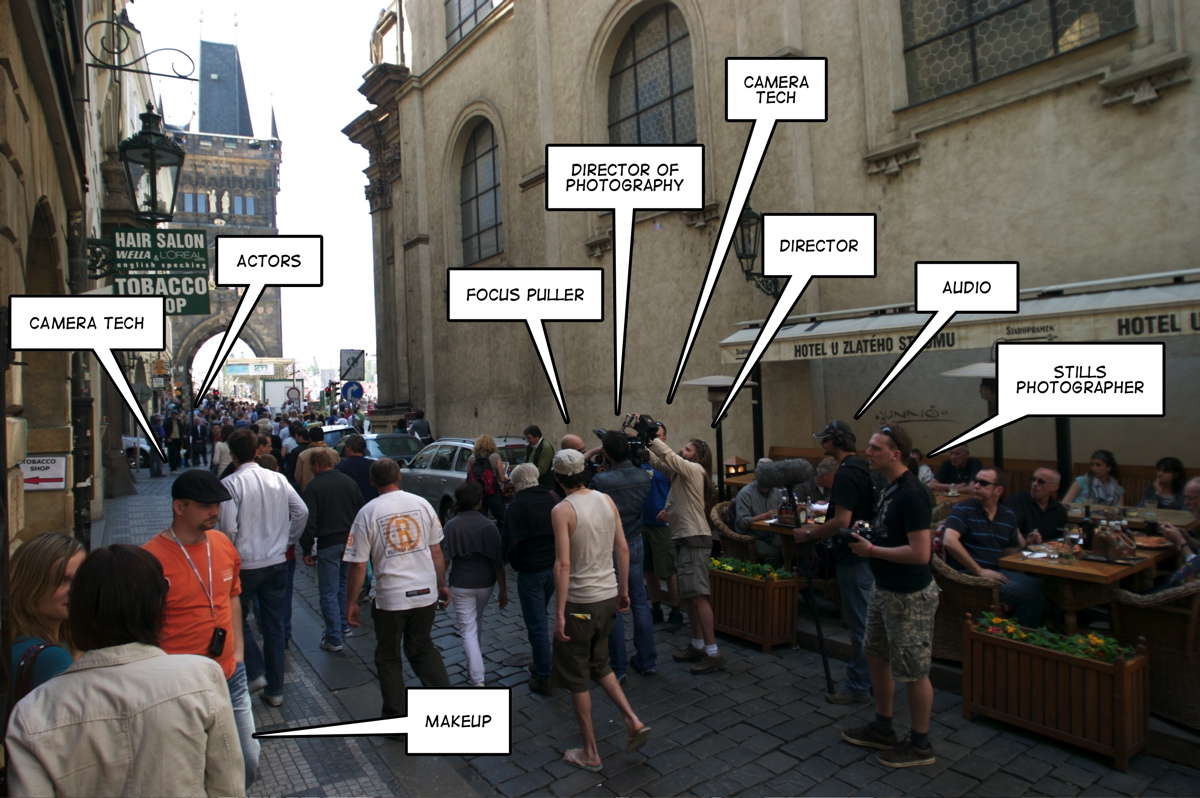
Honest, officer, we're just making a little video of our vacation...

Honest, officer, we're just making a little video of our vacation...

There is a rule about shooting films on the streets of Prague. If you put your camera on the ground (by using a tripod, for instance), you must get a license first. I watched as the crew set up the camera on a tripod. “Um… how much is the fine?” I asked. “I’ll tell you later,” fuego said, but I could tell he was nervous. Finally, for the shot right at Charles Bridge, among throngs of tourists, they decided to go handheld and stay off the sticks. fuego was visibly relieved. The fine, it turns out, is 500,000 Kč, which even when divided by 20 remains an uncomfortably large number. Tomas and the rest figured they could pretend to be innocent film students if trouble arrived, while any non-czechs disappeared in the crowds. They neglected to mention this plan to me, though.

Exterior shots finally complete (the door worked out nicely), we went back to the bar, where preparations were already well under way. Extras were starting to arrive, and mill about, not needed yet and underfoot in that small place. The crew was assembling a large jib arm with remote head for the first shots, and soon the band arrived and began to set up while the art director (Soup Boy had no idea that would be him when he arrived) tried to dress up the stage area a bit. Zlato was our mule to bring munchies and other supplies from a nearby department store. Everyone was pitching in.

Still, we weren’t shooting yet. People were fiddling with the jib, and I assumed that was the cause of the delay. Perhaps the jib setup was behind schedule, but that wasn’t the real problem. It turns out the lighting guys had locked their keys in the van. They couldn’t get to their stuff. Ever-resourceful Steve tried to help, but eventually it became clear that a locksmith was going to be necessary. Meanwhile, no shooting. The band was getting bored, the extras were getting drunk, and I was getting more and more stressed out.

It took an hour and a half to get the lighting truck open. Yikes.

So then we shot, finally using the extras at about 7 pm, the time we had originally told them they would be able to leave. That was when the owner of the bar started to get pissed off. He was supposed to open at seven. While that wouldn’t have bothered us (more extras!) he didn’t think it was a good idea. I’d feel worse for him, but the extras and crew were buying far more than he would have sold to the first arrivals of the day. Still, his anger added to my stress.

In the end, we got most of what we needed. More extras would have been good, more time at the end to shoot some confusion and pandemonium and whatnot. The story may have to be tweaked a bit as a result; we’ll find out once we get a rough edit.

Rene Trossman and his band were helpful and professional the whole time, playing the same song over and over while we shot from different angles and featured different musicians. I’m pretty sure we got what we needed to make a good scene. We’ll find out soon enough.

After the main shoot the band took a break and we cleared out all the gear so the bar could open for business. Just a little later than scheduled Rene and the boys took the stage for their actual concert. We set up in the back and shot the first set for them, Soup Boy catching other angles handheld. Hopefully it’s footage they can use for their own promotion. I was worried that after all that shooting they wouldn’t have any energy left for the actual show, but I was wrong. They had an excellent gig, and we stayed to listen, eat pizza, and unwind. The owner eventually bought the last stragglers a round of something really nasty that he apparently thought was special. Makes for one of those half-hearted thank-yous.

Finally home, bed, and a gradual sigh as the stress went away. We have a film in the can, as they say.

2

On the move!

I have plenty of stories to tell about my last days in Prague, but no time to tell them right now. As the Bars of the World tour draws to a close things are busy busy busy. Nostalgic retrospectives, details of our day shooting in Blues Sklep, and other tales will have to wait for another day or three.

Note that as I fill in the episodes the dates will be reflective of when I should have posted them, not when I actually did. I’m doing it for posterity. Or something like that.

1

A Slow Day

I’ve been waking up early lately. I’m not proud of this fact, but there you go. Six, six-thirty, sometimes earlier. I blame the sun. Wednesday night was my second late night in a row, and I resolved to sleep in on Thursday. I had no pressing engagements until noon, so it seemed like a good time for some extended shut-eye, if my body would allow it.

I was in that vague place between sleeping and waking the next morning when my phone rang briefly and stopped. Aargh. Still, I thought I’d better check who it was. I got up and fetched my phone, and noticed the time. 12:20. I was late for my noon meeting. I put on a different sweater than the day before to make it less obvious I was wearing the same clothes and staggered out into the day. I was unprepared for the rain that soon began to fall.

Soon enough I was in the friendly confines of Alex Bistro, a little place that’s the home of the best burgers in Prague (although this time it seemed a little salty for some reason). A thick 100% beef burger (not a given here, not at all) with fries for 95 crowns. You can do a lot worse in this town. Angelo and I had a pleasant lunch, as always (Angelo is good company), but I wasn’t exactly sparkling. In fact, it seemed a large part of my head was still off in the land of Nod.

Lunch done, it was time to go to the bank and get some of the local currency. I don’t have ATM access anymore, so I have to go to one of the big banks in the center that has a money-changing desk. Only thing is, I’d forgotten my passport. No passport, no money. It was that sort of day. I went home.

Later I hopped a tram again to meet with fuego and Rene Trossman, who will be playing Old Ray Black on Saturday. It’s our last day of shooting and in some ways the most complicated, what with a band and live concert as well as the carefully staged shots during the afternoon. Rene had a lot more energy than I did, and the dude likes to chit-chat. It was an interesting conversation, touching on the experience of the American in Prague, the evolution of the blues scene here, and what it’s like to have a life that’s not that firmly attached to a location.

I left that meeting with a good feeling about the shoot on Saturday, and rode the tram home (Tram 11—tram of the dead.). My plan: grab my computer and a bite to eat, and visit Little Café Near Home to use the internet for a while and defer paying my tab until after a visit to the bank. Once home, however, and sated on leftover pizza from Pizzeria Roma (it was one of those nights) all those stairs and doors and the short walk were just too great an obstacle. I went to bed instead.

Now it is morning. I woke up early, managed to doze off again, and got to LCNH at about 8 a.m. Unfortunately, their Internet is down again. I have no money, so it’s difficult for me to go elsewhere. The good news is that my brain seems to be functioning again.

2

AiA: White Shadow – Episode 11

Our story so far: Allison Crenshaw is an American transfer student in a Japanese prep school. In this Japan, however, transfer students always have some sort of mystical power. The rest of the class is intent to figure out whether she’s a demon, an escaped lab experiment, or perhaps a killer robot. Transfer students always attract trouble. No school ever survives a transfer student, and generally the destruction reaches much farther. Allison’s classmates are happy to report that the next backup city is almost ready, and it’s a nice one.

White Shadow is a computer virus that is able to affect people’s minds, putting them into a sort of waking coma. White Shadow also seems to be a person, a super-hacker who wants to recruit Allison for a purpose only vaguely hinted at but probably world domination. Why Allison? It seems that she’s pretty good with computers herself. Apparently she got in a bit of trouble in the US because of her skills. Was White Shadow behind that as well?

At the end of last episode, tragedy struck at a dance club. White Shadow took over the video monitors and claimed dozens of victims.

When Seiji reached the classroom students were gathered in small knots, talking in subdued tones. The Emergency Committee was in its traditional corner, not speaking at all. Ruchia was crying softly while Tasuki tried to comfort her. There were other tears in other groups.

Allison sat at her desk, alone, her face white, her jaw set in grim determination. She was scowling dangerously. The rest of the class cast wary glances her direction, but none dared go near her.

Seiji approached the group of boys who formed the Emergency Committee. “What’s going on?” he asked, his voice barely above a whisper, but it still seemed to echo around the room.

“Didn’t you hear?” Hissed Naota. “It’s on all the news shows this morning!”

“I don’t watch TV,” Seiji said. “It rots your brain.”

The moment the words left his mouth he realized he’d said something horribly wrong. The entire class looked at him with such venom that he wanted to slink away. “That’s not funny, you know!” Tasuke said. “Ruchia’s older cousin was there!”

Where?” demanded Seiji. “I can stop saying stupid things when someone bothers to tell me what happened.”

“That new dance club,” Naota said.

“Happy Dance Dance Dance,” Yomiko said, referring to her notes. “Opened July 22nd last year. Average age of patron 17.6—”

“Yeah, that place,” Naota said. “White Shadow got into the video system. It was all computer controlled. The whole club… everyone…” He couldn’t continue. Ruchia’s tears began to flow more quickly.

Seiji looked over at Allison. Half the class probably thought she’d written the virus. The other half thought that as a transfer student she should have been able to stop the tragedy. Perhaps she thought so herself. That would explain the smouldering rage on her face. She was angry with herself. Couldn’t anyone else see that? Someone should talk to her.

He looked at her fierce expression and swallowed. Someone else.

The teacher arrived and the students broke up their groups and made their way to their assigned desks. Seiji sat next to Allison and tried to think of something to say.

Just as the class came to order Allison stood. “I’m sorry, Sensei, but I have to go.”

“Is something wrong?” the teacher asked.

“Yes,” Allison said. “Something is wrong.”

The class was silent for a heartbeat, waiting for the transfer student to say more, to explain what was going on, but Allison lifted her bookbag and moved out from behind her desk.

“I have to go also!” Kaneda blurted, standing abruptly and tipping his chair over. It clattered to the floor, leaving behind a silence even more complete than when Allison had spoken. Allison whirled to look at Kaneda, her face a mixture of alarm and gratitude. She wasn’t alone, Kaneda had told her.

While Kaneda groped to right his chair Ruchia stood, her eyes fixed on the teacher’s feet. Her voice was quiet. “Please forgive me, Sensei, but I must go as well.” Behind him Seiji heard a chair scoot and he didn’t have to look to know it was Tasuki. She would support Ruchia all the way to hell.

Seiji swallowed, and from far away he watched himself stand from his chair, his hands gripping his desk with white knuckles. He stared resolutely at the formica surface, his eyes lost in shadow. “Sensei! Forgive me! I must go!” out of the corner of his eye he saw Allison turn in surprise. She started to reach out to him but stopped herself. Seiji didn’t know whether to be relieved or disappointed that she had stopped.

“So, umm… where are we going?” Tasuki asked.

“Happy Dance Dance Dance,” Allison answered. She stopped walking. The sky was cloudy; thunder grumbled in the distance. Plum blossom petals filled the air. The street was deserted except for a nondescript van. The same van that had been outside her house, Allison thought. Did they think she was stupid? None of the others seemed to notice it at all. “It might be dangerous,” she said.

“They turned off the electricity there,” Kaneda said. “Doesn’t matter how good the virus is then.”

Allison scowled. “Unless it’s already in people’s brains,” she said. She was watching Seiji, his hands in his pockets, his gaze downcast so his eyes were hidden by his hair. Yet he was alert, subtly scanning in every direction. Every direction except the van, he was studiously ignoring it. Seiji glanced up, caught her watching him, and sent her a fleeting smile. A shared moment of recognition.

“What do you mean ‘in people’s brains?’” asked Tasuki.

Allison started walking again. “Computers are often compared to brains,” she said, “but there are some important differences. Computers are made to be be reprogrammed, where brains have programs in them that took tens of thousands of years to come about, and they’re not made to be reprogrammed. But there’s a more important difference. Brains are pattern-finding machines, not calculating machines. Language, vision, memory, those are all pattern-matching problems. Brains are so good at finding patterns that often they find patterns where there are none, and we have superstitions. But that’s the weakness.”

“Patterns?” Tasuki asked.

“Senses trigger memories. Memories trigger other memories. At any moment in our heads there are billions of tiny connections being made, and the pattern of all those connections determines, more or less, what pattern happens next. The part of the pattern that comes from our senses is really pretty small. A lot of the rest might be called ‘imagination’ or ‘intelligence’. The pattern, and the pattern that follows, and the one after that, defines who we are.”

“So…” Ruchia ventured, “White Shadow is not a program like we learned in computer class, a bunch of instructions to make a machine do what we want. It’s more like, I don’t know, hypnosis or something.”

Allison was amazed at this modestly delivered and extremely convenient paraphrase. “Yeah. Like hypnosis that digs a trench in your brain until your thoughts just go around in circles forever.”

“That’s terrible,” Tasuki said.

“Thing is, you wouldn’t even know it was happening.”

“When you take away the weird video, it hurts them,” Ruchia said. “Sometimes they shout ‘Reset!’ What does that mean?”

“I have no idea,” Allison said.

“How do you know so much about this?” asked Seiji.

Allison glanced at Kaneda. It was time to come clean. “I’ve… met White Shadow. I think I have, anyway.”

When they reached Happy Dance Dance Dance (HD3!!!, the neon sign proclaimed, its garish colors muted now for want of electricity), the police detective in charge, a military man, and a European-looking guy in a trenchcoat were in a heated debate over who had jurisdiction. “You can’t just come in here and take over!” the detective said. “This is a police matter, not a military issue.”

“This is a national security issue,” the colonel said. “The very existence of our society is at stake.”

The man in the trenchcoat raised his voice. “You boys can just clear out! Our organization was created to handle exactly this sort of threat.”

The Colonel frowned. “What organization was that again?”

Trenchcoat hesitated. “I’m with Section 42.”

“Section 42 of what?” the detective asked.

“I’m… not at liberty to say.”

The colonel pressed the question. “So there are 41 other sections? What do they do?”

“I’m not at liberty to say.”

For the moment the detective and the colonel seemed to be on the same side, but the resolution of jurisdiction would be a long time coming. Cops, soldiers, and men in dark suits waited for the outcome of the discussion. Allison and her friends lifted the yellow crime scene tape and walked right past all of them.

The interior of the dance club was dark and quiet, the faint smell of perfume lingered in the air. On the floor were outlines marking where the bodies had fallen.

“Should have brought a flashlight,” Allison muttered.

“Perhaps this will help.” A beam of light stabbed out of the darkness, shining in their faces, blinding them. “You brought friends, I see.” The man’s voice carried a tone of disapproval. The light came to rest on Allison’s face, allowing Seiji to get a look at the man. In one hand the man held a flashlight, in the other was a darker object…

“He’s got a gun!” Kaneda shouted.

“Yes, I have a gun,” the man said. “My apologies, Miss Crenshaw, but I’m afraid that we cannot risk allowing you to have any further contact with White Shadow.” Slowly he raised the pistol as he spoke. “You see—” the man’s speech was cut off with a gasp. Seiji turned and staggered with amazement. The transfer student had vanished into thin air.

Your Support Matters!

Thanks to the those of you who have generously donated to help defray the (still rising) costs of making our little epic. I’m told the footage looks great. A lot of people are working for us at a discount, but let’s face it, making this thing isn’t cheap – a whole lot more not cheap than I had originally hoped. Then there’s post-production…

Special thanks to:

  • Philip and Barbara Seeger
  • Anonymous Donor
  • William Forman (aka Bill Bob’s Brother)
  • The Right Honourable Rev. Damen P. Dowse, D.D.
  • Jesse Kenyon
Support the arts! Someone’s got to do it.

You can get your name in the credits, too! For an explanation of what you get with each level of donation, the details are here.

  • less than $50: Hearty slap on the back.
  • $50 – $150: Seriously cool people who want to make sure the little guys can still make movies.
  • $151 – $500: Honest-to-God supporter of the arts.
  • $501 – $1500: My new best friend.
  • $1501 – $5000: Where have you been all my life?
  • $5,000,000: Guess I’m done.
2

Episode 30:The Eye of the Beholder

Our story so far: Charles Lowell is a detective in vaguely-nostalgic chiaroscuro New York, a town where everyone has an angle, the deal is king, and money is god. Charlie himself is a painfully honest man, pragmatic but unwilling to play the game that defines the city. He dreams of going to San Fran, but in his heart he knows it’s the same everywhere. Charlie and his plucky (if a little weepy) secretary Alice have been hired to help Lola Fanutti (nee Meredith Baxter) recover a treasure of fabulous value. Getting her hands on whatever it is is Lola’s only hope for survival now that her husband, a notorious criminal, has been killed.

There are a lot of people interested in this treasure, and they’re willing to kill to get their hands on it. The only thing keeping Charlie alive is that he’s got a chance of finding the Blood of the Saint, and most parties seem willing to wait until he succeeds before killing him and taking it for themselves. Depending who you ask, The Blood of the Saint is either a wine, a painting, or a mysterious organization willing to kill to preserve its secrets. The painting used to belong to them, and perhaps the treasure it leads to is already in their hands as well.

None of the factions involved has any interest in whether Charlie survives or not.

Then the shooting really gets going. Meredith is killed, along with one of the most powerful people in the underworld. It turns out Alice left a few things off her resume when she applied for work with Charlie, “Daughter of Mobster” and “Assassin” being conspicuously absent. Still, it seemed that she was genuinely touched when Charlie made her a partner in the firm.

Now they have the painting, The Blood of the Saint. It’s not going to take long for people to come calling.

Writing this is recreation for me, something I do when others might watch television. (Lately, I’ve been watching more television and writing this stuff less. That’s not good.) Editorial standards are low, though I must confess that just this once I did a bit of research before writing the episode. That was a few weeks ago; I’ve subsequently forgotten everything I read, except for one detail in the story of a saint.

The package sat on the table between us, unopened. Inside… not treasure, but perhaps a treasure map. If there was anything. No telling, at that, that we’d even be able to read the map if one was in there. Old Man Fanutti had hired experts to analyze the painting, and he, at least, thought they’d found something. Enough other people were convinced that he was right that a lot of people had died, including Fanutti himself.

The box was made of pale wood, battered and humble on the glossy dark-stained mahogany of the table. The only other times I’d been in a hotel room this swanky there’d been a corpse involved. Now we were entrenched in a suite on the top floor, the air cool despite the heat of the day outside. Through the door to the bedroom I could see a bed large enough to raise livestock on. My client may have died last night, but she’d left me with a large roll of spending money and no way to return it.

Alice was all for blowing town, heading west, Portland, maybe. I understood, but while that might buy us some time, it would be time spent looking over our shoulders, always wondering where the bullet was going to come from. There was no escape, no side exit we could slip out of and cease to matter to these people. There were exactly two ways this story could end: with us in control of the treasure or with us joining Fanutti at the bottom of the river, feeding the eels. Whatever was in the box was simultaneously meal ticket and death warrant.

“You gonna open it?” Alice asked me. Her hands were tight in her lap and her back was erect, her mouth tight and tense, bruises still visible on her face. She preferred low-calibre, high-velocity rounds when shooting people.

“Think I’ll have a drink first,” I said. I reached for the single-malt, poured myself a healthy snort in a highball.

Alice frowned. “That stuff’s going to kill you if you keep drinking it like that,” she said.

“I should be so lucky,” I muttered, and took a sip, inhaled the fumes and for a moment forgot all my problems. Money can buy happiness. Anyone who says otherwise hasn’t tasted the good booze.

After a moment she laughed, the same bitter hopeless laugh that echoes up and down death row as the gallows is being constructed in the yard. “Pour one for me, would you?” she asked. I did. “When this is over, we should just go somewhere and get tight,” she said. “Tell each other our secrets.”

“Yeah,” I said. She had a lot more secrets than I did, apparently.

She smiled. “You’re thinking that you don’t have any secrets, aren’t you?”

I smiled in return. “Something like that.”

“That’s where you’re wrong, Charlie. That’s all you are. One big secret.”

After that there wasn’t much to talk about. We fell into an odd sort of peace, a thousand miles apart but thinking about the same thing, looking anywhere but at each other. The Box waited with the patient apathy that only the inanimate can have. They say that primitive cultures believe that there is a spirit in everything, that the whole world is a big zoo of rock spirits and tree spirits and watermelon spirits and on and on. People are just the most active spirits of the bunch. I’m not sure how that makes them primitive, but I think they’d stop believing it if they met some of the people I know. Not a spirit in the bunch.

I set my glass down next to the box and rested my hand on the rough wood. “Guess we’ve put this off as long as we can,” I said. I turned the box over, awkward with my arm in a sling. It was nailed shut and the seams were sealed with wax. I hefted the screwdriver we’d picked up on the way over and attacked a seam. The box slid away from me, scratching the tabletop.

“Let me help,” Alice said, and took hold of the box, bracing it better than I could with my bum wing. I attacked the seam again and soon the top pulled free with a groan. Inside something flat was suspended on wood blocks, wrapped in red silk. Alice lifted the parcel out and removed the silk. Finally, there it was, the Blood of the Saint, in a small but ornately-carved frame.

I had joked that I would decorate my apartment in San Fran with the painting, but after one glance I decided against it. The picture might have been art, but it wasn’t pretty. It was small, less than a foot either direction, painted with the tiniest brush imaginable. There, reproduced in detail that transcended life, was the image of a young woman weeping in agony, while a man stood before her, knife in one hand, great iron tongs in the other. The tongs still held the woman’s severed tongue. Other men held her, on their faces a mixture of revulsion and fear. The man who held the knife wore a look of smug triumph. All the people in the picture wore those flowing robes the renaissance people liked to paint so much. There was a lot of blood, but none had got on the guy with the knife and tongs.

“I wonder what saint that is,” Alice said.

“Meredith told me Fanutti stole the painting to see it out of the frame,” I said. “There’s supposed to be something important on the edges.”

Alice flipped the painting over and scowled. “Huh.”

“What?”

“Oils aren’t usually framed with a backing,” she said. She fiddled with the metal bits holding the painting in the frame and everything slid neatly onto the table: The backing, the painting, and four sheets of paper, three written with a neat hand, the other filled with diagrams.

“Bingo,” I said. I should have been happy, I suppose. On those pages was likely the answer to all this, an end to the running, an end to the killing, but it was impossible to ignore what had happened to Saint Whoever. I had no aspirations to rise in the church the way she had.

Alice picked up a sheet and scowled. “Catalan, I think,” she said, “but I can read most of it.”

I sat across the table from a woman who had three things: The key to all the wealth and power she could imagine, a gun, and a guy who could ruin everything for her. I hoped she didn’t do the math the same way I did, but I was just fooling myself. She was much smarter than I was.

Alice scanned the pages for a few minutes then set them back on the table. She rubbed her eyes and leaned back in her chair. “Can’t concentrate,” she said.

“You look beat,” I said.

“You don’t look that great yourself,” she said, though her eyes were shut, her head rocked back. She sighed and stood. “I think I’ll take a nap. I have a feeling we’re going to be busy later.” She stopped by my chair and turned her back to me. “Can you unzip me?”

I stood and did my chivalric duty, careful not to make any contact with her skin. I looked straight ahead over her shoulder and found her watching me in a mirror. She smiled, a little sadly, I thought. “Thanks,” she said.

I had to say something. “What would your long-suffering grandmother say if she knew you were in a hotel room with a man?”

“She’d probably be happy I was with a man at all,” Alice said. “If she existed.” Alice walked into the bedroom and closed the door without looking back. The strap of her brassiere was black, I noticed, and hooked in the back. Her skin was pale.

I picked up the pages and took a shot at deciphering them. There were some familiar words, but the letters started swimming in front of my eyes and I decided Alice had the right idea. I stretched out on the sofa and put my hat over my eyes. I adjusted the sofa pillow under my head and was very nearly asleep when the knock came at the door.

I’d known it wouldn’t take long for people to find us, but I’d hoped for a little more time than that. I tried to be encouraged that whoever it was had bothered knocking.

Tune in next time for: Final Offer!

The Scourge of Weblessness Seems to be Spreading

I am without Internet in my home, and am likely to be for my remaining two weeks here. I have come to rely on the connection at Little Café Near Home for most of my connectedness needs. Mornings are definitely a better time to get things done and chat with That Girl and so forth. The only problem: mornings have an ugly habit of coming before noon. Nevertheless, I dragged my butt out of bed this morning and staggered down here through the rain (fat, heavy drops but far apart), plopped down and accepted my tea gratefully, and fired up Ol’ Pokey, my laptop.

The WiFi signal is strong, and my computer connected to the base station without a problem. That’s as far as I got, however; the world is not responding to my entreaties. Perhaps there is no Internet any more. Maybe it broke. Maybe the terrorists got it and no one has realized it’s a global problem yet because people don’t have any way to communicate. Everybody’s just assuming that it’s only their connection that’s down. Man, it would suck if the Internet broke.

Of course, since you’re reading this now, the Internet must not be completely broken. This time.