Pardon the Dust – again


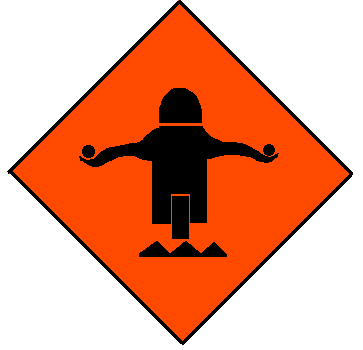
A warning sign I saw between Calgary and Edmonton.

I’m putting in a new comment system that hopefully will answer a couple of annoyances I found with the old. It may look wonky compared to everything else. I’ll probably just turn it on, see how things look, and turn it off again in a few hours once I know the effort it’s going to take to get it looking right.

In the meantime, leave a comment and tell me what you think!

Maskera!

There’s a bunch of fun stuff going on in the Pinup Realm to tell you about, but let’s start with this one: Maskera! Maskera is a superhero who never runs.

The backstory for the project (rather than for the hero herself) is that I shot a series of pictures of Harlean Carpenter (who is a fiction) on a green screen. They came out pretty well, so Harlean then worked her contacts to find a cartoonist to draw some villains and whatnot to match her action poses. Those turned out to be completely awesome.

“I can’t wait to see it in print!” the artist said. Until that moment Miss Carpenter the Fiction had not considered print. But what the heck? We know an awesome printer, and it would be a hoot to make an actual comic book. I will be writing the story, but honestly it’s more about the great poses of Harlean and the whimsical-yet-menacing bad guys of Michael O’Connor. Oh, no! It’s Angry Meteor!

We’re doing this thing through Kickstarter. For those unfamiliar, it’s a system that allows people to pledge support for a project, but only if the project actually happens. So you say, “Hell, yeah! I want a comic! And a poster!” and then if and only if the project meets its goals will you be charged. This means we can make sure we reach a certain threshold before getting a bunch of stuff printed, and it means you kids out there in cyberland can make sure you get your money’s worth.

So hop on over and take a look! It’s sure to be a hoot!

1

Data Centers and the Environment

Greenpeace has been outspoken recently, denouncing Apple for having inefficient, carbon-spewing data centers. There are worse offenders than Apple, but let’s face it, when the protest is at Apple, more TV cameras show up, and there’s a better chance of making a national story. Also, Apple has certainly had room for improvement in this area. On top of that, as Apple goes, so goes the industry. Directing protests at Apple makes perfect sense if you’re Greenpeace.

For a while now, Yahoo! has been at the top of Greenpeace’s eco-friendly data center list. The guy that built those data centers now works at Apple, and I heard a talk from him yesterday. It was really interesting, and I got the feeling that the environment was important to him personally; that he saw better, cleaner data centers as his legacy.

Mostly I’m going to talk in the abstract here, and when I do mention Apple I’m going to be careful to only say things that I can find in public sources.

I’ve always thought of data centers (warehouses filled with humming computers) as being pretty clean, except for all that dang electricity they suck up. It turns out there are other issues as well, and Greenpeace would do well to broaden the scope of their scrutiny. For instance, modern data centers use a crap-ton of water (that then has to be treated), and they have (literally) tons of lead and sulphuric acid onsite. There’s a bunch of ways besides just consuming electricity that the huge server farms popping up everywhere can hurt the environment.

But let’s start with electricity. There’s no getting around it, computers need the stuff. Data centers are not rated by how much computing power they contain, but by power consumption. Keeping the computers cool is another massive power drain, but it’s WAY better than it used to be. One simple shift made a big difference: cool the computers directly, rather than the room (or even the cabinet) they’re in. Physical changes to allow heat to escape through convection also save a lot of energy. So that’s good news.

Also good news is the efforts of some companies (well, I assume more than one) to provide their own power, onsite, to remove the need for batteries and backup diesel generators. Apple has built a huge fuel-cell plant and a large solar generating farm at its new data center in North Carolina (I’m pretty sure this is where Siri lives). Fuel cells still put out CO2, but Apple is getting their fuel from “biomass” — methane coming out of local garbage dumps. The logic is that putting that gas to use is better than letting it loose in the atmosphere. CO2 bad, CH4 worse.

Now, don’t get all misty-eyed at Apple’s greenness. They do this stuff to make money. If you had a big pile of cash at your disposal, wouldn’t you spend it now to gain immunity from energy price fluctuations in the future? You bet your sweet ass you would. If you can do it in an environmentally responsible way, all the better. (Fuel cells are definitely not the cheapest solution short-term.) But as Apple’s new data centers come on line at a ridiculous rate, Greenpeace is finding less to complain about. And that’s a good thing for everyone. Greenpeace can say, “See? We influenced this giant company and now they’re doing the right thing.” Apple can reply, “We would have done it anyway. It’s good fiscal sense.”

Either way, it’s still a good thing. Although, there’s no getting around the fact that these server farms still use an enormous amount of energy. Even “green” energy puts a burden on the environment — something people seem to forget. So, let’s not get complacent here.

Oh, yeah, and the water thing. Apple’s newest data centers don’t use any. The only burden on the sewer system is the toilet in the office. Take that, Yahoo!

1

Silver Lining

Traffic in the Muddleverse has been down lately, largely due to Google losing its love for my definitive treatise on over-easy eggs. (Seriously, though, there’s no better tract on that subject out there.) Another formerly-popular page has also sunk below the top-twenty fold: My episode titled ‘New York Sucks’. To be honest, I was surprised that my offering ever rose so high; surely there were plenty of other folk voicing the same sentiment.

Yet, for maybe two years, I was one of the top hits for the phrase ‘New York Sucks’. I learned during that time that idiot mouth-breathers occupied seats on both sides of the debate arena. There were some really cool responses as well, and I’m looking forward to my next venture into the hive. I think it’s going to be pretty awesome.

But now my little rant is off the radar, has been for some time, and I can breathe a sigh of relief.

1

Fingerprints

Tonight I created a new Google profile. The goal of the exercise is to increase my privacy by creating a separate Google account (with bogus information) so I can use the Google RSS service without dropping my pants. Not that I subscribe to anything particularly telling, but that’s my business. The answer: create a completely unique profile for only that purpose.

But, there’s a catch. There’s still a pretty good chance that the Goog (and all their pals) can still tell it’s me. They do this through fingerprinting.

Every time your browser asks for something over the Interwebs, it tells a little about itself. A lot of sites have little scripts they send your way that report back even more. It starts with screen resolution, the default colors for visited links, and a host of other little bits that, when put together, create a unique profile. Based on unprotected information, sophisticated sites can pin you down, even if you don’t (knowingly) volunteer information.

So tonight, before setting out to create a new Google account, I wanted to do something to prevent the Googlemind from figuring out that Arthur Kingman (not the name I used) was really me. It seemed like a pretty easy quest: I was looking for a plugin for my browser that would cause it to send slightly different information each time it made a request.

I found one (I think) — FireGlove for Firefox. I didn’t realize just how off Firefox I am until I was faced with the dilemma of using Firefox with this privacy plugin or using Opera naked. I never use Opera, so if I’m diligent and only use Opera in privacy mode when acting as my new alter ego it will be difficult for them to connect the dots. It’s inevitable, though, that at some point I will mess up.

It seems like there should be fingerprint randomizers for every browser. Maybe I’m just not looking in the right places. Anyone out there know where I might find one for any given browser?

Wearing the Flag

I suppose the Olympics have always been an exercise in nationalism, despite propaganda to the contrary. I have quite consciously avoided the medal count page on my favorite sports sites, but let’s face it, that’s what people care about.

Then there’s the US basketball team, who recently pummeled some other hapless country to the tune of more than 150 points. In that game we demonstrated than we are better at basketball than some tiny nation, and that we are total dicks.

The rest of the world doesn’t see running up the score as such a big thing, but this is one of the things that’s supposed to make us better. Right? When you have the outcome in hand you think about those guys who will always talk about this game, a highlight of their lives, when they shared a court with the best of the best. Don’t shit on them. The trap: being condescending would be far worse than running up the score. But there has to be middle ground. Play loose, toss out a high-five when one of the other guys makes a good move. Maybe pass instead of shoot. Show a little respect, and have a little fun.

Which isn’t what I set out to say. This was intended as a grumpy-old-man episode about respect for the stars and stripes. It’s not a cape!

But if you’re going to wear the flag, or represent the flag in the arena, show a little class. The American Ideal is mostly a myth, but if you’re over in London with old glory soaking up the spilled beer on the table behind you, maybe that’s a good time to actually be who we say we are. A champion of the little guy. Someone who leads with a smile and is as trusting as he is trustworthy. Someone who will cheer for a great performance without regard to political boundaries. Always ready to help out a friend in need. While you’ve got our flag draped over your shoulders, be that ideal person, even if it’s just an act.

I’ll give you the cape if you live up to what it means.

A few guidelines for Americans visiting the games:
Don’t be loud unless there are Germans to drown you out.
As long as there’s no chance of losing, remember that it’s only a game.
When you meet a gold medalist in a bar, buy her a drink, and keep your opinion of rhythmic dance to yourself.
Heh. Rhythmic dance.
It’s the summer olympics. Hockey is… not hockey. But they still use the word.
Learn to say “thank you” in British. Use it often. Same with “please”. Even if you don’t learn any other words, you will do well.

No RSS in Safari 6? Seriously?

I am mostly happy with the new version of Safari. Mostly. I am also stunned and dismayed that they have removed the support for RSS feeds. Yes, stunned and dismayed.

No more will I have a little notification right in my browser that someone has left a comment here at Muddled Ramblings. And Apple seems to have completely forgotten this use-case: When I read my comics in the morning, some of them have feeds and some don’t. Now, to take advantage of the feeds in some, I’ll have to read the comics in two different apps. (Or, check for the availability in one app and have it switch to my browser to read it, then go back to the previous app for the next comment and so on. Yuck.)

Sure, the Safari implementation of RSS has some issues, but it was right there, where it was most useful.

Something important has happened in the
Media Empire!

You see how simple and unobtrusive that is? Not some feed that shows me big blocks of info, just a number in a place I’m likely to notice. Not in some other app that I need to check periodically.

With a heavy sigh this morning I set out once more to find an RSS reader that doesn’t suck. I couldn’t find one. Out of the pile of newsreader apps I waded through, they ALL failed on at least one of these criteria:

  • Synchronize across my computers without a google reader account. I am NOT giving them a list of the things I subscribe to. The same sentiment applies, with less vehemence, to any that require a subscription to some service out there on the Web. This is what iCloud is supposed to be for.
  • Built-in Webkit. I should at least be able to see the site without switching back to a browser.
  • Let me organize feeds and don’t bother me with noise. There are a bunch of ticker-style apps that constantly show the latest from your feeds. Which, if you follow news sites, would be a constant distraction, and I’d be constantly wondering what has gone off the list that I might have been interested in. Gah. Just let me see a compact list of feeds organized how I want them, when I want them.
  • Note that “Free” is not on the list of requirements. I’d pay (a bit) for something that didn’t suck. I’d especially pay (a bit) for a Safari plugin that put the functionality back where it belonged.

    If I didn’t work for Apple, I’d probably be coding something up right now.

    For now, I’m giving Vienna a go (nice clean interface, no synchronization) on one computer, and I’m probably going to install Shrook on this machine. If I can stand its interface and lack of built-in page viewing (as far as I can tell from the limited description), it might become my choice.

    Update: Shrook was a bust. The synchronization feature required a paid subscription to their service. No promises of better privacy were mentioned. Come on, developers, this is what iCloud is for!

    3

Getting Over the Hump

Now, I didn’t get my degree in futurology from a major university, but writing that last episode about one specific medical breakthrough made me sit back and think about the larger picture.

Here’s the thing: There’s some bad shit coming down the pike, but there are also some good things. Let’s start with the bad:

There are more and more people on the planet, and they have to eat. While the human population shoots upward, our ability to produce food is under stress on several different fronts.

  • Nitrogen burn — a huge chunk of farmland is at risk of becoming sterile as a result of modern agricultural practices. The nitrogen in fertilizer comes from the atmosphere and doesn’t go back. It’s building up all over the place, and is starting to affect things.
  • Running out of phosphorus — this critical mineral is in short supply. This article put the timer at 50 years. We might find more in the meantime, but China is buying all it can now.
  • Water — some of the most productive farmland in the world gets its water from the ground. The supply is finite.
  • Water, part II — changing climate patterns are likely to put too much water in some places, and not enough in others.

I had a few more, but you get the idea. Keeping everyone fed for the next few decades is going to be tough. War and pestilence will follow where food is a problem.

2050 could be pretty ugly. If sea levels rise, there will be a lot of displaced people. (I say save San Diego and kiss Miami goodbye. Topologically, it makes sense.) Agriculture will be maximally stressed. It’s going to take everything we have to get past that hump.

But it is a hump. This is just number-crunching, but so far every group of humans that has reached a certain average lifespan has stopped reproducing so much. There’s good reason to believe that after around 2050, the human population will start to decline for the first time in history.

This leads to some new problems — or at least adjustments. Consider the American Social Security system as an example of something that happens all over the place (although, most times there’s less lying about what’s actually going on). Young folks pitch in to support the older folks. THIS IS NOT A BAD THING. (Although with Social Security we’re told we’re saving for the future, and that’s patently false.) Young folks looking after the ones who came before is admirable. The problem comes when there aren’t enough young folks to carry the load anymore.

Answer: redefine “old”. By 2050, working 75-year-olds will be typical (I originally used a bigger number, but pulled back). If I were king, I’d start sliding the retirement age three months each year, starting now. I’m not king, however, and it will probably require a few major nations to default and a million pensioners to die of starvation or exposure before it is politically possible to start this adjustment. Naturally, the pension hump comes at the same time the food supply is at maximum stress. But it’s a hump, and on the other side is the recognition that people will be productive for a lot longer. There’ll still be young’uns, they’ll just be sixty years old.

And come on, young at sixty? That’s not a bad thing. You might have to delay retirement a decade or two, but you’ll still have a better retirement than folks did in 1935, when retirement age was set at 65, and the average lifespan was 62.

So, that’s two humps we have to get over. There are others. We will have to make a pretty big transition on our energy sources in the future. Bad people will have access to some really scary shit. Robots might take over (they will do this by making us so fat and lazy we don’t bother to reproduce).

But on the other side of the hump is a population gently shrinking to what the planet can comfortably support, humans productive and healthy far beyond original design parameters, and a world that does not, as ours does now, run at a deficit. Once everything runs out, we’ll have to learn to live on a budget. There will still be strife, and greed, and misunderstanding, but just get us to the year 2100 without an abrupt population correction, and I think we’ll be all right.

(Note to readers digging this episode up on Our Benign Overlord Google (may it always reign in peace) in the 23rd century: get your bitch ass in your time machine and tell me if I was right.)

1

Penicillin – and What Comes Next

We’ve heard about the super-killer bacteria, the ones resistant to penicillin and all the derivatives. Nasty, nasty, little guys. But consider: those super-baceria are as dangerous as every damn infection anyone ever got one hundred years ago.

I mentioned once to friends that if I were to travel back in time to live in an earlier age, the thing I would miss most is dentistry. One of those assembled brought up antibiotics. To our generation the very idea of an infection is far less malign than what our great-grandparents knew. We worry about cancer today because we don’t die of starvation or infection first.

But now antibiotics are becoming ever-less effective. We just overdid it, and the nasty little guys still standing just give penicillin the finger. Are we foolishly squandering one of the greatest tools we’ve ever developed to improve the human condition? Absolutely. Antibiotics have to number among the seminal achievements of technology.

But check this out: There are viruses that attack specific bacteria. For instance, there’s a virus that attacks tuberculosis. Seriously! Now, that virus may not be gnarly enough to completely wipe out TB in a human, but that seems like a pretty promising start to a new way to fight infection. It also strikes me as poetic to fight germs by getting them sick.

Yeah, the fact that we can now imagine a world with home build-your-own-virus kits can be a little worrying. Let’s just make sure we’re afraid for the right reasons. Often when you hear about genetic engineering, hand-wringers focus on the possibility that a created life-form that was supposed to be benign mutates into something evil that destroys the world. I’m not saying it can’t happen, mind, but it’s far more likely that a virus that’s already dangerous to humans — flu or chicken pox or even the common cold — will make that leap than some organism who just hasn’t been practicing at hurting people very long. The viruses already inside us would require a much, much, muchmuchmuch smaller mutation to get to wipe-out-humanity status, and they have a way to make a living even if they don’t get the whole mutation in one jump.

No, the reasons to be afraid are twofold: One, bad people will have the technology to make a lot of people sick. They will start with flu and do it right. Two (and this is my own personal hand-wringing unsupported by any actual research), the therapy might work too well. Every once in a while humanity wipes out a pest only to discover it filled an important niche in the local ecosystem. Kill all the mosquitoes and suddenly beetles are eating your crops. (I have a very vague recollection of a chain of events somewhat like that, but don’t go quoting me here.) We could wipe out some bacterium only to discover that it had an important role in the world that we never guessed at.

But you know what? I’m pretty stoked about this. It will be a long time before the our buddies the bacteriophages are cheap enough to change the world health outlook, but a long time isn’t as long as it used to be.

Here’s an article that talks about other applications of custom viruses, and revives my hope of getting out of brushing my teeth.

2

Another Product for Parents

If I had teen-aged children, I’d pay to have a phone-jamming device installed in my cars.

Filed under Get-Poor-Quick because most parents would not want to be prevented from using the phone and texting while driving, either.

Seriously, NASA?

You may have heard about the impending arrival of our latest robotic explorer on Mars. The goal of this mission is to finally find those elusive six-armed ten-foot-tall green men and the super-hot (though delicate) princesses that current theory says have to be up there somewhere.

First, Curiosity has to land safely on the red planet. I have to confess that I’m a wee bit skeptical about this plan. I’ve linked to a video below, but before you go there, allow me to enumerate the stages of the landing.

  1. The mother ship releases the landing system. This is pretty routine at this point, and assuming no miles/kilometers snafus, should be all right.
  2. The craft hides behind its heat shield as it streaks through the atmosphere – this also fairly routine, except this time the payload can shift around behind the shield to get a little bit of steering. But it can’t see anything because it’s behind a heat sheild.
  3. Mars’ atmosphere is not thick enough to provide all that much braking, so now it’s time to deploy a parachute! I imagine the (estimated) shock of opening the chute has been tested many times, but needless to say, not in an atmosphere as thin as Mars’. So it’s all been simulations on the individual parts.
  4. As soon as the ‘chute is open, the heat shield has to go, so the lander can see the ground with its radar. This is the kind of thing that seems simple but so often turns out to be the killer. One explosive bolt doesn’t fire, and all is lost.
  5. But hold on, there, sparky! The parachute is still dropping too fast, and there’s not enough control over the landing spot. Now it’s time for… rockets! Controlled by computers! 500,000 lines of code! Holy crap. Several things have to happen at almost the same instant: all four rockets fire and the parachute is released.
  6. First maneuver: dodge the parachute. The lander will have to juke to the side. Remember, this machine has not been tested in conditions anything like Mars.
  7. Safe and stable, the lander will pick a sweet spot to set down the rover. It will not have help from humans.
  8. Oh, if only it were that simple. There’s a problem with dust, you see, if the rocket-powered hoverboard gets too close to the surface. (How close is too close? Well, now, how fine is the dust right there? How windy is it? Guess we’ll find out.) Rather than land on rocket power, our little miracle will hover and lower the rover on ropes. (How windy is it again? Are there any conditions the software wasn’t tested for?)
  9. After that, all that can go wrong is that the ropes fail to disconnect or the hover-thingie explodes and crashes onto the rover.

Right here I was going to say, “What? no ______s?” but I couldn’t come up with anything to put in the blank. (I’m sure lasers, ultrasonic beams, and explosives are all used in there somewhere.)

Here’s the promised link: Curiosity Before Mars: Seven Minutes of Terror

The entire sequence lasts seven minutes and we’re fourteen light-minutes away from Mars. We won’t hear anything back until the rover is either free and ready to roam or a twisted pile of junk. NASA is calling the seven minutes of descent “Seven minutes of terror.”

Now, there are a lot of smart people at NASA, and I’m sure I’m not going to come up with an alternative they haven’t considered. But really, I have to wonder if this is the result of solving a bunch of little problems instead of stepping back and reassessing the fundamental goal. Soft landing in a chosen spot without messing everything up with dust. Seriously, there has to be an easier way. It might involve a big-ass zip-lock bag.

Still, all this crazy complexity and systems that could not be tested in the actual environment has a pretty good chance of success. We’re actually getting pretty good at virtual testing, and engineering to amazing tolerances. I’ll be checking in on Sunday to see how the whole things plays out, and hopefully we can finally find that valley with the jewel-encrusted cliffs of solid gold.

Divided Loyalty

I don’t follow baseball religiously, or even regularly. My team is the San Diego Padres, who have sucked pretty bad for a few years, and really raised the bar on sucking this year. I’m comfortable with that. Someday they’ll be good again.

Lately, I’ve started following, now and then, another team. It’s in the American League (also known as the Softball League), so the Padres might be able to forgive me.

The Oakland Athletics just swept the Yankees in a four-game series, and are continuing to beat up the American League East. The A’s also have the lowest payroll in baseball. As a fully-conditioned American, that appeals to me. It makes me think of adjectives like “scrappy” and “selfless” — whether or not those actually apply. Plus they have a guy named Coco Crisp. You gotta like that. (He’s not a power hitter, but he hit two home runs today.)

Do they have a shot at postseason glory? Honestly, probably not. But then again, they sweep the Yankees again in October and Moneyball II will hit the theaters in January.

1

Metaphor Wanted

The other day I was sitting on a wide porch in Kansas, letting the heat soak into my aging joints. As I watched, a big flying critter of a type I’d seen before, pushing two inches long and bulky, with a striped, tapering abdomen, came flying up at maximum speed.

It smashed right into the side of the building with an audible whack, turned around, and flew back the way it had come, vanishing in the distance.

Apparently it had accomplished what it came here to do.

Almost Had It

It was about 35 miles west of Ely, on a section where highway 50 gets curvy. The caffeine hit and “Addiction” by 4gasm erupted from the speakers. I felt it then, that old road feel, wind and sun, and the smell of the desert after a rain.

Than I hacked and shuddered and my cold reasserted itself, and I was glad I’d already booked a room in Reno.

2

Noises Off!

I don’t venture into the world of cinema criticism in these muddled pages very often, but a couple of days ago I saw a movie that had me laughing hard even as my brain was expanding outwards at the speed of light from the brilliance of the writing.

It all started when I was advised that a particular scene (or series of scenes) in Munchies needs to be a “Noises Off!” scene. And what is that? It’s a bedroom farce, one of those comedy devices where a small space is filled with a lot of people who don’t know the others are there, going in and out with crackerjack timing. Hilarity ensues. Mel Brooks has made a career off these things. I confessed I had not seen Noises Off!. My peers resolved to remedy that situation.

“Look at all the doors,” someone near me said at the start of the play-within-a-movie. Indeed, there were a lot of doors, and when things are going according to script one door will open the instant another closes, as people come and go through the central room in a spiral of confusion that ends, of course, with ridiculous calamity. We are first introduced to the actors and the play during a very shaky dress rehearsal, and we learn the play (or at least act one), and appreciate the crackling timing of the cast — made especially clear when the timing breaks down.

“Leave the sardines, take the newspaper!” Bellows director Michael Caine at a weary Carol Burnett. Does it really matter that much? I asked myself. But yes it did. The movement of every piece is critical as sardines appear and disappear, suitcases vanish, and confusion escalates. “But why do I take the groceries into the study?” asks an insecure Christopher Reeve. The correct answer is, of course, “it’s a farce and sometimes you skate fast over stuff like that.” But that doesn’t satisfy our actor, and his director must invent some other preposterous motivation. Rehearsal continues.

So by the end of the film’s act one we’ve met a complicated bedroom farce that’s pretty funny on its own. That’s what I’m shooting for in Munchies (substituting lawyer’s office for bedroom, and honestly I don’t know if I have enough moving parts). But here’s where Noises Off really launches. The cast has a lot of drama going on between them offstage, and during one performance the jealousies and misunderstandings lead to utter chaos backstage. There is a second farce, far more complex, with (almost) no dialog at all, since they must be silent backstage. Because they can’t speak, physical situations are misinterpreted and things just get worse. Throw in a bottle of whiskey, a fire axe, bouquets of flowers of steadily diminishing size, and a cactus, all moving from person to person in a tightly choreographed silent movie that matches the beats of the play onstage, overlapping and constrained by which of the many doors people have to go through at a given time, and on top of that create characters that are funny and engaging, and you’ve got my undying admiration.

I don’t think it’s a spoiler to say that the next performance doesn’t go as well as that one did. We have a third farce, funny for its complete departure from the original.

The movie was adapted from a stage production, and I’d really like to see that. I think my head would explode watching that whole thing performed in a single take.

Which reminds me that the editor of this film had no room for error, either.

If you’re one of the few English-speaking inhabitants of our fair world who has not seen this flick, give it a go! If you’ve seen it before, you might enjoy it a second time, just to appreciate the brilliant layering of farce upon farce.

Note: if you use the above link to buy this book (or a Kindle, or a Colombian Emerald and Diamond Ring in 18kt yellow gold), I get a kickback.