When is a Plant not a Plant?

You’re probably aware that the US government is spending huge amounts of money to support production of biofuel. What they tell you is that this fuel will reduce our dependence on foreign oil and that it is better for the environment. It turns out, at least the way that biofuel is produced now, that neither claim is true. It takes more energy to produce the biofuel than it produces, and our topsoil is taking a beating. Add on top of that the finite amount of water that we’re pulling from wells across the midwest and ask yourself the question: would you rather run out of oil or run out of farmland?

Granted there are many plants that are much better candidates for creating biofuel than corn, the main crop used now, and even corn production could be made more efficient and less destructive to the soil. Still, perhaps it’s time to step back and look at the actual problem we are trying to solve. A better solution just might present itself.

What we are trying to do is make solar energy portable. Plants do that using photosynthesis — they put some carbon dioxide and some water next to each other and wait for a photon to whack the system just right, and out comes an energetic molecule, and some nice free oxygen to boot. It’s a pretty slick system. What we are doing now is using plants as solar collectors. We set them out in the sun, give them access to (lots of) water and carbon dioxide, and later we chop them down and collect the energy. Of course, the form of the energy isn’t quite right (sugars aren’t good fuel), so we have to process the result, using up some of the energy we collected.

The goal, then, is to turn sunshine into gasoline, alcohol, or some other handy hydrocarbon.

Flash back to when you were in grade school science class, watching a movie about how plants work. We zoom down into the animated land beneath the surface of the leaf where the magic is happening. A little wizard is hard at work, gathering the ingredients, then… at the critical moment he gawps at the camera, eyes round, and pulls a screen in front of his workbench. “We don’t know what happens back there,” the narrator says in his happy-narrator voice, “but what comes out is…” (I don’t remember exactly what comes out. ATP? You can look it up.)

Bumblebees. Photosynthesis. Great mysteries when we were kids, but not anymore. (Did no one mention to you that bumblebees can fly now? They have tiny horizontal tornadoes raging just above their wings. Sometimes the explanation is even cooler than the mystery.) Anyway, photosynthesis. Somehow, films made before DNA had been discovered still have us convinced that some things are unknown. I’m no photosyntholigist, but I only have to glance at wikipedia to know that the process is pretty well-understood today.

So I ask you: Do we really need the plant? We know how that stuff works, and we can reproduce it. Can we not create a solid-state device that captures solar energy and puts out an energetic molecule – the exact molecule we want as an end product? We could use such a device to create fuels with absolutely no impurities (no sulfur, for instance), and no net carbon footprint. The system does not have to be very efficient to easily outdistance existing plant-based methods, and it would use land that has much less value in terms of ongoing human prosperity. Farms could go back to growing food.

Picture a gas station on the highway between Los Angeles and Las Vegas. Behind it there is an array of dark panes stretched over the desert floor. From the array a pipe leads to a holding tank which holds the highest-quality gasoline money can buy. And the cost to the dealer is fixed – he just has to pay to maintain the system.

There would be environmental impact, of course. Vast tracts of desert would be shaded, and somewhat cooler as a result of energy being removed from the system. Although our machine would use a lot less water than a living plant, (or perhaps another source of hydrogen?), there would still be some demand. Overall, though, I think environmentalists would see it as a lesser evil.

I’ve been kicking this idea around for years, now, but apparently I haven’t ever written about it here. The plan is filed under get-poor-quick, but man, if anybody got something like this working, they could become some kind of ridiculously wealthy. As well they should.

3

An Odd Preposition

I noticed this on a bottle of Listerine recently:

“Do not use in children under 12 years of age.”

Do you use Listerine in your children? What about in the other adults in your household? I imagine the writer pondered the correct preposition to employ, and finally settled on ‘in’. Personally, I don’t use Listerine in anything other than my own mouth.

3

Amazon Ink

One of the cool things about attending a writing convention is the big pile of free reading material one comes away with. Writers and publishers pay to put their work in the hands of influential readers, hoping to generate buzz. Some are worthy of notice, others… not so much. Amazon Ink by Lori Devoti was in my pile of goodies from last Autumn’s World Fantasy Convention, and it looked promising. My sweetie got to it before I did, and enjoyed it. So, with expectations high, I picked it up.

The Amazons in question are straight from the Ancient Greeks, a tribe of fierce and magically adept women. They have lived among humanity since the ancient times, secreting themselves in out-of-the-way places (like Wisconsin). They live a long, long time, and perhaps that’s why they’re still using swords while the rest of the world has moved on to more lethal technology. They keep to themselves and while they have a lot of rules, there is one that tops all the others: No boys allowed.

Melanippe’s first child was a son, but that was a long time ago. She has not forgotten what happened to him. She no longer lives with the rest of the Amazons. She has gone into de facto exile in the city.

Mel has a reasonably comfortable life there, raising her teenage daughter — who knows nothing of her heritage. Mel’s not looking forward to that discussion. Melanippe herself is an artisan, a skilled tattoo artist, able to apply the traditional markings to young amazons. These markings are more than decoration, they are deeply personal and bind power and kinship among the clans. Mel’s also been dabbling in sorcery on the side, and she’s been getting pretty good at it.

She’s going to need all her skill now. Someone’s killing young Amazons and leaving them on her doorstep, with their tattoos carefully cut off. Whoever is doing it knows who they are. Melanippe must juggle a teenage daughter who is a ticking time bomb, cops who think she knows more about the deaths of the young women than she’s letting on, a mother and grandmother who are not shy about providing their opinions, and on top of everything else she must deal with a lot of very angry women with swords.

In a way this story is thematically kindred to The Delicate Dependency — a superspecies of humanity, a tiny minority, has been living among us for thousands of years, but now they are coming to realize that technology is fundamentally upsetting the balance between the races. Mere mortals can use machines and science to undermine the innate superiority of the few. In the case of the vampire story, they were dependent on humanity for sustenance; in Amazon Ink the main thing they need from mortals is sperm. Melanippe’s position as an exile has allowed her to straddle the two societies and see clearly that the time has come for change, even while most of her peers are content to live tucked away from prying eyes.

There’s romance (single mom, not even 100 years old yet, very fit, seeks…), plenty of mystery, and some great plots twists, all hung on a well-drafted framework of Amazon society. Some obstacles succumb to brute force, while others require wit and craft. As the story progresses you begin to sense that something else is going on, something no one has recognized. Some people don’t quite fit in the world as it’s being painted by the narrator. Some twists I saw coming from far away, while others snuck up on me. Overall it was a lot of fun to read. My expectations were high going in, and I was not disappointed.

This book is set up to the the first in a series, but Ms. Devoti went about it the right way — putting a full and complete story between the covers. There are still unresolved issues at the end, but that’s how real life works. I’m interested to find what comes next for this four-generation all-female family and the odd assortment of characters that have become attached to it.

Note: if you use the above link to buy this book (or a Kindle, or a new car), I get a kickback. You really should. It’s a good book.

1

A little help?

I’m getting the sweet-o-meter reinstalled. The old one broke and there was confusion about versions and so forth and in the end I decided to go with another plugin that seems to be more actively maintained. This one is fancier, but the creator really didn’t imagine all the different ways people might want to customize something like this. As a result I’ve been tinkering under the hood.

To get things right I need to see what it looks like when someone besides me has voted for an episode. Can someone out there click the “sweet” button at the top of this episode? Thanks!

1

Photo Credit!

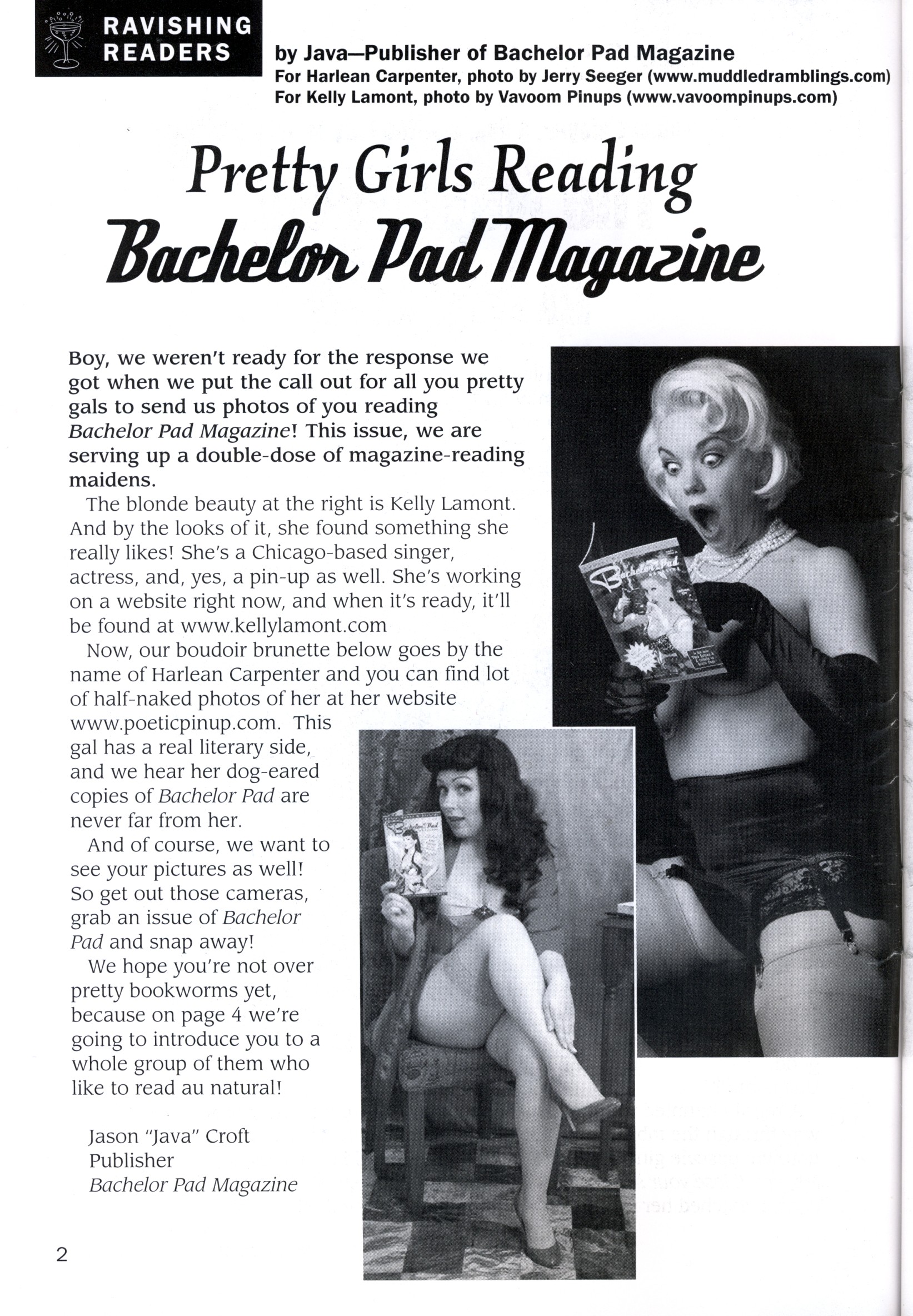
Yep, a picture I took found its way to a print publication that people pay to read. The photo is of Harlean Carpenter (who is a fiction), and the publication is Bachelor Pad Magazine. While I can take but a tiny amount of credit for the appeal of the shot (most of it comes from the model, obviously), I’m still pleased to have helped out.

Harlean Carpenter in Bachelor Pad Magazine

My first print photo credit (click to see full-size).


The magazine itself is pretty cool. It’s a small operation, a labor of love, and worth a look – especially if you’re a fan of pinup-style photography. “For Mature Readers” it says on the cover, which is what separates it from Maxim and the rest of that lot. In the most recent issue is an article about Naked Girls Reading, a… show? performance? franchise? in which women with no clothes on read literature out loud.

It’s a bit off-topic but one of the advertisers in this month’s issue features a photo of Shelby, who is “adorable” in the words of the fictitious Harlean, and who also happens to be bicycling a bajillion miles (give or take) in the near future to raise money to fight diabetes. Oddly buried is the fact that donations will be matched by Dignity Memorial Network. Your generosity will be doubled! Currently Shelby is way behind her friends in fundraising – help her catch up!

If that one’s not your cup of tea, Harlean keeps a list of noteworthy charity events at her blog: http://poeticpinup.com/Fundraisers.html.

4

Legislating Away Reality

I think people should read this blog post by my buddy. The good news is that the next generation of morons won’t be able to pass this particular example of moronism to their offspring. Eventually reality will overtake the debate.

In the meantime, if you live in South Dakota, tell the jackasses in the legislature that perhaps if they had paid attention in school they wouldn’t be passing crackpot resolutions harming their schools now. I would also tell the local school point-blank that my kid isn’t going to a school that pays any heed to this damaging legislative meddling.

2

Cyberspace Open II: Revenge of the writer

I had a great time participating in the previous Cyberspace Open. I didn’t make it past the first round but I participated in the second as if I had, just for giggles. Now I’m back to try again, a little wiser this time, a little more savvy about what they’re looking for. Will I be able to separate myself from the crowd, to elevate myself from ‘pretty good’ to ‘awesome’? We’ll see. I think I can.

The contest works like this: In the first round, a premise is published Friday evening. Everyone writes a scene based on the premise, due first thing Monday morning. No pressure! The 100 best screenplays move on. In the second round a new premise is given and participants have but one night to write their scenes. The top ten of those will be given a new premise and two whole hours to turn it into art.

Last time I did ok with the first round, but not well enough to distinguish myself from the pack. I did the second round just for fun, and though it was not judged, some bystanders thought it came out better than my first round’s effort. That may well be; I think my first round script lost some sparkle as I worked on it. I lost the original quirkiness as I polished the language. While writing a scene in a weekend may seem daunting, last year I think it was too much time for me. This time around I will concentrate on increasing the unique character of the scene as I polish the script.

As I did last time, I’ll be posting my work here, along with any observations about the contest in general. One fun side effect of last autumn’s effort was that this blog became, for a short while, a meeting-place for a few participants in the contest. It was an unexpected bonus that made participation all the more fun.

So pencil the weekend of April 17th, grab your word processors and gather ’round the ol’ Muddled Ramblins. It’ll be a hoot!

Or, just drop by to cheer me on.

The Magic Mouse

I got a new computer as part of my effort to rejoin the workforce. The computer is a Mac, and came complete with a keyboard (small) and a Magic Mouse. The Magic Mouse is almost the coolest input device ever. There’s just one flaw.

Let’s start with the good. Since the dawn of time Apple mice have had only one button. It’s a religious thing with the boys in Cupertino, I guess; even while their operating system supports (and even embraces) functionality that requires right-clicking and scroll-wheeling, the mouse has remained mired in one-button land. The Magic mouse technically keeps the one-button faith, while providing support for a huge range of input. There’s one button, but where your finger pushes the button can change the action. The entire top surface of the mouse is a trackpad. You can configure the mouse to have as many virtual buttons as you want.

There’s no scroll wheel, but if you slide your finger down the surface of the mouse it acts like one. Slide your finger side to side, and you’re scrolling horizontally. I really like that feature, but it took some getting used to.

With a little extra software, things get even better. You see, the mouse can track all five of your fingers at once, and can respond to a huge variety of gestures. Pinch to zoom in. Reverse the gesture to zoom out. Twist with three fingers to rotate something. It’s all configurable and it’s sweet.

The only problem with this hot little number: It’s wireless. I don’t need wireless; in fact, the vast majority of people who use computers don’t need wireless. It’s a convenience for those who use a mouse with their laptops, but I’ve always been just fine plugging the mouse in (and in fact some people have had problems when their wireless mice have awakened their laptops and drained their batteries).

Yet somehow wireless is better (rhymes with ‘power windows on cars’). The Magic Mouse just seems “magicer” when it doesn’t need a wire to talk to the computer. There is no doubt that the marketplace has decided “wireless is better” and Apple (and the rest of the mouse-producing industry) is not going to fight that.

So what’s my beef with wireless? Simple. It’s the batteries. Batteries cost money, and using this mouse produces a steady stream of toxic waste. If the purchase cost of a battery included the cost of disposing of the hazardous chemicals inside it, maybe people wouldn’t be so fast to use battery-powered devices where wired power is available. How many AA batteries go into landfills each year, creating a toxic mess someone will have to clean up someday, because people buy battery-powered devices that don’t need to be? Let’s reserve the battery power for things that need to be battery-powered.

I know that technically people aren’t supposed to throw away batteries anymore, but people still do. The chemicals in batteries are just as harmful in the soil as plutonium for the same amount of energy (he says with no backing evidence), but people treat them with cavalier indifference. And sure, rechargeable batteries reduce the rate that toxic waste is created, but they don’t eliminate it. Rechargeables will be my compromise so I can continue to use my wonderful mouse with a cleaner conscience. Wired power has environmental consequences as well, but I’d be right stunned if they approached the harm that battery power causes.

So here I am, using the coolest damn mouse ever, happy with it, and feeling slightly guilty. My old Logitech USB mouse is right here, with lots of buttons and a scrollwheel and whatnot, but it’s just not as good. It’s ok to pollute if you feel guilty about it, right?

One for the Money

It was after I read this passage:

During the winter months, wind ripped up Hamilton Avenue, whining past plate-glass windows, banking trash against curbs and storefronts. During summer months, the air sat still and gauzy, leaden with humidity, saturated with hydrocarbons. It shimmered over hot cement and melted road tar. Cicadas buzzed, Dumpsters reeked, and a dusty haze hung in perpetuity over softball fields statewide. I figured it was all part of the great adventure of living in New Jersey.

that I turned to my sweetie and said, “this looks promising.”

She was glad to hear me say that, since she had recommended the book to me, and said something like, “The first ten books in the series are all really good. The next ones go downhill, but the fifteenth was the first one I really was disappointed with.” You can probably dispense with the rest of this write-up — that tells you all you need to know.

One for the Money by Janet Evanovich is the first of fifteen (and counting) stories of Stephanie Plum, bounty hunter, and an interesting assortment of characters that surround her life. Stephanie does not wake up one morning saying “I think I’ll go be a bounty hunter and kick some ass.” Far from it. In fact, in this first installment Stephanie proves herself to be really bad at being a recovery agent. Ill-trained, ill-equipped, and unimposing of physique, she ends up with the job because she can’t find any other. Her cousin the bail bondsman doesn’t think she will succeed, but hasn’t got much to lose letting her try for a week.

Stephanie does have one advantage: She’s a local girl, and some of the kids she grew up with are still around, working as cops and storekeepers. It is this network that will allow her to survive.

Not all her friends are on the right side of the law. At the top of her list of people to apprehend: Joe Morelli. She hasn’t seen him since she hit him with her car years ago, in retaliation for his taking her virginity behind a deli counter and then never calling. You might say they have a history.

Stephanie is in way over her head, and if she were the stereotypical lone wolf hero type she would have been dead in two days. One man she tries to apprehend laughs at her, steals her stuff (including her brand-new gun), and slams his door in her face. There’s nothing she can do except call for help, and help comes. I imagine this is much more like what a real newbie bounty hunter would go through, no matter how badass they were.

What does she bring to the job that makes us care whether she succeeds or not? Well, she’s persistent, no doubt about that. And she’s courageous. She’s got grit. Moxy. A desperate need for cash. She’s willing to learn from her mistakes and it’s easy to imagine that one day she’ll be a kick-ass bounty hunter, if she lives long enough. (The release of the fourteenth novel in the series would indicate that she will live long enough.) I wonder if I’ll like her as much when she knows what she’s doing.

Meanwhile, Stephanie and Joe are driving each other crazy. She’s not good enough to capture him, but she’s persistent enough to cause him serious trouble. When she needs a car, and Joe’s is just sitting there going unused… well, what’s he going to do, call the police?

Joe is not Stephanie’s most serious problem, however; there’s a psychopathic boxer who likes to rape and torture women who has set his sights on her. He is very creepy and very scary and a real, believable threat to her life.

There are a lot of interesting characters (some of which are automobiles) in this book, and while they all have quirks, they are all believable. The reason for this is consistency – I never once thought, ‘Ramirez would never do that’. Well, actually there was one point where I thought exactly that, and in fact he hadn’t done it. Characters are consistent enough that behavioral changes are significant clues. It’s sad that we can’t take such basic craftsmanship for granted when we pick up a book to read, but let’s appreciate when it’s done well.

There’s an interesting quirk to the writing and I wonder if it’s intentional. Many times Stephanie comes home to her empty apartment (new extra deadbolt installed on the door) and we follow her through a series of mundane tasks — setting down her bag, putting away her keys, splashing water on her face or whatever. It’s the kind of thing that other books and screenplays use to slide us into the “She’s not alone!!!” moment. So trained have I been with this device that it’s more of a surprise now when she is alone. I was surprised several times in this story. Probably the author was just using these lulls for pacing, not realizing that she would be pushing my suspense button. It was pleasant all the same.

Naturally I have a couple of criticisms. The most serious is that the bad guy does the classic full-confession-before-I-kill-you-in-a-complicated-manner mistake, which really wasn’t necessary.

Overall I really enjoyed the language and the descriptions. The passage I quoted at the start uses some pretty high-falutin’ language but it reads gritty, which means the writer has mastered the language, rather than the other way around. There are lots of descriptions like this, where Evanovich finds just the right word to really put us in the scene. (OK, in the above I could quibble with shifting the scope of the description from a street to the entire state, but that’s the kind of thing you notice later, when you go back to take a closer look at a passage you particularly enjoyed.)

Will I read Two for the Dough? I don’t know. Probably, eventually. There are a lot of books on my shelf to be read first, though. While I liked this story plenty, it did not fill me with the burning desire to sit down and plow through the entire series.

Note: if you use the above link to buy this book (or a Kindle, or a new car), I get a kickback.

2

Lost in Translation?

Even if you’re not a programmer, take a look at the following lines of code:

public function sendCommunication($oCommunication)
{
    if (self::emailMode != EMAIL_TEST_MODE_NONE) {
        if (self::emailMode == EMAIL_TEST_MODE_LOGGED_IN_ONLY) {
            // DO NOT COMMENT OUT THE FOLLOWING LINES
            // EVER
            // FOR ANY REASON
            // INSTEAD CHECK THE TEST MODE AND SET THE ADDRESS FIELDS ACCORDINGLY
            $oCommunication->to = $oCommunication->from;
            $oCommunication->cc = '';
        }

Now, I ask you, even if you’re not a programmer, you know there’s one thing you would never, ever, do to the above code. Right? Now let’s say you are a programmer, a professional, being paid because of your ability to find solutions to problems and express them in an abstract language.

Now further imagine that changing the above code can lead to the customers of the people paying for this work getting spammed with confusing emails with our client’s name on them.

Yeah, you guessed it.

1

Festivities Under Way

For the next couple of days we will be holding the official ceremonies to commemorate my sweetie’s embarking on her fifth decade of life. Heady times! Yesterday I got to meet a sister-of-sweetie, one I had not had the pleasure of meeting before, and tonight we will be gathering at the parent’s house for The Casserole.

I’m not sure what The Casserole is, but when the light of my life mentions it I can hear the capital letters.

1

Jer’s Software Hut Falls Silent

The shadowy, misshapen minions have all gone home; the vast underground chamber that once rang with their chants as they turned the giant wooden capstans has fallen silent. The river of lava flows unimpeded, the precarious rope bridges spanning it falling into disrepair. Above, the streets of Sky City Research Facility, once teeming with antigravity cars, are empty, the crystalline architecture acquiring a layer of eagle guano and dust that is transformed into gritty runoff when it rains.

The crudely-crafted Web site at jerssoftwarehut.com no longer accepts payment for Jer’s Novel Writer software licenses, and bears the following statement:

Well, it’s happened; I have a regular job. As I slave away working for the man I often wonder if things might have been different had I only worked harder at making Jer’s Software Hut a business rather than a hobby. Probably now we will never know. It was a good run but it’s time to ackowledge that development is stalled and customer service around here has been really awful.

That pretty much says it all; despite thousands of happy users, some of whom even paid for the software, when it came time to have a steady income again I took the safer path of working for someone else. (The ironic twist to this narrative I will leave for another time.)

It was a good run, and as I get my work life under control I hope soon to at least return to using Jer’s Novel Writer for its intended purpose – as a writing tool that helps me create fiction. Until I do that I can’t even consider opening the shutters on the Hut and throwing the big switch that raises the lightning rod into the violent midnight thunderstorm, while sparks fly and the turbines spin faster and faster, the needles on their gauges creeping ominously into the red. Maybe someday, though. Maybe someday.

1

Pride and Prejudice and Zombies

It is a common practice these days for publishers to put a series of questions at the end of their more ‘literate’ offerings. The purpose of the questions is to help drive book club discussions, and therefore book club sales. Pride and Prejudice and Zombies by Jane Austen and Seth Grahame Smith is no exception. The last of these study questions reads thus:

Some scholars believe that the zombies were a last-minute addition to the novel, requested by the publisher in a shameless attempt to boost sales. Others argue that the hordes of living dead are integral to Jane Austen’s plot and social commentary. What do you think? Can you imagine what this novel would be like without the violent zombie mayhem?

This was a question I had asked myself many times while reading the book. If our protagonist, Elizabeth, were not a superlative zombie slayer, trained in the ways of Shaolin and other deadly Eastern arts, what would she do instead? Skimming Project Gutenberg’s archive of an earlier draft of the story, it seems Elizabeth was originally an accomplished musician. That’s not bad, but the motivation of this pursuit seems mainly to attract the best mate possible.

And what of Mr. Darcy, her foil in this early example of the I-hate-you-so-much-I-must-love-you story? Even as a highly refined killing machine he doesn’t bring that much to the table except a generous nature (it turns out – sorry for the spoiler) and a lot of money. Take away his skill with blade and musket and there’s not much left.

So bring on the zombies, I say. Let Elizabeth kill several of Lady Catherine’s ninja bodyguards. Let the final confrontation between Catherine and Elizabeth take place in a dojo, with swords and grievous wounds. Let Mr. Bennett spend an amiable morning with Mr. Bingley trapping, decapitating, and incinerating the undead. Let Mr. Wickham — oh, but there I go spoiling things again. Anyway, let’s give these people some teeth!

As an afterthought, I would be curious to know how well a student would do on a typical exam for the abridged Austen-only version, having read and Zombies instead. Would some teachers decide that reading the expanded version was better than not reading it at all? Would some teachers say quietly to unmotivated students, “If you read the zombie version you can still pull a B”?

Note: if you use the above link to buy this book (or a Kindle, or a new car), I get a kickback.

2

Happy Birthday to my Sweetie

It was my first chance to spend the day with my sweetie on her birthday, and it was a big birthday at that. Yesterday my honey turned forty years old, and I was there to help celebrate. We didn’t whoop it up or anything, just let someone else do the cooking, opened up a nice bottle of wine, and watched a movie. We’ll be having a slightly larger celebration when more family is in town.

In the meantime, happy birthday, sweetie! Let’s do that again lots of times!

1

Crazy Eyebrow Hair

I was never blessed with much in the eyebrow department; where some people have well-defined and expressive eyebrows that add character to their faces, I just have a faint hint of eyebrowage. It’s one reason that eye surgery has never really appealed to me – my glasses provide some definition on my face that most people get from their eyebrows.

It is possible that my brother took my eyebrow mojo – he certainly has more going on on his forehead than most.

Recently my sweetie and I were cuddling and she started to laugh. “Oh, my God,” she said (or something like that), “you have a crazy eyebrow hair! Go look in the mirror!” I did and she was right; I have one big kinky gray eyebrow hair.

Crazy Eyebrow Hair!

My only notable eyebrow hair.


You can see in the picture that the rest of my eyebrow hairs are nothing to write home about. Sparse, thin, and pale. But behold the majesty of the mighty gray one! Could this be a sign of things to come? As more of the hairs turn gray will they, too, become part of a crazy, kinky, shrubbery that will give me that mad scientist look that makes all the girls swoon?

Man, I sure hope so. That would be cool.

1