Did a photo shoot with Cricket LaFaux last night. At some point I’ll show you some of the pics. Here’s the living room at the end of the evening.

The aftermath of a photo shoot with Cricket LaFaux
After reading a post in my buddy’s blog (and the articles that post links to) about National Security Letters I started to get more and more irate. Apparently, our government sends out thousands and thousands of letters to Libraries, Web hosts, and the like, saying, “We’re the government, we’re fighting terrorists, so give us everything you have about this person. Also, you’re not allowed to tell anyone about this, not even your lawyer.” This is not like a search warrant, because there is no judicial oversight.
The FBI’s use of national security letters to get information on Americans without a court order increased from 16,804 in 2007 to 24,744 in 2008. The 2008 requests targeted 7,225 U.S. people.
Those are all requests for personal information with no warrant, no need for probable cause, and no right to legal counsel even for the people who are not themselves under investigation. I’m not a trained legal scholar, but good lord, this can’t possibly be constitutional.
Well, it’s not like I have anything to hide, but if my ISP got served with one of these letters, would they turn over the information, or would they fight? Would Google protect the emails mouldering in that account that I rarely check? What about my Web hosting provider? I would love to see each entity that has my personal information publicly state that they will not turn over information without due process.
The only way this governmental bullying will be stopped is if everyone agrees not to be intimidated.
On a personal level, I’ve decided to start a policy of encrypting my emails. Not because there’s anything incriminating in there, but because if only secrets are encrypted, then everyone knows where the secrets are. And really, it’s nobody’s business but mine what I put in private correspondence. If everyone encrypted all their messages, the constitutional rape called National Security Letters would be pointless.
Toward that end I have installed Gnu Privacy Guard, which is based on OpenPGP (Pretty Good Privacy), a system which can withstand any attacks feasible at this time (naturally as computing power increases, the encryption must be made ever-more sophisticated).
It takes two to pass a secret message, however. I’m not able to encrypt messages to people who do not also have GPG or PGP installed, and who do not have my public key. The system works with a pair of keys – one I keep secret and another that everyone can see. When the message is encoded using one key, it can be decoded using the other. So if I have your public key, I can encode a message that only you can read.
It’s a bit of a hassle to set up GnuPG (available for Mac, Windows, and Linux), but once you have your key generated and all the pieces in place, it’s pretty transparent to use. My public key is now available on many servers, so once you have the plugin to your email program installed, it’s easy to load.
You can learn more through the link called “Jerry’s public key” on the sidebar in the top section. Please join me in taking the teeth out of National Security Letters and the bullying bureaucrats that use them.
Addendum: Comcast’s privacy policy states that they will not disclose information without a subpoena, warrant, or “other valid legal process”. Then they go on to say they will also disclose information if they think “the disclosure of information is necessary to prevent financial loss“. That means they reserve the right to sell out their customers if they think they could end up incurring legal costs to protect them. Sigh.
My sweetie and I have been an item for a long time now (years!), but yesterday marked the first time we ever went to a movie together. How is this possible? I just don’t know. There’s always something else to do, I guess.
Despicable Me came out while I was off on my adventures, but the light of my life turned down an invitation to see it with friends so she could watch it with me instead. It took more than a week, but finally we managed to chuck all excuses into the “later” bin and off we went.
To watch the movie in 3D: $12:50. The same movie in 2D: $5.50. 2D wins! (3D for me remains a gimmick to cover for the lack of a plot or at least interesting characters.) We went to the little cinema, paid the afternoon price, and plopped down for the flick.
My sweetie began laughing about two minutes in, and is still giggling today. The minions just kill her. I laughed too, but maybe not quite as hard.
The story is, of course, entirely predictable. Curmudgeon + adorable kids can have only one outcome. The fun of a story like this one is in watching the transformation of the grumpy old man, and of course in the completely over-the-top silliness of his minions. Oh, yes, in this case the curmudgeon is an evil genius complete with minions, and they are ridiculously funny.
It was a good date. I even stole a kiss right there in the theater.
Yes, I’m talking to you. You know who you are; you’re the guy that thinks flag-burning should be constitutionally banned, yet you drive around with a tattered, battered mockery of the flag and the country it represents. Oh, I know you felt proud when you put that little flag on there. DAMN I’m a good American! Let’s all stand up and salute (me)! Just remember: when you bought that flag, you also took on responsibility.
Then you continued to fly that flag in the rain, and at night. Huh. Kinda disrespectful there, Sparky.
Now your flag is much the worse for wear. It is truncated, and the edge is tattered to threads. The dyes have all faded, especially the red, so that the stripes are barely discernible. Yet still you parade around with this thing attached to your car. How is this not worse than someone burning a flag as a conscious exercise of free speech?
There used to be a lot more of you. In the last patriotism boom millions of folks bought (incorrectly packaged and handled) little flags and put them on their cars. Look at me! I love America! What happened to all those little flags? I’ll tell you what happened: those patriots threw them in the trash once they got too tattered. Somehow sending a flag to rot in a landfill is not as bad a burning it.
Which brings me to the US Flag Code. You’ve already abused the hell out of the part that says “The flag should never be fastened, displayed, used, or stored in such a manner as to permit it to be easily torn, soiled, or damaged in any way.” (This is under the section titled “Respect for the Flag”.) It’s time to move on to disposing of your shameful insult to your country. What are you going to do? You’re not going to just throw it away, are you? You’re a patriot! The flag is a symbol of your country! That’s why you’re flying it in the first place. So what are you going to do?
How about “The flag, when it is in such condition that it is no longer a fitting emblem for display, should be destroyed in a dignified way, preferably by burning.”
Yep. You should burn that American Flag. Of course, this won’t be the camera-drawing antics of a hippie protester, but instead will be a solemn occasion while you consider the flag, what it stands for, and respect the service it has done. Gather the kids around to pass that deep respect on to the next generation. I recommend flagkeepers.org as a reference for the proper way to respectfully dispose of your little plastic badge of patriotism.
Gah! You’re going to throw it in the trash anyway, aren’t you. Yeah, you’re a real patriot.
It all started here. Joey Comeau needed a job. Somewhere along the way he began to exercise a little more creativity than perhaps is optimum in job application cover letters. Some are hilarious, some are poignant, some are just plain odd. None of them are bound by any sort of requirement to tell the truth.
He didn’t get any of those jobs.
After the police showed up on his doorstep one morning, he stopped actually sending the cover letters in. He continued to compose them, however, and post them on his Web site. He didn’t really want any of those jobs, anyway. Somewhere along the way he got the idea that he could use this form to tell an actual story. Each letter would in itself be significant, but when strung end-to-end they would reveal a larger story, at first hinted at and subsequently revealed.


Put another way, it’s “take what you’re doing already and repackage it in a way that you can sell.” And thus, Overqualified
It is a book of moments, beads on a string that form a larger pattern. Some of those moments are pretty powerful. Some of them aren’t. They go by quickly and before you know it you’re at the end of a brief autobiography told in nuggets of nonsense.
I was a little disappointed, I guess, that many of the supposed cover letters in the book had no ties to the job being applied for. One of the fun things about the letters I linked to above is the cleverness with which he twists the job descriptions, and the decidedly odd ways he represents himself as a candidate. While it does happen occasionally in the book, I missed that cleverness much of the time.
Of course, before there was a larger story to tell, the letters were all about cleverness. The book has a larger purpose and I suppose that means trade-offs.
Comeau certainly has a gift with language. The words he chooses are often evocative as well as descriptive, and a sense of tragedy grows as we move along. He’s at his best when he’s both funny and poignant, as near the end when he applies to be a tour guide, revisiting the scenes of past failures. That bit alone is probably worth the cost of admission.
EDIT YEARS LATER: I still think about this book. Possibly you will, too.
Note: if you use the above link to buy this book (or a Kindle
I was wondering whatever happened in the Cyberspace Open – the organizers seemed happy to find any excuse to email contestants earlier but I hadn’t heard anything in a while. I went over to check things out and found that the finalists have been selected, but so far no mention of the YouTube voting for the big winner.
You can read the top three here, if you want to see what a winning entry looks like. The prompt for this round was to write a scene in which one character has been betrayed by a confidant, and confronts the betrayer.
A hearty congratulations is in order for all three. They made something that sparkled and shone in the eyes of their peers. Not bad for a day’s work.
I considered whether to put my own thoughts on the top three here, but the contest is still going, and I don’t want to come off as a sour-grapes kind of guy, picking at the flaws of writers who scored better than I did in the previous round. I’ll just say that I think one of these scripts is substantially better than the other two, while another had nice moments but seemed fundamentally flawed.
It was a good exercise for me to read them, because there were several places where I could tell that the writer was not getting everything out of their head and onto the page (writing time was very limited, after all). In the future I will try to identify those places in my own writing, before I leave my audience flat.
Edited to add:
If this page is any indication, they have decided to go back to the old format (a ninety-minute period for the finalists to craft a third scene) for the next iteration of the contest. (In fact, that is the same page as last year, just with the dates changed.) This is either to make the contest work better in conjunction with the Screenwriting Expo or it’s an indication that the current format isn’t working out. Or maybe both.
I hope they get the kinks worked out — it’s a cool contest (despite my frustrations). As you will see in the comments, I wasn’t the only one wondering what was going on over there.
Rolling out of Los Alamos at the bright-and-early hour of 10am, I realized two things: First, that it was a day to find little, wiggly roads I’d never taken before, and second, that I’d forgotten my toiletry bag. I was already going forward, however, and at times like that I’m quite simply incapable of turning back. Stopping for gas in Totavi was difficult enough.
It was not a day for driving with the top down. The first significant showers hit as I was passing Cuyumunge, but it was a small storm cell and I was through it quickly. I took a right turn at Albuquerque but only stayed on the Interstate until the turn-off for Quemado.
I’ve been through Quemado plenty of times (haven’t we all?) but only going east-west on Highway 60. Today, for the first time, I decided to take the little north-south highways down through the last echoes of the rocky mountains, the spine of the continent.
Immediately I knew I’d made the right choice. I had NM 117 almost entirely to myself, except for the State Police cruiser I passed almost right away. A good reminder that today was about the road, not the destination. No need to hurry.
As I crossed the continental divide I had a massive storm feeding the Atlantic off to my right, lightning flicking and flashing with abandon (thunder in my little world provided by Social Distortion), and ahead a smaller but no less electric storm dumping into the Pacific. The latter would be my host for the last few miles into Quemado.
After a brief fluid-related stop in Quemado, where I had a pleasant conversation with a local, mostly about the weather, it was further south on NM 32. That was a fine bit of roadway right there, and hopefully next time it won’t be bucketing on me so hard I can’t look anywhere but the road. Cruising down a narrow canyon by Apache Creek was especially nice, and exceptionally rainy.
After the signage confused me a bit in Reserve (roads that don’t show up on my maps accompanied by a turn that felt like I was going in the wrong direction), I got myself on US 180 for another southward leg. It was only sprinkling off and on, and I had a little more attention for the world around me. After I came through something-or-other pass (elevation six thousand something) I started to notice patches of white flowers along the roadside, sharing space with purple-blossomed thistles. The white flowers looked like poppies as I motored past. Very pretty.
There is a section of US 180 past Glenwood that is a) Under construction and lacking all markings, and b) 35 mph speed limit. I, in my “what’s the hurry?” attitude, was doing 55 mph along there just to keep the people behind me from running me over. Then it started to rain. Did I mention the rain before? Yes? Well, that wasn’t rain. This was rain. Lashing, blinding, dumping, end-of-the-world rain. No stripes on the road to key on. I slowed down, and those behind me (who had tail lights to track) got even closer.
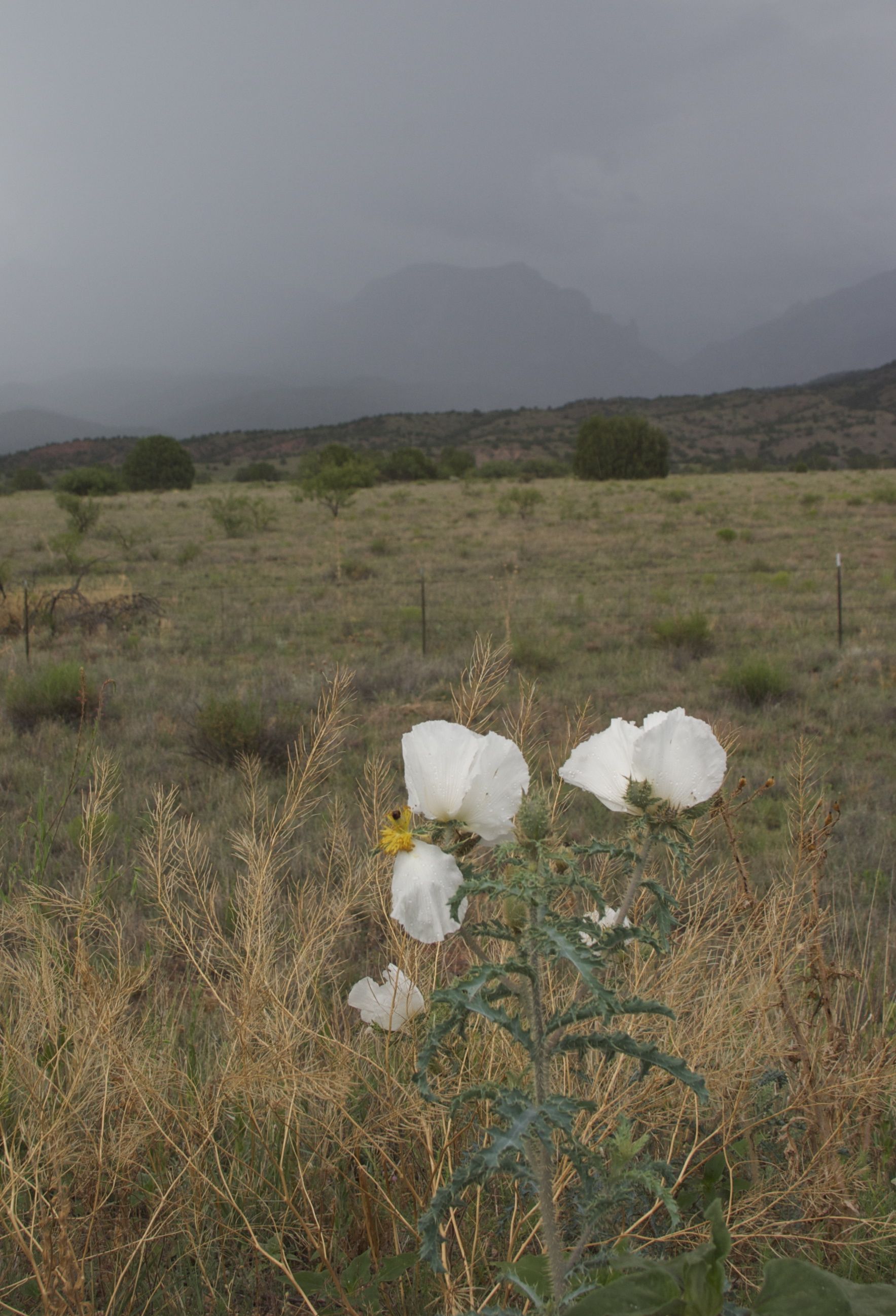
some sort of white flower
Along the road up to the overlook there were more of the white flowers. I stopped and took a couple of pictures, but I was standing in the rain and didn’t have the patience to get the really good shot. I did notice, however, that despite the petaled, poppy-like flowers, the stems were bristly and stiff like a thistle. Perhaps I was looking at some Frankensteinian hybrid of a gentle garden plant and a thug from the wrong side of the tracks, botanically speaking. (If I were in charge, the plant would also be able to uproot itself and shoot poison darts. I saw no evidence of these abilities today, however, so there’s no need to panic… yet.)
Not far south of the rest stop was a turnoff I’d been debating. NM 78 broke off the “big” road and headed west into Arizona. I was still enervated from the previous downpour adventure, but I decided to give the little road a go.
When I turned onto 78, there was a sign reading, “Steep grades and sharp curves. Trucks not recommended.” Music to my eyes.
I hadn’t got far when I saw the battered old pickup some distance ahead of me hit the brakes. Hm. I got closer and as i came over a rise saw what he had. There was a pretty decent river flowing across the highway. Still, an old pickup got through, so why should someone in a low-slung sports car worry? With all due caution (I have a friend who lost his engine to high water), I forded the river, came out the other side in second gear with a sigh of relief. On I went, but not very far before I encountered the next river. I noticed that where the river flowed off the pavement on the downstream side there was a pretty significant dropoff, with a waterfall I might have appreciated more if the Bronco coming the other way weren’t trying to get over on my side to avoid a big rock. We all got through just fine in the end, Mr. Bronco waited for me to pass. Good thing, too, because I didn’t have a free hand for the window control.
The four fords went something like this:
Of course, there was no next one, but I did manage to get my phone ready for pictures just in case. From there 78 became steeper and I made a note to add this little ribbon of asphalt to the list of the best drives in the US. I suspect it would be better to drive it eastbound (better to be going uphill for the steepest parts), but my buddy in the pickup and I were treated to one heck of a beautiful and active drive.
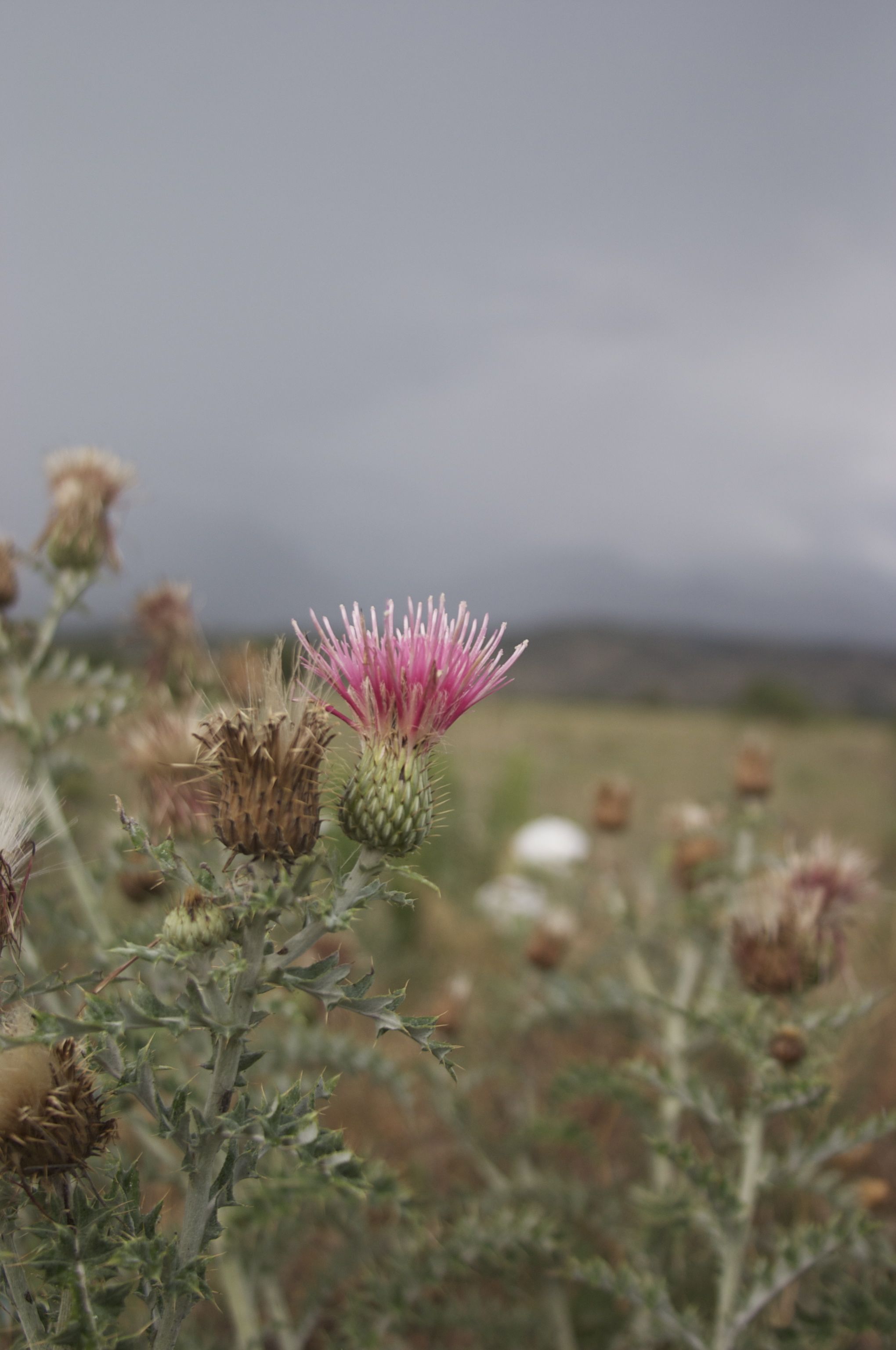
Thistle
Down, down, and more down, the sort of down that affects your mileage, on twisty-windy roads, trapped behind trucks pulling camping trailers, but that was all right. As we came out of the mountains I almost stopped at a wide spot on the road that had one of those desert views, where you can see across multiple time zones, and you can see the rain falling over there and the sun shining on that mountain and a hell of a lightning storm off to the north.
Did the Navajo think the Earth was flat? What about the Apache? Seems like a question we need answered.
At the bottom of AZ 78 I was faced with a choice. I pulled over for a moment and consulted my not-very-good road atlas. (My previous was Rand McNally and was much better.) I decided on US 191 all the way down to Interstate 10. As I mototed along the flowers gave way to succulents. An occotillo-like plant a vivid green against the red clay. Yuccas and either skinny barrel cactus or stunted saguaros. Cholla and woody shrubs in the overgrazed areas (the contemplation of which triggered a get-poor-quick scheme for another day).
(Note to self: If I ever need a good movie location with an impressive bridge with no traffic that we could maybe even blow up, there’s one next to Highway 191. Ample parking.)
I rejoined civilization in Safford, AZ, a farming town and then some. Not sure, but it might have been cotton in those flooded fields. Safford seemed like a nice place on my flyby, with a sense of community if the signs for this and that event are to be believed. After my high-altitude excursions, however, I could really feel the heat.
I stayed true to my highway headed due south of Safford. On the stretch between Safford and Interstate 10 I saw three things that I claim are thematically related. Just don’t ask me what the theme is.
I saw decay. The human settlements along that stretch of road had obviously seen better days. Even some houses that at 60mph looked like they had been pretty nice once lay abandoned. There were still plenty of people living there, but whatever had been supporting that community is gone. A ghost town in the making, populated only by people with nowhere else to go.
I saw plenty. The yuccas’ long stalks were bent over, forming weary arches. At first glance this is in harmony with the human plight of the town, until you realize that the plants are bowed over by the weight of their own fruit. The yuccas, at least, seem to be doing well this year.
I saw waste. For most of the way south, US 191 is a simple, well-maintained stretch of two-lan blacktop. Then, without any change in circumstances, there is a section that is divided highway, and then a section of perfectly adequate two-lane again, and then back to divided highway. I’m sure someone somewhere can tell me why it’s critical that US 191 be upgraded, but seriously, I’m not buying. I thought at first I was looking at stupidity, but then I realized I was most likely looking at the price tag for the vote of a powerful senator on some other issue. “We’ll send one hundred million of other people’s dollars to Arizona if you vote for…”
If you study those three observations long enough you’ll see an important convergence, a glistening polyp of knowledge that will make this whole crazy thing called life make sense. When you find it, let me know, ok?
Freeway! High speeds (except where there’s construction)! The entertaining route is rarely the fastest one, and there was still a long way for me to go. I was already exceeding the speed limit when I hit the top of the on-ramp. Time to fly!
Only, directly ahead loomed a big-ass storm. We’re way in the south of Arizona at this point, right? This desert could eat your pisante desert for breakfast, and wash it down with a glass of burning sand. Yet there in front of me is a rainstorm. Careful readers of this blog, those who keep score and try to catch my continuity errors, will note that the last time I drove this stretch of road, it was a white-knuckle gullywasher experience. That time I found myself in an America’s Best Value Inn, and likely that will be my last time with that chain. It sucked and cost a lot.
This time the plan was to fly Best Western. In the days of my months-long road trip they were the most likely to have Internet access, and that made me a fan. Right now they’ve got a buy-two-get-one-free special working. I hope to figure it out. Anyway, I was thinking, as I approached this storm, that if I saw a Best Western sign then my day was done.
I saw one such sign, in Hickox (Willcox?), and got off the freeway. I navigated the flooded roads for a while, never spotting the promised hotel. Finally, I saw the tall standard in the shape of a Best Western sign, empty. The hotel has apparently severed ties with my preferred chain. I drove on, into the mouth of the storm.
It was all pretty much routine, except when I was passing a truck, with a car in front of me, when we all together hit a section of the pavement where the water sheeted up. I never lost traction, but I was completely blind, all the glass of my car completely covered by torrents of water. Somewhere to my right was a big-ass truck. To my left, the median. Ahead, who knows? What if that driver hits the brakes?
My first fumbling act was to flip the wiper speed lever up to full blast. It wasn’t until several seconds later, the crisis passed, that I even realized I had done that, for the effort was completely futile. Water was dumping on me far too quickly to be wiped away.
I tapped my brakes, partly to send a signal to people behind me but mostly just to know they worked. I clenched the wheel, invented newer and better curse words than have ever been uttered before, and forgot them. Then we were through the crisis, all still alive, and slowly I got my heart under control.
Total time elapsed: maybe fifteen brick-shitting seconds.
That’s the thing about the road. It doesn’t care how much you love it. It’ll kill you anyway.
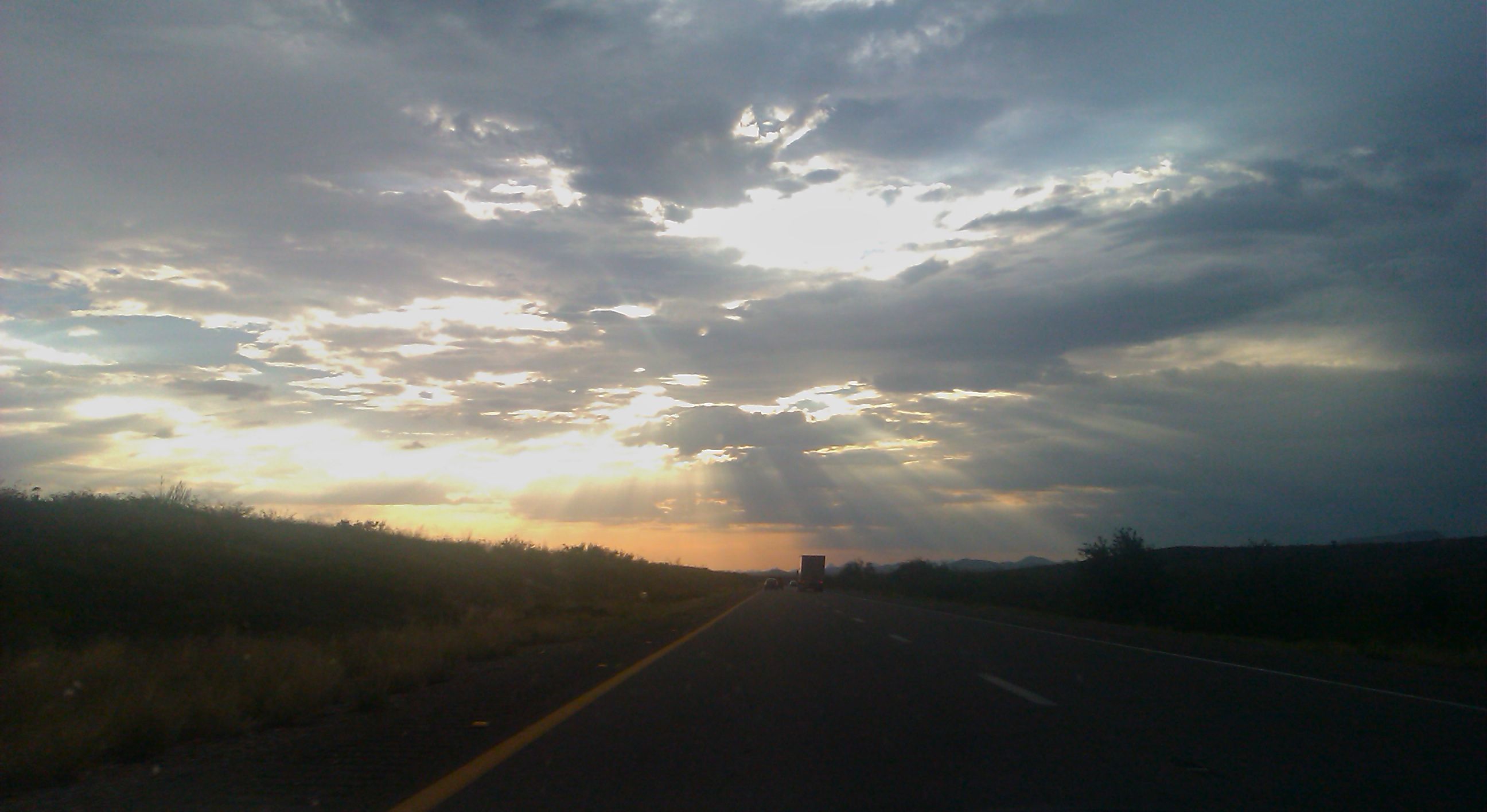
Sunset in Arizona
Let’s say you’re part of a bunch of immortals who have been around since ancient times. Let’s further posit that you feed on people and are better than normal humans by any physical measure.
There was a time when there were only a few of you — the First Ones — and wherever you were at the time, you gave your species a name in the local language. That name would translate to “super-humans” or “immortals” or “silent killers in the night” or something like that. Something badass.
Unfortunately, time has passed, as it tends to do, and language has changed with it. That badass name doesn’t mean quite what it used to, either phonetically (I spent the last half-hour looking up the phonetic match for “douche” in Sanskrit and Sumerian but didn’t find anything useful), or perhaps the actual meaning has changed into something entirely different, the way “lesbian” has.
Any thoughts or ideas are welcome!
The best advice I can give to aspiring filmmakers is get a good opening and a good ending and get them as close together as possible.
— Steve Sabol, President of NFL Films
All storytellers should take this to heart, especially long-winded ones like me. The story I’m working on right needs to be tight.
While driving through southwest Kansas and the Oklahoma panhandle, I noticed that the horizon was brown — the air is as dingy and grim as the air in Los Angeles ever was. It is tinged with particulate pollution that at one time was part of one of the richest topsoil systems on the planet. Now our soil is floating on the breeze, not doing anyone any good.
It’s time to do something about it.
Back in the prairie days, before the plow reached the plains, there was grass to hold down the soil. Then came farmers and soon after came the dust bowl. When there wasn’t enough rain, crops withered and the desiccated soil was exposed to the wind. These days, the main reason we don’t have more dust bowls is irrigation. Mighty pumps draw water from below the surface and spray it on the crops. This is still not as effective at erosion control as the prairie grasses were, and the activities of farming just plain raise a lot of dust. Not much one can do about it.
Or is there? What if we could do something about the other element in a dust storm — the wind? Slow the wind down and the air won’t be able to carry as much particulate matter. If we can slow down the wind enough, we might even begin to accumulate soil from less-enlightened neighbors.
Oh, I hear you now: “Hold the phone, there, Sunshine! Slow down the wind?” Yeah, it sounds crazy, I know, but in fact we already have machines that slow down the wind, and as a special bonus they give us electricity. Yep, windmills are machines that take energy out of the air and turn it into juicy, useful, power. There are already wind farms popping up in Kansas, giant pylons standing in neat rows across the very fields that are losing topsoil to the wind.
The difficulty with the current setup is that the windmills are put way up in the air, where there is less interaction with ground winds. This is done on purpose, as the giant rotors’ primary purpose is electricity, not erosion control, and the wind is steadier up there. (Also, it makes sense to get those giant rotors up where they won’t be whacking into things.) For this job we’re going to need windmills closer to the ground, which probably means many smaller windmills. Since efficiency at generating electricity is no longer the top priority, we can put them closer together. Each will generate less electricity, but the rows of them will make a more effective windblock.
How much do windmills slow down the air? I’m not really sure, but I’ve heard about habitats being affected downwind from them. It’s all a matter of taking enough energy out of the system.
That might be enough to make a difference, but we can add a low-tech modification to our fields to deflect the wind up off the ground and into the whirling blades. Simple scoop-shaped fences, perhaps configured in V shapes, can funnel the air whooshing along the ground up and into the windmills. More electricity, even less soil erosion. I’m not sure, but it wouldn’t surprise me if the water needed for the crops was reduced as well. Less water per acre means more land can be irrigated, which means more food.
The fence system assumes that wind usually comes from the same general direction; I imagine that when the wind is blowing parallel to the fences they might do more harm than good. Judging by the way the wind farms are set up, I think the direction is pretty steady, however. The V-shaped fences may prove to be a hassle for the farmer; modern machinery likes straight lines and big circles. Perhaps the fences could be replaced by long rows of grape vines. They would be less efficient at deflecting the wind but they would provide a significant additional crop. Another type of food makes the farmer less vulnerable to crop-specific pests and to random market swings.
I picture the ideal field as having some of the giant turbines to slow down the air up above, with rows of closely-spaced windmills below to slow the surface wind. Air moving over the field would be slowed enough that it’s carrying capacity was reduced, and rather than picking up sediment would deposit some of what it was already carrying instead. Free dirt!
The cool thing about this get-poor-quick scheme is that while it may not have the same immediate return on investment of a traditional wind farm, the watts per acre will be pretty high. Assuming energy prices keep climbing, it could even pay for itself. Then, when the aquifer runs out and the dust bowl returns, maybe America will still be able to feed itself.
I drove off the campus of Kansas University at about noon, playing my new Boxcar Satan CD louder than is strictly necessary. I went south on Highway 59 for a few miles until it crossed 56, which seemed to be going more or less my direction. It was an older stretch of road, more inclined to roll with the terrain rather than blast through it. Around Baldwin City I stopped and applied sunscreen (only a little too late) and carried on, enjoying the rolling hills and the barns. There are a lot of barns on that road; large and small, stone and wood and brick, red and white, ramshackle and tidy.
Traffic was light, polite and scrupulously obeyed the speed limits. I’m on the Santa Fe trail, which appeals to me, because Santa Fe is my next stop.
Jim Gunn asked me if I’d learned enough at the workshop. I said I’d learned all I could, but we’d have to see if that was enough. My brain is like a glass, I said, and knowledge is beer. Right now the foam is up to the rim; once it settles we’ll see how much beer is actually in there.
While saying goodbye, several of my fellow writers said (more or less) “You have to finish your novel! I have friends that will love it!” That’s encouraging, and flattering, but now I have to write the damn thing. These other good folk have constructed in their heads what the story will be like, and they like the image. But can I live up to those expectations? I don’t have a single chapter in final form yet.
I guess time will tell. All I can do is string the words together while wearing a quirk of a smile on my face, and hope the funny comes through in the darkness. For there will be darkness.
The boys from Madrid and Barcelona managed to work together, and scoring only nine goals in the entire tournament, have become world champions.
I was pulling for Spain, as in general I prefer finesse over brute strength. I would have been much happier, however, if the winning goal, which came at the most dramatic moment possible, when overtime was almost expired, had not been scored by the most flagrant flop artist on the pitch. He will go down in history for scoring The Goal, rather than for being The Big Whiny Whistle-Baiter. Except in these pages.
An indication of the state of the sport: At one point a Dutch player was breaking away. There was contact. Rather than fall down and draw a whistle, he tried to score. The announcers questioned his judgement. FIFA, we have a problem.
Some of you may have noticed on this site a black-and-red screen with a self-congratulatory message from a bunch of assholes who are not me. Naturally this occurred when I was out in the middle of Nevada, so it took a while before I was able to effect repairs. Things are (mostly) working now. Actually, I had them fixed even before the hosting company became aware of the problem, apparently. The time they cite for the intrusion was 10pm July 3rd, but it was 10am or even earlier that the attack occurred. That fills me with confidence. (Maybe it’s just a typo in their message.)
My hosting company is setting up a new server and will be restoring this site from backups that are a few days old. Hopefully I’ll be able to update the database (no affected) to include episodes (like this one) and comments that have happened since the hack.
I assumed at first that the brand-new version of WordPress might have a security exploit, but then I discovered that jerssoftwarehut.com and all the sub-sites I have on that server (except paseeger.com, for reasons I can’t figure), were hacked. Then I tried to get into the control panel and it was hacked. That takes more access than even I have; the control panel code is off in some other place. No, my Web host was hacked.
I do not yet know whether the credit card fraud protection kicked in at about that time as a result of actual fraud or because I was traveling and some robot flagged the behavior as suspicious. It looks like there might be some bogus charges, but I won’t know for sure until I can talk to an actual human tomorrow. (I did talk to a human in India, but she was unable to access the information I need.
So now I have no credit card, and the ATM powers of the same card seem to be suspended as well (that or I’m misremembering my PIN). All the cash My sweetie thrust upon me for the trip, more than I would have taken otherwise, has proven a lifesaver.
Once I had a glowing recommendation for MM Hosting on this site. I really liked them at first; their service and responsiveness was fantastic. Things have been going downhill with them for a while, and I had already been investigating other options that gave me more control. Inertia has kept me here for the most part. No longer. Goodbye, MMHosting. I’ll be asking for a refund for the remainder of my contract.
I’m rushing around getting ready to leave for a two-week writing conference. I’ll tell you about that once I’m on the road but I thought you might want to take a look at a Web site I’ve been working on for some nice folks I’ve never met face-to-face. It’s CAKE! Yummy!
Climate Adaptation Knowledge Exchange
It’s all about global warming and doing something about it. The planet’s getting warmer; best to have a plan. Take a look!
When one is in an airport bookstore after spending ten hours on a plane with no reading material, still looking at another few hours before reaching one’s final destination, one doesn’t take chances. One buys multiple books, in different genres, to ensure that the remainder of the journey will pass smoothly. If the first novel fails to please, there is always another.
In the above paragraph, I am the One. Among the books I purchased that fateful day was The Reapers: A Thriller
Connolly has written several stories featuring a detective named Charlie Parker; in this installment the crusty ex-detective plays a subordinate role as the author focuses on Louis, one dangerous mo-fo to be sure. Gay, black, soft-spoken, likes country music, frighteningly cold-blooded. Louis is unusual even among killers; his ego makes no demands, even when he is motivated by revenge. He doesn’t need to see the person die, he doesn’t need to make it poetic, doesn’t need to gloat, as long his target’s heart stops beating. (Although the author glosses over one purely egotistical touch that allows the bad bad guy to get away at one point.)
How did Louis come to be this way? It’s a long story, or a short story, depending on how you look at it. The short version: some people are just born that way. The long version is told over several long flashbacks. As a young man Louis is witness to a particularly horrific hate crime. More crimes against his family follow. After Louis takes his revenge he is discovered and nurtured (or at least trained) by men who work for The Government (or do they?). Louis is retired now, the only one of his group to walk away without being killed. Or so he thought. (insert dramatic sting)
To be honest, after a while the long backstory sections started to feel redundant, as if Mr. Connolly was himself unsure of his thesis that just because Louis was a cold-blooded killer doesn’t mean he’s a bad man. At least for me, he was selling past the close. I got it about two flashbacks before Connolly was ready to trust me that I got it, and move on with the story. The rest started to feel defensive.
Naturally to bring out the best in Louis in this story he must be confronted by a rival of similar pedigree. Turns out that he and his rival have each failed to kill the other on previous occasions. Not a bad set-up by Mr. Connolly.
One of the best things about this book: No one is safe. Even people you like, some little more than innocent bystanders, are fair game. There’s no guarantee that everyone will live happily ever after. That’s critical if you aspire to the title ‘thriller’, and in this case you better not let your guard down until you’ve closed the book. Maybe I have to take back what I said about about it not having much thrill.
Still, did I really have to know the whole backstory of the hired goon who gets whacked? Three pages of backstory for his half-page of action? No, I don’t think I needed to know that. Did I need the detailed description of a rifle, just to have the bad guy choose the other rifle? No, that just came off as the author showing off. Should someone who goes into such great detail about firearms refer to ‘clips’ in an autoloading pistol? Absolutely not.
This sort of story thrives on detail, but let’s keep it to the details that matter, please, and make sure our terminology is correct. Louis would never say ‘clip’ when he means ‘magazine’, and neither should the author.
Overall, however, the rather straightforward plot was very satisfactorily balanced by the character study of the central personality. He is a complex person, a perfect storm of intelligence, physical ability, and near-complete dispassion toward his victims. Was this a thriller? I can’t say I was on the edge of my seat. Wasn’t thrilled, per se. I was interested, and I was wrapped up in the action, however, and I really liked the central characters and they way Connolly introduced them to me. Overall, a pretty good read.
Note: if you use the above link to buy this book (or a Kindle

