Rock Week

After an extended grind at work, it was time to take a few days to get my regular life back on track. I had several goals, from getting back on the bike to installing a ceiling fan to making appointments with doctors.

I was successful-ish. I got enough done to feel like I was catching up, but I didn’t accomplish all I wanted to. I didn’t ride my bike as often as I had planned, but I got plenty of exercise. I didn’t get the new ceiling fan installed, but I learned about alternative home wiring.

I moved a lot of rock. On Wednesday I shoveled up old rock and moved it to its new home in the raised gardens where is color would not be wasted. I was pretty blasted on Thursday, but the real cost of exercise comes two days later, and in Friday I was hurtin’.

Hello, Saturday.

The night before I couldn’t sleep. A shit-ton (shit ≡ 6.5) of rock was going to be dropped in the street. There would be no stopping until all 13,000 pounds were not in the street anymore.

I woke up feeling all right, and when the Most Wise Official Sweetie called to have the rock dropped in the driveway rather than the street, my anxiety dropped. And I felt pretty good, physically.

“Today is going to suck,” Official Sweetie said. I was inclined to agree. But if you accept that going in, you can steel yourself to the pain.

The rock arrived, deposited with great care in the driveway. Five cubic yards, 6.5 tons, 13,000 pounds. A shit-ton. “That’s a lot of rock!” The dump-truck driver said, many times.
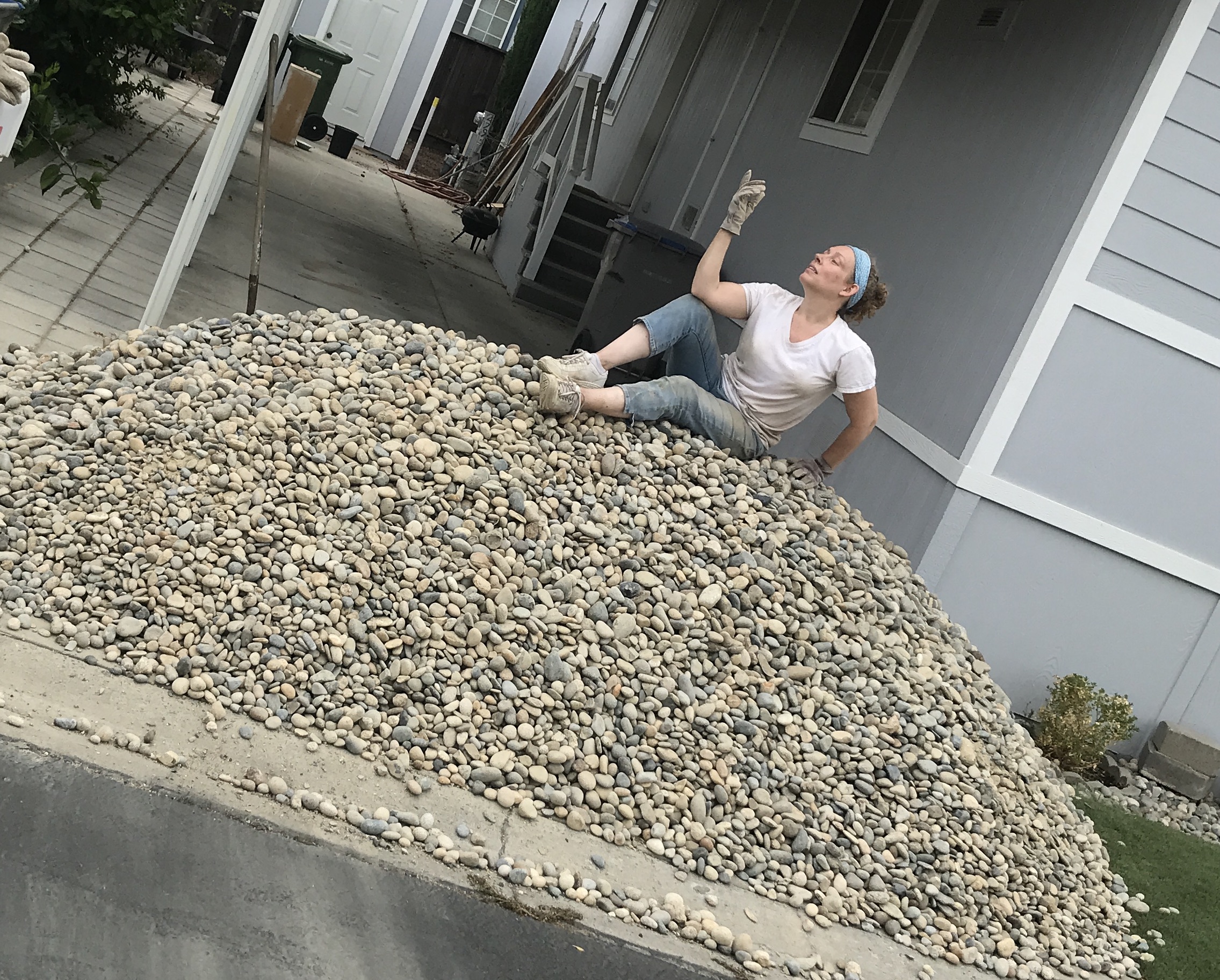
I didn’t reply, “We’re going to rock this town!” though I probably should have. I believe that was the only pun or cultural reference relating to rock that was not spoken over the next two days.

I just wanted to be a machine. Even as the great pile of rock loomed over me, I wanted nothing more than to be a tireless agent of transport. Shovel shovel shovel, trundle trundle trundle, dump. But we weren’t there yet. There was planning to do. Brian stuff.

Official Sweetie did the brain stuff. She also pushed more than a couple of barrow-loads of rock. She is tireless. She is awesome. But it was up to me to move old rock and to place the new stepping-stones.

Once I had discussed whimsey-level for the paving stone placement, and I put some math to use to establish spacing, I spent a while carrying paving stones and digging them in to their new happy places.

Eventually it was time to move rock.

Shoveling is a skill. “Lift with your legs, not your back,” is the axiom, but for the longest time my knee heartily disagreed with that aphorism. For the first few hours of shoveling I put an enormous load on my arms to compensate for all the other body parts not ready to step up. My arm was on fire and I knew there would be hell to pay. Finally I found an odd straight-backed crouching form that did not extend my knee through its vulnerable range, and shoveling improved greatly.

Eight shovels a load, around the house and up a curb. Ten-shovel loads were tough to pull up the curb so I decided to walk more, and just roll with it. It was a big job and it was going to take some time.

As night fell I was beat. Junked. But not finished. My body was hammered enough that I knew I couldn’t assume I’d be motile the next day. I really wanted to finish. My tireless, motivated bride wanted that even more than I did.

But it was not to be. My feet hurt so bad I had difficulty walking. As the night grew darker cars were giving me less room as I pushed loads of rock around on the street. “Five more loads after this one,” I told myself. I had to call it quits for the night.

I managed the five loads, another few hundred pounds of rock moved from A to B. Completely depleted I staggered home with Official Sweetie and when we got there I greeted the dogs and just lay on the floor.

My watch was happy, congratulating me on my biggest workout ever. My dogs were happy to have a chance to bury themselves in such a magnificently redolent pack leader. I was less happy; I knew that as empty as I felt at that moment, there was still a lot of rock to move.

Sunday came round, as Sundays always insist on doing, and I was mildly amazed to discover that I could move. I could even walk. I was expecting agony and I got… okness.

My feet — I don’t know if I’ve properly communicated how they felt Saturday night. I was filthy down to my pores, but I put off taking a shower as long as I could because that required standing. I was amazed that I could put on shoes, let alone walk.

The good part about Sunday was that the job was finite and known. Three or four more hours of shovel, shovel, shovel, trundle trundle trundle dump, with occasional breaks for level level level. Two wheelbarrows, two motivated trundlers, and a few thousand pounds of pebbles.

Then it was over. I gathered up our tools and staggered once last time along the path I had blazed along the street.
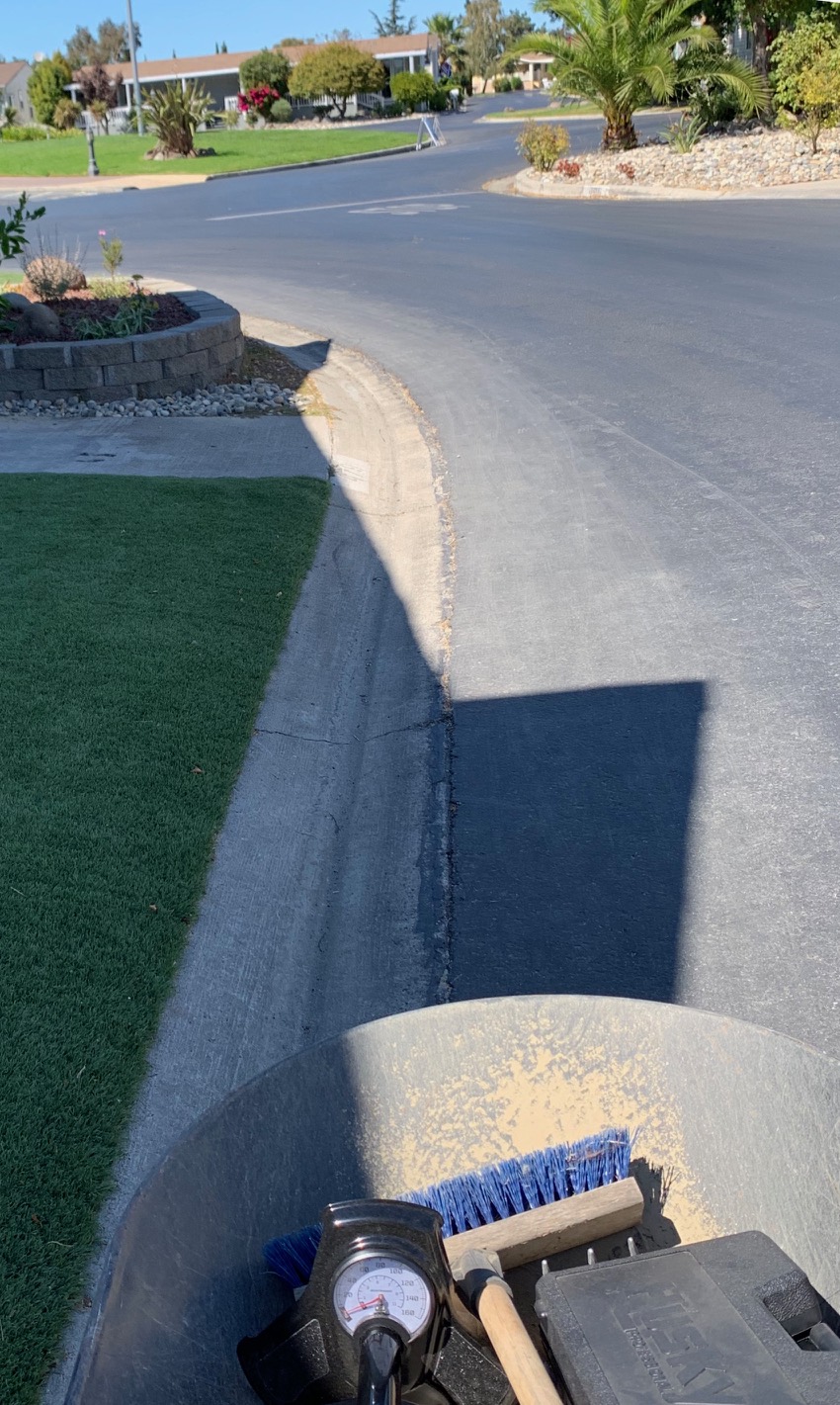
The rock is spread, and it looks good. My legs were noodles, but no worries about getting exercise during my time off.


3

Gilfoyle’s Been Having it Tough, Lately

We just celebrated two years with Gilfoyle, and I have to say that while the little dog is an asshole, he is an endearing one. Chicks dig him especially, but men also respect his demeanor. He has that certain something, and even as his social skills improve, he will always be an asshole. Perhaps that is to be expected from a ten-pound dog bred to move cattle around.

A few weeks ago we were at the vet for routine stuff, and she spent an unusual amount of time listening to his heart. Something wasn’t right. Experts were consulted, measurements were taken, and all is not well with Gilly’s little ticker.

On Monday the Official Sweetie of Muddled Ramblings and Half-Baked Ideas took him in to have a heart-monitoring rig strapped to his body, so the vet could get a good reading on his heart in more normal circumstances.

Gilfoyle handled the visit well, and consented to having a lot of his lush fur shaved off while it was installed. When I go home from work I found this:

He hardly noticed the rig at all, except when he was cutting corners too closely. Official Sweetie kept a diary of events that might be of interest when looking at the data: “3:20 p.m.: Squirrel; 5:40 p.m.: UPS delivery.”

A day later it was time to remove the heart monitor. About noon I called from work with some rather good news, and OSMRHBI didn’t react at all. She was not in a good place.

It was the tape, you see. The vet, carefully following the letter of the instructions, had used a particular very sticky tape to affix the sensors to the poor little guy. When I called, Official Sweetie had just spent an agonizing amount of time trying to peel the tape off a frightened, hurt, confused, betrayed dog.

The title of this episode may be deceptive; Gilfoyle has recovered from the trauma, although he still has stripes of adhesive in his fur. The Official Sweetie, being cursed with a remarkably good memory and a wonderfully big heart, will take a little longer to recover from the episode.

And now we wait for the data to be loaded up and analyzed by the experts. Gilfoyle has been downright spry lately, still improving after a couple years of normal dog life. I’m not sure what his life was like before he joined our family, but I’m pretty sure it wasn’t normal.

Of course I’ll let you all know what the prognosis is when Gilly’s numbers are crunched – at least I will if it’s still Blogtober.

2

Blogtober!

The Official Sweetie of Muddled Ramblings and Half-Baked Ideas decided to challenge herself to writing a Blog post every day in October (the month also known as “Holy Heck, it’s Almost November”).

Seems like a good idea to me, forcing me to do at least some damn thing with words each day.

Even if it’s just some cheap quickie episode about how it’s Blogtober.

3

On Second Thought…

Depicted: a car driving up the vertical glass side of a skyscraper.

The fine print: Professional driver on closed course. Do not attempt.

You know what I say? Give it a shot, bunky. Drive up the side of a building.

2

Programming and Pocket Universes

Programming is an odd activity. The goal of the exercise is to build something completely abstract that somehow does something useful. To build this abstract network of symbols and interactions, one uses a rigidly-defined set of linguistic constructs.

On many occasions I have declared, with a level of absoluteness proportional to my blood alcohol level, that good programmers are spatial thinkers. That programming is inherently visual. But the thing is, it’s not visual at all, because physical vision is bound to the real world.

Geeks corral the abstract concepts and in their heads build fantastic frameworks that only they can “see”. The deepest part of the programming is often done with boxes and lines on a whiteboard. The implementation is just details.

But those flat whiteboard representations don’t fully capture the life of the system. And we talk about the “problem space”, which is a rough definition of the world this software is supposed to improve, and a host of other spaces that aren’t like the space Captain Kirk flies through, or even the space Martin Short navigates. It is a space entirely in the heads of the people working on the project, and maybe not even all of them see it.

But it is beautiful in its own way. That space is not bound by physical al law; it is bound by the requirements of the project: rules created by some guy in a suit who wants to sell more used cars or by some lady in jeans who wants to identify people at risk of heart attacks. For each problem the programmer builds a world, a new space, unbound by that old, “traditional” space that has finite dimensions and entropy all those other distractions.

Programmers create small, specific universes. Pocket Universes. Most of those universes would be pretty boring to you; as you listen to Jane Geek at your class reunion go on about how she streamlined insurance claims, remember this: even if Jane Geek didn’t create a new universe, she sure as hell improved on someone else’s crappy universe (there are myriad crappy universes now). She is right to feel proud. How many Universes have you improved lately?

3

Alternative Listerine

A few months ago the Official Sweetie of Muddled Ramblings and Half-Baked ideas and I were looking for a good mouthwash that was not made by a company that engages in animal testing. There are a lot out there, actually, but the trouble is that none of them left our mouths feeling clean the way Listerine did. Listerine feels potent, whether of not it actually is; there’s no substitute for that alcohol bite.

I had always imagined that Listerine was more… sciency that what it turns out to be. There’s the whole American Dental Association endorsement and all that. But it turns out that Listerine comes from the heyday of Snake Oil medicine, and was first marketed as a surgical disinfectant. It was almost certainly better than nothing, which is what most surgeons used back then.

But the thing is Listerine is just a combination of water, grain alcohol, and some essential oils like menthol and thymol. All the ingredients are easily purchased.

OSMRHBI realized that if no one else was making the right mouthwash, that she could just make her own, and tweak the essential oils to better suit our tastes. (This is one of her Superpowers, to say “fine, I’ll make my own.”) It took a couple of iterations to dial in the recipe, but now I would never go back. Our home-brewed version is simply the best mouthwash I’ve ever used.

Is it as effective? I’m not sure how to measure that, considering Listerine’s efficacy claims are maybe not all that scientific either.

It makes smooching better, though, I can promise you that.

1

A Few are Making a Stand

A few days ago I was reading an article by Bill Barnwell over at ESPN. Barnwell writes long, data-driven articles about sports (mostly football), and he has the ability to make what is often very dry subject material interesting. In this case, he caught my attention for something that wasn’t there.

This article was something like Blah Blah Blah NFL’s 10 Worst Teams. What he said about each team doesn’t matter for this episode; what matters is the list itself.

10. Denver Broncos
9. Detroit Lions
8. Buffalo Bills
7. Oakland Raiders
6. Washington
5. New York Giants
4. Tampa Bay Buccaneers
3. Cincinnati Bengals
2. Miami Dolphins
1. Arizona Cardinals

Don’t see it? Look at number 6 again.

When I noticed that, I dared hope for a moment that ESPN had decided as a powerful media company to simply not use an offensive racial slur on their site.

Nope. The r-word is still all over the place. But at least Bill Barnwell has made the choice to never utter it. If enough of his colleagues do as well, maybe something will change.

Robinson Crusoe Without the Whitewash

My recollections of the 20th-century film adaptations of Robinson Crusoe don’t include slavery. In the source material our hero is on a ship taken by Moorish “pirates” and he is made a slave.

(Pirates in quotes because they’re just doing the same shit as the Europeans.)

But slavery’s not so very bad, right?

While the rest of the crew is sent off God-knows-where, our narrator enjoys a fairly benign period of servitude. He’s technically a slave, but the degradation is absent. It’s just an involuntary job that Robbie executes well, and he is never beaten to an inch of his life, or raped, or humiliated in any of a thousand ways for the pleasure of someone else.

Then there is the escape. A pretty easy escape, really, but let’s just allow that literature was young and even the greats back then leaned on the gullibility of the bad guys. Crusoe escapes with another young slave named Xury who immediately becomes Robbie’s sidekick and biggest fan.

Free! Except of course they are on the open sea in a small boat and that is not sustainable. They have a few adventures along the shore, proving both the power of gunpowder and the stupidity of a hungry European deciding that lions aren’t fit to eat. Xury shows bravery and resourcefulness, and they continue to survive.

More than once, Crusoe said he was heading “south and east”. I checked the map, checked it again, and that just doesn’t work. South and east puts him right ashore. Which is weird, because otherwise Defoe’s descriptions of the geography are accurate.

As Crusoe is heading down the African coast bearing south and west, he reaches a point where Dakar now sits, thrusting out into the ocean. It is here that Robbie and his crew of one spot the sails of a Portuguese (slave) ship. They risk everything to give chase and attract the attention of the men on the ship, and eventually they are rescued.

The Portuguese captain is impressed with Crusoe’s little boat, and offers a nice chunk of cash for it. The captain is also impressed with Crusoe’s sidekick Xury, and offers almost as much for the kid as he did for the boat.

Before I tell you Crusoe’s response to that offer, let’s review. Crusoe has been a slave. He and the kid gained their freedom together, and have struggled together to stay alive. They have been partners, and Xury has shown some moxie in the process. Safe to say, without Xury, Crusoe would have died.

Yeah, you got it. Robbie sells his sidekick — but with a caveat! If the kid accepts Christianity he will only be a slave for ten years.

Well, all right then. I guess that makes it OK.

It was a different time. I get it. Slavery was to maritime trade what porn is to the Internet: The thing no one wants to talk about that funds the rest. But while Robinson Crusoe’s fortunes seem to be rising at this point in the narrative, I just don’t like the guy. Not at all.

I think the writer, Defoe, at a gut level, realized that his main guy was being a complete asshole. Friends don’t sell friends. So in the end Defoe (the writer) compels Xury himself to agree to the terms of the deal, where Crusoe (the character) could not consummate the deal alone without moral compromise. But if it was Xury’s choice, then he should have been the one to get paid.

In my previous episode about this story, I remarked on the lack of visceral detail during the scary times. Perhaps it’s this same detachment that allows Robinson to fucking sell his friend. Perhaps Crusoe doesn’t actually feel anything. That would explain a lot.

3

The Old-White-Man Fear Machine

Yesterday I read an interesting article over at FiveThirtyEight.com titled Could Trump Drive Young White Evangelicals away from the GOP?. It was an interesting article, but the title didn’t really fit. While Trump may accelerate the generational divide in the Evangelical world, the divide would be there anyway.

In a nutshell, the kids these days aren’t buying the fear that Republicans are selling. That applies to every segment of the population, and the Republican bedrock of white evangelicals is no different.

Younger white evangelicals aren’t worried about becoming a minority; in their world they already are. And they’re dealing with it. They are generally more conservative than their friends, and that’s just a part of life. Their church groups are less white as well. They spend significant time with people who are not lily-white, and many of those brown friends share their values.

Trump, as a world-class fear salesman, might be accelerating the divide between young and old. Older Evangelicals drink that fear like the Kool-Aid it is, but the young ones, while retaining their conservative ideals, just aren’t buying the “scary brown people” narrative. At least, not as much as their parents do.

Those kids will still throw down hard on the subject of abortion, but they’re not going to vote for some joker who has likely funded more than his share of terminations just because he promises to build a wall.

So can we take a moment to stop bitching about millennials? “Kids these days” are not buying the random fear of their elders and instead they are asking their predecessors to stop bankrupting the world just when it’s their turn. Republicans know they are aging out, and it pisses them off. But rather than adapt to the sensibilities of the new generation, they are digging in their heels, and saying that the kids are WRONG!

If it weren’t for the slavery-inspired Electoral College and some pretty damn flagrant gerrymandering, Republicans as we know them would be finished already. But here’s hoping that the young conservatives, even the ones I disagree with, can find a political voice outside the old-white-man fear machine that the Republicans have become.

2

In a Word

I thought maybe I’d take a break from mediocre Space Opera and find something more fulfilling to read. One good thing about the modern age is that with a suitable device one has access to countless classics of literature. I’ve read more than one of those.

Robinson Crusoe recently caught my eye. I have vague recollections of a least one movie based on the story, those memories smelling slightly of Disney. Guy gets shipwrecked, has adventures, gets rescued. I think there was a dog, and natives. I have no doubt that the original will be substantially different.

If I can manage to read it. Here’s a sentence from near the beginning:

“In a word, as the sea was returned to its smoothness of surface and settled calmness by the abatement of that storm, so the hurry of my thoughts being over, my fears and apprehensions of being swallowed up by the sea being forgotten, and the current of my former desires returned, I entirely forgot the vows and promises that I made in my distress.”

My eyes were getting blurry by the end of my count, but I came up with a total of sixty-one words to finish a thought that started with “In a word…” But I am in no position to criticize someone for rambling.

There has already been one Interesting Idea (that the happiest people are in the economic center of the spectrum, and that adventuring is not for people who have a chance to be actually happy), but Daniel Defoe spends so much time talking about the people trying to convince Robinson to stay home that he kind of neglects the far more interesting expression of what that desire to roam feels like. There’s nothing visceral in his descriptions; I don’t feel the pull of the sea. Maybe I’m viewing this through a modern lens, but I want to understand his irrational decision from an emotional level, rather than just be presented with it. Other than the weeping of his father (factually presented), there’s not much emotion to be found.

And to be fair, Crusoe is telling this story from the point of view of regret. All those people telling him to stay home were right.

The first storm has come and gone and Crusoe has managed to convey his fear well enough even without any visceral imagery – but it felt flat to me. One sentence stood out, however (yours truly stops to copy sentence, realizes the sentence is easily more than 100 words long and the good part was just a piece of it):

“I expected every wave would have swallowed us up, and that every time the ship fell down, as I thought it did, in the trough or hollow of the sea, we should never rise more; in this agony of mind, I made many vows and resolutions…”

Were I in a writing workshop with Mr. Defoe, I would have advised him to go back and add the groaning of the timbers of his fragile ship, the cursing of the crew, the water washing over the deck, and the feeling in his gut when his little boat slides off the crest of a wave and into the waiting trough, and the juddering in his legs as the boat smashes her bow into the wall of water rising above her, to repeat the cycle.

Although this was a pretty minor storm; maybe Defoe is saving up his descriptive prose for the real thing. That might be an excuse, but you never forget your first storm at sea, I bet. The next day Crusoe’s pal says “that was nothin’!” But wouldn’t Crusoe’s terror be all the more meaningful when reviewed in that context?

I’m pretty sure I could have helped a lot of authors of classics really get over the top with their “great works”. Story idea: I and Michael Bay go back in time to fix a bunch of boring old “literature”.

3

Casual Conversation in my Home Town

“Turns out a bear had dragged it across the street and into our back yard.”

3

… its own Reward

I just prevailed in a design discussion with my boss. The result: I get to implement the feature.

2

And Now We Wait

I have been working on a big project for the better part of a year now. It is a massive overhaul of the systems my department uses in their daily grind. Over time, those systems have become downright awful, and much of the awfulness was beyond our ability to address. A key part of the system was run by our IT department.

That system was never very good, but as our needs changed, the system… stayed the same. Any change would cost hundreds of thousands of funny-money dollars and take a year just to find out that it was going to be another year, and another bucket of funny-money. It’s budget-dollars, not real dollars, but spending on that system would take budget-dollars away from other projects.

This antique system left the rest of our tools making terrible compromises so that the missing functionality could be wedged in. It was time for a change, and I set out to replace that system we didn’t control with a better one that we did.

Hand in hand with that, is that my department’s servers are very, very old in server years. My employer, meanwhile, has created new services so departments like ours don’t need to maintain our own hardware. So this change became not just a massive software update, but a major infrastructure upgrade as well.

I underestimated just how much our applications had been warped to accommodate the crazy compromises. Unwarping them was worthwhile, but time-consuming, and none of these applications had been built with testing in mind. On top of that, the new infrastructure placed its own limits on the applications that required further refactoring.

The goal: to pull the tablecloth off the table without disturbing the dishes, then to slip in a new tablecloth.

For the first few months I worked alone, but as the Big Day approached (and receded), the rest of my team got increasingly involved. I managed to hand off the DNS and server config stuff to my boss just in the nick of time, before the complexity of that exploded in my face.

Not totally alone; I must amend. There were people in many other groups — the people creating the pretty dang awesome new infrastructure tools we are using, who went out of their way to accommodate me and help me along, even though my group is tiny in the scheme of things.

I mentioned the Big Day. That’s not quite accurate. Much like “Happy Hour from 3-7 p.m.”, the Big Day started three hours ago and lasts through the weekend. Right now a script is running, a complex bit of software I have devoted hundreds of hours to, that pulls the data out of the old databases, reconciles an incredible number of different ways the data can disagree, patches the Definitive Data together and houses them in their new, shiny home. When the script is done tomorrow morning, it will never be run again. It will be archived as a historical curiosity and that’s that.

So this evening my boss put all our systems on hold, and we began the migration. After the first giddy flurry of excitement as we all worked to make sure we were ready, I started my script. “And now we wait,” I wrote to the team.

6

Headstrong is Code

In my last episode I mentioned that he use of “headstrong” to describe a female character is almost as bad as calling her “beautiful”.

Headstrong. I suppose I should explain why I find that appellation awful, even as it is widely regarded as a strongly positive trait for female main characters. We can add to the list ‘rebellious’ and ‘independent’. In a man, the exact same traits would be spun positively as ‘confident’.

Why is confident considered a separating characteristic for women? Why is independence a trait worthy of a fantasy hero?

Independent and whatnot are all traits that, applied to a fictional role model, imply that she is somehow special. But hold on there, Sparky! None of those things should be regarded as special. “She a woman… but.. she’s also independent? MADNESS!” Let’s just stop right there.

All those descriptions are code for “hasn’t met the right man yet.”

Seriously, I wish I was wrong. While there are a couple of notable exceptions, there exists shit-tons of novels and series of novels based on the simple premise that an otherwise-powerful woman must somehow care about the merits of her multiple asshole suitors, and when she chooses the best asshole-suitor prosperity ensues. Each asshole is almost-perfect, and fans can form teams around the assholes. But that misses the point.

Our girl doesn’t need any of those assholes.

So let’s get to the real headstrong. She’s got her opinions, and she’s ready to defend them, but she will also listen gracefully and accept when she’s wrong. She’s strong that way. She loves hard, and when her best friend says, “that woman is using you,” she says, “hope you’re wrong,” because she’d not going to stop loving. She’s not one to let go easily.

But she’s headstrong, and change isn’t so easy. It’s a curse she lives with every day, the inability to let go of the little battles to win the war. Her lover whispers in her ear every night, little nothings that add up to something, but nothing will erase the big picture, even for a moment. You can never stop being a hero.

2

OF COURSE She’s Beautiful

I haven’t been getting much writing done lately, and an important way to break out of that slump is to make sure I spend more time reading. So this afternoon I was poking around the ol’ virtual bookstore looking for one of those free “first taste” novels intended to get one hooked on a series.

Today I found a book by Morgan Rice, the first of eight installments (and, presumably, counting.) That many installments in the story can be a red flag; the world does not need another Robert Jordan fumbling his way though an epic he knew how to start but not how to finish. As each book of Wheel of Time got longer, the amount that actually happened went down.

That notwithstanding, if each installment of the saga can show vestiges of a beginning, a middle, and an end, it could be a fun read.

There is one thing that annoyed me right off the bat, however. This is the first sentence of the blurb:

17 year old Ceres, a beautiful, poor girl in the Empire city of Delos, lives the harsh and unforgiving life of a commoner.

Beautiful. Not “resourceful”, not “paranoid schizophrenic”, not even “headstrong” (which is awful for different reasons). From that sentence, I am left to believe that her primary tool for escaping poverty will be her beauty. That’s the least-interesting tool imaginable.

And come on, she’s the hero in a pulp drama. There is no way anyone on this side of the blurb even considered the possibility that she might not be beautiful, or that the most worthwhile men she meets won’t also be beautiful. I get it; the beauty is part of a fantasy shared by the primary audience of this story. But the first high-impact word in the blurb — arguably the most import word in the whole description, the one word that will influence the success of the novel more than any other single word — is a throwaway.

She’s beautiful. Big fuckin’ deal.

3