Goodbye to That Girl

I cranked this out with the last gasp of my laptop battery after a cople of beers. Just a few impressions from our last morning. I could make it better, but I’m just going to let it stand — if I started to edit it I’d probably never publish it at all.

Goodbye to That Girl

A morning of lasts
The last embrace
The last kiss
The last goodbye

for now

Green tea, cup, eyes
Stories, a rush,
words unnecessary
to cover words unsaid.

Everything back in place
folded, stowed
ready
One more cup of tea
sips of time
One more kiss goodbye

red hair a flag at the door
as I walk away.

2

What it means to be Tom

Just as painters spend a lot of time doodling, I often scratch out little bits that aren’t stories but are just sketches of ideas. Maybe some element of it will find its way into a story some day, maybe not. I was talking to That Girl about a thematic fiction publication, and I thought of this little snippet I dashed off some time ago. Just for giggles I thought I’d share it with you. The idea of a name and its meaning has been with us since naming was invented, but I have often reflected that the most meaningful names are the ones we give each other.

What it Means to be Tom

Our conversation fell into a lull. He took a sip of his almost-beer and regarded me seriously. “I name you d’rhath boran,” he said. “In your language it means ‘Speaks with sadness.'”

“I don’t know your name,” I said.

“That’s all right. You can name me later. It’s best not to rush.”

“Actually, my name’s Tom,” I said.

He looked at me quizically. “I do not understand.”

“My name is Tom.”

His eyes lit up. “Ah! My apologies. Your language is difficult sometimes. You are naming me Tom. What does this mean?”

It was my turn to be confused. “Tom is what people call me.”

He looked at me intently, then nodded. “You are giving me a name that you also bear. I had not felt the kinship until this moment, but you are wise indeed to recognize it, for it is there. What does Tom mean?” He laughed in his odd wheezing way. “Nothing too bad, I hope.”

“I’m not sure, really.”

He regarded me seriously. “I am surprised and flattered that you should give me such a complex name after such a short acquaintance. I look forward to learning what it means to be Tom.”

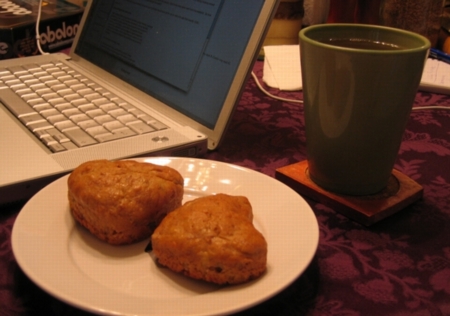
Breakfast!

banana%20bread.jpg

Breakfast!

rainy morn, groggy head
ooo! heart-shaped banana bread
big-ass pot of tea

1

Episode 27: Day of Reckoning

Our story so far: There is something a lot of people are prepared to do a lot of bad things to get, a thing of such value that for its possessor it renders the idea of money inconsequential. Charles Lowell does not have that thing, but he and his faithful assistant Alice have been caught in the middle of a struggle for the possession of a painting that is said to contain a map to the fabulous treasure.

Now Charley has the painting, and people around him are starting to kill each other at an alarming rate. Meredith Baxter, a.k.a Lola Fanutti, his employer and one-time lover, has fallen in the opening stages of a shootout on a pier over the East River.

To read the entire story from the beginning click here.

I ran through the pea-soup fog, hunched over, the package wedged close to my chest. Behind me guns cracked and chattered furiously, and more than once I heard grunts, coughs, and cries of pain choked with blood.

Ahead loomed the glow of the single bulb, and my running was finished. The light cast a feeble glow over the door of the shack that seemed to hover in the darkness, the entire world reduced to me, a weathered wooden door, and a few rough planks between us.

Behind me, the intensity of the gunfire was decreasing; I figured that most of the men still standing must be running out of ammunition by now. If only they could all kill each other. Someone would survive, however, and once the opposing faction was eliminated, they would start looking for the package I carried. A painting, Meredith had said, that carried in its imagery the key to a treasure worth dying for. Plenty of people had done just that. I wondered if there was anyone alive anymore who even knew how to read the damn clues I supposedly carried.

Meredith lay back there, dead. I thought of the look she had given me before she pulled her trigger. Did Meredith die — kill herself, really — because of me? Because I had contacted Cello?

It didn’t matter, I told myself. Dead is dead, and the top priority now was not becoming one of the dead myself. There would be time for second-guessing later, on the long nights when the whiskey wasn’t enough. Remorse is a luxury reserved for the living.

Cello. He was dead now as well. How had he found us? I had passed word to him, but nothing specific. Obviously he had other sources of information as well. In the end, all I had done was give him a way to get under Meredith’s skin, a tool he used at the cost of his own life. He hadn’t thought Meredith would fire, either. She was colder than that, not prone to such an emotional response.

Damn, I wanted a drink.

Silence had fallen over the pier. I listened to the gentle sloshing of the water below me, smelled pungency of decay and life and fuel oil. There was a whiff of something else as well, something that didn’t belong here.

With my pistol I smashed the light bulb, but I didn’t try the door to the shack. It wouldn’t protect me in any case, and that’s the first place anyone would look for me. The first place and the last place; there was nowhere else to hide except in the darkness itself.

I groped my way to the left, careful not to fall off the pier. My hands met the rough wood of a pylon and I crouched down, thinking, waiting, hovering between earth and the dark water below, the water that held the secrets of this mad city, the people and things lost and forgotten save for quiet whispers and legends. Gone, now, all of them, all those people, gone along with their hopes and dreams, reduced to lunch for the eels who lived in the darkness. In the end, that’s all any of us could hope for. We were born to feed the eels.

Footsteps approaching, heavy on the planks; two people, one’s shuffling gait betrayed injury. They moved cautiously, and carried no light that would make them a target. I considered trying to slip past them, hugging one edge of the pier. I decided to make a move when they were checking the shed; the noise they made might help mask my own movements. It was about the only chance I was going to get. Despite the chill air my palm was wet where I held my little Walther.

It seemed an eternity for the footfalls to come close; the silence and the heavy air played tricks with the sound, making them seem closer than they were. In the distance I heard a siren.

The footsteps stopped, only a few feet from me but the source still invisible. There was a pause as the two men sized up the shack in the darkness. After a few seconds the silence became absolute once more. Finally one of the men cleared his throat.

“Charley?” he said. “You in there? Mr. Lowell? It’s OK, it’s just us.” He didn’t specify who just us referred to. I waited.

“Mr. Lowell,” the other man said, “Ms. Fanutti told us to look after you if things went wrong. Told us to do what you said.”

The sound of sirens was close now, and I heard the screeching of brakes. I could convince myself that back down the pier I could make out the throb of flashing red lights.

“Mr. Lowell?” one of the men said. “Listen, we’ve got to get out of here.” I heard a rustling sound from within the shed. The door opened with a soft moan. Suddenly light shone from within. “Who?” was all the first man said before four more shots cracked out in the night, the four muzzle flashes turning the surrounding fog brilliant white for an instant. The light from the shack went out before the two had even hit the ground. The door of the shed closed quietly. From shore came more excited voices as the police prepared to assault the pier.

“Charley,” a voice said, quietly, in control. A woman’s voice. “I’m glad you’re all right. There’s not much time. I have a boat over here.”

“Alice,” I said. “I thought that was your perfume.”

Tune in next time for: The Invisible Hand!

1

A Short History of Nearly Everything

Bill Bryson is a talented and entertaining writer; he has written more than one book that I enjoyed quite a lot. When I opened up A Short History of Nearly Everything and read the opening paragraphs, I told myself that I was in for a treat. Bryson, it seems, had throughout his life stumbled on questions about why things were the way they were and how we came to understand them. Finally, after one such episode, he set out to find answers to those questions and report back to us what he discovered.

The title is misleading; the book is much more a history of how we came to understand the world, rather than a history of the world itself. It would be better named A Short History of Science. Even that would be a little off, however, as it quickly becomes apparent that what fascinates Bryson isn’t so much the science as it is the scientists. A Short History is a very interesting book about the personalities behind modern scientific thinking, and about how those people and their disciplines interacted. And, well, as such, it’s not very short. It’s hard to see how it could be, since it covers so many discoveries by so many people, and often discusses the controversies around those discoveries as well, and about how some people got totally screwed by their less-scrupulous peers.

Some of the science history was surprising to me. When I was a kid I learned that the Earth was about 4 billion years old. This number, to me, fit into that bin of “things we’ve always known.” That number has been refined since, but the tweaks have been minor. What I did not know was that when I was a kid, the 4 billion figure was pretty new. As late as the 1920’s, the dominant estimates for the age of the Earth were much, much, less. That is just one example of the tremendous rush of knowledge that occurred in the 20th century. Things that were taken for granted by the time I was in grade school were considered wacky theories (if they were considered at all) by the previous generation. After centuries of muddling around, science in the early 20th century managed to reach a state across multiple disciplines to finally allow mankind to lay a solid theoretical foundation for just what the heck is going on in the universe. We talk about the rush of technology today, but that was all made possible but the enormous strides in physics, chemistry, biology, medicine, geology, cosmology, and on and on.

There are a few aspects of the march of science that Bryson finds much more interesting than I do. One area where we particularly diverge is the classification of plant and animal species. Bryson explores at great length the competing systems and the proponents of each. My take on the whole thing: *yawn*. This debate is critically important to a few professionals, and I’m not one of them. About the third time taxonomy came up, I thought, “Let’s get back to Darwin’s social difficulties, please.”

Remember how I said that the first paragraphs had me rubbing my hands in anticipation? Well, there’s another problem. The rather over-the-top style of the introduction got pretty tiresome as the book wore on. Opening a page at random, I came across the phrase “splendid waywardness” to describe the property of ice floating on liquid water. It’s a nice phrase. There are way too many of them. Another annoying trait is the never-ending parade of metaphors to illustrate what a very long time ago things happened. If the first three didn’t get the point home, then then one about flying backwards in time for three weeks to get to the beginning of human life, but twenty years to get to the Cambrian Explosion isn’t going to do the job either.

Despite my complaints, this book is filled with historical tidbits about the lives of people whose names you know and quite a few that perhaps you should learn. It shows how preconceptions and petty jealousy have dogged the advancement of human knowledge, and the book often instills a sense of wonder in it all. It is a flawed read, but there’s really nothing else like it that I know of. As such, I recommend A Rather Long History of Scientific Thought.

Note: if you use the above link to buy this book (or a Kindle, or a new car), I get a kickback.

Hangin’ With That Girl

I write this while sitting at John’s XLNT Foods. The waiter just asked me, “You doin’ well, buddy?” which struck me as an odd combination of casual address and unusually correct grammar. I am in a neighborhood called Willow Glen, which has a nice little main strip of shops. Most of the places are trendy and upscale; there are at least five coffee shops — only two are Starbucks — and there are no bars. OK, actually there is an upscale-looking wine bar, and I bet they even serve beer, but it didn’t look like the kind of place to settle in and open up a laptop. So I’m at John’s, and while (as you will see) there is no reason at all for me to order food, I noticed that they had egg salad sandwiches on the menu, and a craving ensued. It was, um… excellent.

Things have been quiet here the last few days. The drive from Arizona to the bay area was routine; I stuck to the big roads and arrived much sooner than I expected to — and earlier than That Girl expected me to, as well. I cooled my heels for a while in a nice little deli, ate a remarkably good sandwich, and read a few chapters. Overall, it was a good way to transition from life on the road to life in an apartment.

When enough time had passed I popped over and was made welcome. There’s something different about the second time you come to visit someone. The first time is an unknown; anything could happen, it’s an adventure undertaken with limited expectations. For the second visit there is history, and it has been recognized by all that there is something going on that is worth developing. Consequently, there is something to lose. It is the visit, to harken back to a previous episode, when you open the mysterious door. (My mysterious doors have proven to have rusty hinges and missing handles. That Girl is patient about that; she figures I’ll manage to pry them open when the time is right.) The second date is the time you regret not mentioning you don’t like mushrooms during the first visit. There’s a lot at stake, and already the misunderstandings are piling up.

We have a good rhythm, That Girl and I. We talk a lot, snuggle often, and when we need to we get out of each other’s way so we can work. That Girl has a square job, so her weekends are valuable for doing what she really loves doing. Yesterday she spent several hours tucked away in her office, working on her own media empire, and I know what it’s like to have other personalities around pushing into your space. We went to our respective work places, enjoyed the quiet, but (at least in my case) it was just a little better knowing in the back of my head that the mental elbow room was a gift happily given by someone close by.

That Girl cooks excellent meals, and I pay her back by making yummy noises as I eat. I feel like this arrangement is one-sided, but one thing I’ve noticed about relationships is that it’s OK for things to be lopsided. There are even times when both parties feel they are getting the better end of the deal, and those times are what we have relationships for.

Weekdays when That Girl is at work I’ve devoted to getting my work done. I have The Screenplay That Refuses to Get Shorter to wrestle with, and last night I submitted “The Short Story that Probably Should Be Longer” to another paying market. It is the third time I’ve submitted the story; the first time it was 1100 words, now it’s up to 2000. At some point the words will be there to allow the reader to see what was in my head. If it gets rejected enough, it will end up an epic. But a good one.

So now I sit at John’s XLNT Foods, sipping Sam Adams, belly full despite the large amount of really tasty leftovers filling the fridge back at That Girl’s place (and cookies! Cookies cookies cookies! And home-made truffles! yum!). Paying John six bucks for a sandwich, however XLNT, is really pretty dumb, but there you have it. I mean, come on! Egg salad!

Mad Dog’s Dog House, Last Observations

As I released urine back to the wilds (Andy Williams singing “Born Free” in my head throughout), I discovered that I had the opportunity to purchase “the ONLY glow-in-the-dark condom certified to prevent unwanted pregnancy and the transmission of sexually communicated disease”. That quote is, I afraid, only approximate, but the word “prevent” was definitely there. I cringed a bit at that; I suppose it’s already been argued in court just what reduction in statistical probability qualifies as “prevent”. Foe me, prevent is absolute; condoms are not. So somewhere, I imagine, “reduce the probability by 99%” has been legally defined as “prevent”. Meanwhile people in the real world read that word and believe prevent means prevent.

I’m just sayin’, is all. I’m not arguing against condoms, far from it. 99% protection is massive. Maybe it’s better than 99%, but they are imperfect, and lives are at risk. Not a time to be harboring unrealistic expectations.

And… crap. When I started this episode I had the serious thing to discuss and then the light thing. Start serious, go light. Journalistic gold. The light thing has long since wandered off to the sunny meadows where happy thoughts romp, and unfortunately I forgot to put a radio collar on the idea so now my chance of tracking it is negligible. It’s a funny thing (in the not-funny sense of the word); I set out on this episode absolutely confident that there was no possible way I could forget the second point. Whatever is was. It probably wasn’t that good anyway, or I would remember. That’s what mom used to say, but maybe that was before she realized what a rockethead I am.

Cyberpunk theme: You get an idea, and you say “tag that”, and the machine that is part of your brain applies a verbal recall code to your thought. The machine then remembers the idea for you, and you can recall it by invoking the tag. The crisis: most people decide to tag everything, which leads to hopeless clutter, and civilization teeters. The moral: there’s a reason you forget stuff. Most of it is crap anyway. I see a sit-com…

2

Mad Dog’s, Kingman, Arizona

It’s been a long day, and a quiet haven with decent beer is just the thing. I’m sitting now at Mad Dog’s. It is quiet in here right now, a couple of locals are playing pool, a few more are sitting at the bar, and I’m across the room in one of the booths. There are televisions, but the big ones are turned off due to lack of sports, and the small ones are quiet enough to be avoidable. I am drinking Black Dog Ale, which has a nice balance between hops and malt. It is also quite reasonably priced. There are paper towel dispensers on the tables, an indication that ribs are on the menu. There is a very big Iguana in an enclosure, and he’s territorial. I looked in on him and he immediately began to go into the old head-bobbing, throat-flap-showing, weird-disk-throat-things (ears?) flashing routine. The dude’s got to be five feet long.

Behind the bar is a pitcher to hold donations for Biker Bob. To meet his expenses. I asked, and Bob’s dead now. Pancreatic cancer. The locals lost a bit of color recently. I wonder how long that pitcher will be there. Could you take it down? Will you rate a pitcher?

As I write this, I am pausing periodically to take a deep breath. Air in, stress out. Prolonged adrenaline shock. It all started in Holbrook, where I had planned to stop so I could assault the pass in Flagstaff after the storm passed. That was going to leave a long, long drive tomorrow, and then I heard the weather guy say that things were going to be no better in the morning, and perhaps worse. I decided to forge ahead.

At first things went pretty well. The snow started coming down in big, fat, flakes, but there was enough traffic to keep the slow lane fairly clear. We all just slowed down to 40 mph and trundled on. At the flagstaff exit that leads to the hotels, things were going well enough that I decided to keep going.

The “things going well enough” lasted another mile. There I was in a long line of trucks keeping the slush churning so it wouldn’t freeze, then every damn one of them went south on I-17 toward Phoenix. Road conditions got suddenly, dramatically worse, and they stayed that way. To make matters worse, there was no place to pull over to put on chains. In Donner Pass chains are commonplace, but through Flagstaff no one had them, or, like me, they were unable to find a place to put them on. The next exit was a ways on, and after slipping and sliding down the road I reached the exit to find it unplowed and untracked. I decided not to guess just where the road was, and continued on down the freeway at a nerve-wracking 20 mph.

At one point traffic came to a stop as we worked past an accident. Despite the level ground the back wheels broke free when I tried to start moving again. Finally I put the car in 2nd gear and worked the clutch very, very gently and managed to creep forward again. After a couple of miles of barely moving, my clutch leg was wearing out.

My old ice-driving skills slowly came back to me, and things were going smoother, but there were accidents everywhere. On truck had a trailer folded in a big ‘V’, with boxes strewn about, interspersed with what looked like loaves of bread. There were plenty of solo spinouts as well. Traffic crept on, and in the distance I saw another truck off to the side of the road, next to a structure I couldn’t make out. As I got closer I realized that I was looking at the underside of a horse trailer that had tipped over. Holy crap. As I passed I saw the two horses standing off to the side, but that must have been a pretty traumatic time getting them out of the tipped-over trailer. I hope they weren’t hurt.

Not long after that a truck passed me. It was a flatbed trailer carrying steel, and as it pulled up next to me it hit the brakes. I could just imagine the trailer skidding to the side and swatting me off the road like a fly. I started making emergency contingency plans. Nothing happened. We all continued our creep over the divide and gradually down the other side.

After a while tires started making the splashy hiss of water, but it was a long time before anyone on the road summoned the courage to speed up. The collective trauma of the pass still held us all, and it wasn’t until many miles later that traffic gradually picked up speed again. That was fine with me. Snow turned to rain as darkness fell, Half the traffic sped up while the other half continued to creep along, adding one last threat before I saw the lights of Kingman and said, “No mas.”

The girl at the hotel desk pointed me to Mad Dog’s, an easy walk, and it was the right choice. The juke box is playing now, and the tunes are pretty good (at this moment Jimi Hendrix is playing “The Wind Cries Mary”), and loud enough to be worthwhile.

One more deep breath, one more beer. It’s OK now.

2

Ratings System Thingie

I have turned on a new Haloscan feature that allows you to rate the blog episodes here. Honestly I don’t know if such a feature makes sense in this context, but I thought we could give it a try together. I have a feeling that most episodes (like this one) won’t really inspire readers to give it a score, and I’m pretty sure that I won’t want ratings on the fiction episodes and the like.

But what the heck. It’s free.

Edited to Add: I voted, then when I reloaded the page, it showed no ratings again. If anyone loads the page and sees a rating, could you mention that in the comments? Thanks!

Also note that the ratings thingies are the very last thing on the page to load. That might take a while on a slow connection.

Edited again to add: I have tried to put the ratings thingie in manually, rather than depending on the automatic implementation by Haloscan. We will see if it can remember votes now, and this way I can also control where the ratings show up a little better.

An Open Letter to Café Press

There was a quality issue with some of the crap I sell through Café Press. Today I finally got around to doing something about it. Here is the (almost) exact text of the final message I sent to Jennifer, my support representative (one rather awful writing mistake fixed):

Hey, Jennifer,

I just want to waste a little more of your time to say that I am quite impressed with your swift and friendly service. Please forward the following message to your boss:

Dear Jennifer’s boss,

You’ve got a keeper there. I know you can’t give her a raise just on my say-so, but maybe next Friday you can let her off a little early. I think she’s earned it.

Yours in commerce,

Jerry Seeger

Finally Getting Muddled U. Rolling

MuddledUniversity.png

That’s right, boys and girls! Muddled University will soon be opening its doors!

As I type this I’m having technical difficulties registering the domain — it’s at that worst possible moment when you click the “pay” button and then wait. It’s been a few minutes now, and still no response. The big question, of course is “if I try again, will I be charged a second time?” Meanwhile, I need to go. What happens if I disconnect from the Internet now? Arrg.

As a side note, .mu belongs to Maruitius, a place that by all reports is quite nice — as long as you’re not a dodo. They didn’t do so well here. Funny that’s not mentioned on the tourist Web site.

Meanwhile, it’s time to get this institution off the ground! Over the next few days I’ll be fiddling with the site off an on, but what every quality institution of higher learning needs first and foremost is merchandise. I know that several of you have had suggestions in the past, but of course I’m too lazy to go find them. So, those who wish to earn the Muddled Bachelor’s Degree in Marketing, please leave suggestions in the comments below. Don’t forget the mascot, Ollie, the elevator-riding, rutabaga-eating ocelot. Dodos would also be a good tie-in.

I am also seeking students who would like degrees in graphic design and Web design. Additionally, if you feel you belong on the faculty of the Web’s Newest University, please submit your application in the comments.

Hockey in the Snow

They go together, ice and snow, and in hockey country you get plenty of both. It’s a bit strange, then, to think that yesterday was the first NHL game ever played in the snow. That’s because it was the second NHL game ever played outdoors.

Even on television, the outdoor game amid the swirling flakes was fun to watch. The players, apparently, enjoyed it as well, as it took them back to childhood games at the local outdoor rink or on a frozen lake. It was also the highest attendance ever for an NHL match; the football stadium they played in was packed with more then 71,000 enthusiastic fans, few of whom could see the action very well.

The ice itself was a problem, though. The rink was constructed over plywood laid out over the grass of the stadium field, and there were bad areas that required repeated attention. In general the ice was soft and the pace of the game relatively slow (for hockey). Note to the NHL: Take a cue from the Czechs. Ice babes. Several Czech teams have attractive women whose job it is to rush out onto the ice to repair problem spots. All we got in this game was a batch of guys in parkas. Judging by the results, the ice babes may be more skilled as well. Perhaps an enterprising individual can start an ice babe agency over here, and bring some of the czechs over here as instructors. It’s a win-win!

Still, it was fun to watch the game being set free from the confines of buildings constructed to hold at bay the very elements that created hockey in the first place. The game ended in a shootout, which I dislike in principle but grudgingly admit is pretty exciting. The Penguins won, and I imagined that somewhere Rose was smiling.

Happy New Year’s Day (observed) Eve Eve

That’s right, it’s only two days until January twoth, or New Year’s Day (observed).

While we’re on the subject, can someone explain to me why people get excited about the ball dropping in Times Square? I can think of few things in our society that are so lame and yet still get so much press. It’s a electrified sphere. It drops a few feet, slowly, in a fashion that completely fails to create suspense. It’s a ball. It drops. In Prague at midnight you’d be dodging fireworks.

Meanwhile, to those who still follow that old-fashioned calendar, enjoy New Year’s Eve. I’ve got a good feeling about this next year. Something big is going to happen.

The Best of the Year

Most Fridays over at the online rag Fantasy Magazine there is a “Blog for Beer” contest in which they give $10 cash on the barrelhead for the best F/SF comment – either a bit of original work, a review, or whatever. This last week they decided to have a special year-end version of that contest, with a bigger prize and more time to post. Entries were to be on the theme “The Best of the Year”.

What the heck, I figured, and the other night I jotted out a little blurb that in the end really had nothing to do with fantasy or science fiction. It was an OK mood piece though, a late-night ramble through a quiet part of my head, perhaps closer to the spirit of flash fiction than most things that use that name. It needs some work to be actually good, but it was a decent rough draft. It didn’t follow the contest guidelines but I went ahead and posted it anyway.

My post was followed by a very complimentary post by a guy who recently quit his job at the post office to become a writer. Judging by his comment, he may be hoping to be the Bukowski of fantasy. I’ll let you decide from there.

Since then the comments over there have been pretty quiet. I’d feel pretty good about my chances to bring home the bacon if I had somehow found a way to include some sort of Fantasy or SF element, but in the end they just didn’t fit. (Unless you count a wee bit of license with meteor showers, but heck, Arthur C. Clarke moved Sri Lanka south.) There are hints of things going on that, if expanded, might invite some sort of fantasy explanation, but they are not explored in the blurb at all.

Of course that leaves the door wide open for you, faithful readers, to post something profound or entertaining that has something to do with the genre, and scoop up a book or three. Plus, you can make the editors feel better about their contest, so they’ll be more interested in doing it again. And remember, every Friday there’s ten bucks of beer money on the line. While you’re over there, hang out and read a couple of stories. I haven’t read the latest one, but a couple of them in the past have been pretty good.

Just for giggles, I’ll go ahead and reproduce what I wrote over there, but you really should follow the link and see what other folks have wrought.

______

The Best of the Year

He stood in the darkened hallway of his childhood home, listening to the silence. Waiting for something, maybe. A nudge in one direction or another, or the echo of a voice from long ago. The memories sifted and stirred, but none rose into view. On nights like this he believed in ghosts.

“What are you doing?” Claire’s voice came from the guest bedroom — once his room — and sounded sleepy.

“Nothing. Just thinking.” He walked into the room and in the pale moonlight for a moment he thought he saw Gwen there instead; it was Gwen who had always wanted the curtains open even in that south-facing room. She had complained about the sun every morning, but would never consider sleeping where she couldn’t see the sky. Now it was he who felt trapped when the blinds were closed, and Claire who patiently tolerated his idiosyncrasy.

“Now, honey, remember what the doctor said about thinking. It’s bad for you.” She tried to keep her voice light, but he could tell she wasn’t really joking. There is a time for thinking, a time for the mysteries of life and the mad world we occupy, and there’s a time to lie quietly in your lover’s arms, knowing nothing but the scent of her and the heat where her skin touches yours.

“Let’s go for a walk,” he said.

“Are you kidding? It’s freezing outside.”

“But there’s no wind. Once the moon goes down it’ll be perfect.”

“But…”

“There’ll be meteors.” They had a tradition of kissing whenever they saw a falling star. “It’s the Quadrantids. The best of the year.” He heard an echo when he said it, like deja vu but not quite; the last time he had been the one in bed.

Claire smiled seductively and flipped the covers back, showing her skimpy nightie. Her Christmas gift to him. “Come on to bed, sweetie.”

He felt the pull of her, her form indistinct in the darkness but radiating heat. He took a step toward the bed when a flash of light streaked across the sky outside. “I just need to go out for a while, have a look,” he said, but he knew he was lying.

When Claire heard the door close she knew he was gone. She had felt him slipping away almost the moment they met, as she cast her net and drew him in gently, ever so slowly, trying not to hold too tight. Bastard. Now here she was in his parent’s house, and in the morning it was going to be up to her to tell them their son was gone. Where? I don’t know. When is he coming back? A shrug. Maybe never. Would she be able to say that?

At least now she would be able to sleep with the curtains closed.

She rose from bed and stood at the window, her hand on the pull cord for the curtains, looking out at the stars as they clustered in the black high desert sky. The stars he was looking at, somewhere else, not far away as the crow flew but light years along the crooked paths the heart followed.

A meteor flashed past, and another. She stood, her bare legs gooseflesh. Another. If she had followed him they would be kissing now. She wondered how she felt about that. The sense of loss wasn’t the acute distress of a breakup, but the yearning for something she had perhaps never known. Another meteor, another bit of drifting debris, ancient, consumed silently in the time between two heartbeats, a flash of light and no more. Billions of years and then poof and that was all.

Finally, tired, she crawled back into bed, but she didn’t close the curtains.

The Road

The Road by Cormac McCarthy is a story of the journey of a father and son across the lifeless, blasted terrain of post-apocalyptic America. There is nothing living except a few bands of desperate survivors; the barren earth is no longer capable of supporting complex life. The only food available is what can be scrounged from the ruins, the only fresh meat is human flesh. The man and the boy are heading south, but they have no reason to believe that what they find will be any better than anywhere else. To the north, however, lies certain death from exposure and starvation.

They have a gun, with two bullets. One for each of them.

We would never eat people, the boy asks. No, never, the man replies.

The man and the boy are never named, conceits like that belong to another world, a place that doesn’t exist any more, a place the boy has never known. In the new, unrelentingly grim, world, there are only bad guys — people who will do anything, anything at all, to stay alive — and good guys — people who still entertain notions of right and wrong. People who, in the words of the boy, are carrying the flame. Even in the face of the horrifyingly pragmatic decisions the man has to make, the boy retains an inherent goodness, and on his shoulders lie the future of mankind.

I was going to write that McCarthy has discarded many of the rules of modern grammar and style, but it would be more accurate to say that he has developed his own grammar and honed it over the years. Rather than bind his sentences with the concepts of subject and verb, in McCarthy’s writing sentences are units of thought, impressions, fragments that map the experience of the characters. Most of the time this works, but sometimes in dialog it is easy to lose track of who is saying what, and the prose sometimes suffers from ambiguous pronouns. When reading this story it’s best not to worry about those things too much, but to let the words flow, bump, jitter, and lapse into silence the way the writer intended them to.

I can see them coming now, the scores of writers who think that it is McCarthy’s style that makes him such a compelling writer, and who will try to imitate him with disastrous results. What makes McCarthy a good writer is his clear vision, his ability to make language work for him, and his ability to create sympathetic characters in the bleakest of situations.

The future shown in this story is a grim one indeed, and there were times I thought to myself “all right, already, life sucks, I get it.” But there is movement in the unrelenting gray of the world, as we see the toll the road takes on the travelers, and watch as their courses diverge. This is a mighty fine read.

Note: if you use the above link to buy this book (or a Kindle, or a new car), I get a kickback.