Here it comes…

I woke up this morning wondering just how many days has passed under the banner of February. Quite a few, I was certain. But fourteen? I hoped not.

The prospect of Valentines Day looms. That Girl assures me that for her That Day is not a perilous journey into the valley of despair in which man in certain of only one thing: It was not enough. It’s a holiday in which a guy could hire the Rolling Stones to play just for her in the corner of the four-star restaurant, and she would say, “I wanted the original drummer.” I don’t have any figures to back this up, but I’ll bet dollars to donuts that more couples break up on valentines day than any other day.

Once Jesse told me about a buddy of his that routinely broke up with his girlfriend before the day of horror, and reconnect after. I laughed at the time, but later I realized that the trauma of the disconnect-reconnect was miniscule compared to the failure on the big day.

Womenfolk out there, I can hear you now: “That’s not me.” Based on a fairly large sample, I regret to inform you that YES IT IS YOU. Ask yourself honestly, what would you say if your boyfriend/husband/other said, “Let’s not do valentines this year.” Wait, let me rephrase that. You would say “oh, that’s fine. I don’t like the whole obligatory show of affection anyway.” Then the day comes around and you discover to your horror that he meant it. “Not even a card? No flowers?” Valentines Day is a big, fat, hairy deal, and I hate it.

From a guy point of view, it’s a cynical chance to go nuts and hope to overcome all the little failures from the previous year. It’s like going to church only at Easter. Keeping the faith is an every-day thing. Observing the annual rites doesn’t make you a true believer.

Dudes, you want to be a good valentine? Give her love 368 days a year. That means love her every day, and go double (no big deal) on her birthday, valentines day, and one other day when she least suspects it. In fact, don’t hesitate to spontanify a few more of those special, unscheduled days. Those are the ones that will live forever in her heart. And screw those guys with their mass-market holidays. After a couple of years she’ll forgive your inferior valentines performance, and appreciate the other 364 days of the year.

Of course, this gives you the chance, around your 17th Valentines, to really blow her socks off. Oh, yeah, baby. Been setting it up all along.

Dead Girls

… if stories about technologically-altered humans can be considered old-fashioned. And if it was actually good.

This review kind of got away from me. If you don’t want to read the whole thing, you should at least check out the excerpts. I highlighted them to make them easier to find.

I wanted to like this book. I really did. I pulled it off of the shelf at John’s house (and, um, accidentally stole it), and the blurb on the back hooked me. It seems that at some point in the future, the art of doll-making has become a science, and the science of nanotechnology has become an art, and it’s pretty tough to tell dolls from people, sometimes.

The story opens with a guy on the run, a desperate dash for freedom, to be caught is to die. Ahead is the Mekong river, on the other side possible salvation. His pursuit, identical-twin killer hottie robots, are closing in. You can feel the tension, feel the fear. He’s almost home free, and then… he’s caught, agrees to go back, they don’t kill him, and the whole episode is filed under “always start your story with action.”

In this world, the greatest doll-maker of all time reaches so deeply into the esoteric world of quantum uncertainty that the result is more than human — and dangerous. Into this doll is built her creator’s deepest neuroses about the fairer sex. His creation has a few unexpected habits, like the desire to drink blood. In the process the doll passes nanomachines into the bitten one, and the victim’s female offspring will be rebuilt by the nanomachines until she herself is a doll, and no trace of humanity is left. They become Dead Girls. The vampire element is nicely soft-pedaled; the story focuses more on the tragedy of women created as objects, vessels to carry all of man’s fear and hatred. Men don’t come out looking too good in this story.

The dolls are a venereal disease. Parasites. When mankind is extinguished, the dolls will also die out. This turns the tale from a “man replaces himself” story to a “man finds an especially poetic way to exterminate himself” story. That’s a plus. The fleeting rise and fall of this other species, the dolls, adds to the poignancy. Intellectually the dolls know they should leave a few people uninfected. Unfortunately, even though their brains are machines, The dolls are a pretty emotional bunch.

With all that going for it, I wanted to like Dead Girls. It gets mired, at times, belaboring the fact that the dolls and their progeny are not truly alive, they are automata of incredible sophistication but in the end just machines. Most of them seem to accept this, and aren’t terribly bothered by dying. There are, however, exceptions, and one of those is Primavera. A question knocked about beneath the surface of the story is just what “alive” means, thought it is not addressed directly. But if the sincere wish not to die is a measure of sentient life, then Primavera (who has little regard for anyone else’s life) is most certainly alive herself.

Still, the book has its share of problems. For the first time ever while reading, I thought “Wow, I’ve got to remember this page for the review.” That’s not a good sign. Near the start I just had no idea what the hell was going on, and after a while the author cut me some slack and provided a badly contrived vehicle for filling in backstory. Dialog at the start is trying very hard to straddle the divide between speech by people who know full well what’s going on, but will be read by people with no idea. It’s not easy to do, and in Dead Girls, the writer doesn’t do a very good job of it.

The story is told in the first person by Primavera’s sidekick, himself not a terribly well-adjusted lad, the only (living) man infected by Primavera. Perhaps, in fact, it is he that makes Primavera unique; he has loved her since before her transformation, before the nanobots restructured her molecules. It is agreed by all that she is not able to love him back, but maybe… The narrative style can be over the top, but generally that’s OK if the story is written with an atmosphere of recollection, words carefully considered over time.

Then, suddenly, the story abruptly shifts to another point of view, also told in the first person. Umm… wha? This is all the more confusing because the voice doesn’t change. This isn’t narrator A faithfully recording what narrator B told him; there’s no sense of oral storytelling at all. It’s more like narrator B borrowed narrator A’s diary and wrote in the chapter. They have the same voice, like the two narrators are machines created in the same factory. Bugged the hell out of me.

The shift happened on page 111, a page that included this gem: “Each morning that summer the sun effervesced into my room like a champagne of lemonades.” No, context doesn’t make it better. He (not the usual ‘he’ but the suddenly-substituted ‘he’ of narrator B) was having a good summer. I’ll admit that if you ignore all meaning and just look at the sentence as a pile of pleasant words, that a certain glow is conveyed. But still…

It remains to be seen whether page 111 has taken me over a threshold, and changed the way I read. Will I now habitually note pages with especially outlandish language? Is that a bad thing?

Next on my memorized list of page numbers is 145, a page I fell asleep to twice (more due to circumstance, but still not a good sign), when our protagonists (including Primavera) are trapped inside Primavera’s mind. (Suddenly the doll’s cognitive ability can include multiple human minds as a subset. So much for assertions that the robot mind is inferior or fundamentally incompatible.) The dialog for the whole sequence is a series of quips and bon mots, but then there’s this:

This was dollspace. Machine consciousness. Impure, like all thought, but more massive than the consciousness of mankind, its constituents were psychons of iron, glass and steel, a neon-bright vortex of complex simplicity from which rose the aleatory music that so bewitched the world. Music that was solid, dimensional; music that was sinew, muscle, physique.

Actually, I’d like the last sentence in that excerpt, if it was referring to, say, Beethoven. It’s not, of course, and after the neon-bright vortex it was too late to rescue this paragraph. This was not the only mention of “complex simplicity”, an interesting idea lost in this simple complexity.

Finally, there was page 167, when Kito, herself a low-budget knockoff doll who seems uniquely imbued with a sense of self-preservation, has got the drop on people who are currently trying to zap her with energy weapons. Quips Kito in her pidgin English, “I wake up first. Take Duracell from gun.”…”Bad day for you when Smith and Wesson merge with Mattel…” That line right there almost redeemed the whole damn book. Almost. Someday I’m going to write a Dirty Harry across the 21st century movie and make Clint Eastwood say that line.

The book takes place in Southeast Asia, and it’s obvious the author knows the area well. (Well enough to convince me, anyway.) At the end there is death, and life, and a personal decision that may doom humanity. Good stuff. Then, right there at the bottom of this first-person narrative, the story closes with a tagline: “Nongkhai, 1991.” 1991? I thought the story was in the future… Oooohhh, that’s the real author breaking character, stepping out of voice just to tell us, “I was there, you know.” It’s a silly thing to do, but especially distracting in a first-person narrative when I imagine I’m reading someone’s diary or a personal account, which the narrator felt compelled to authenticate with a date. When the last two words of the story broke voice it was one last jab at my already-annoyed story-loving self.

I did not read the teaser for the sequel, Dead Boys.

Note: if you use the above link to buy this book (or a Kindle, or a new car), I get a kickback.

I’m Still Here

So, while nobody’s actually come out and said “Hey! Blog, dammit!” I’ve had a few gentle prods lately reminding me that the blogosphere has been under-rambled lately. Sorry about that. The Media Empire is crumbling, and I am playing kazoo while MySpace clamors at the gates. (‘Clamors’ carefully chosen; I like to tell myself that the signal-to-noise ratio here, while dismal, is better than elsewhere. I am fighting a trend that finds signal to be a quaint ideal. Long live noise.)

Here’s the thing: I haven’t been saying much because I don’t have that much to say. While I was hanging with That Girl plenty of things happened, but they fell under the unbrella of None of Your Damn Business. [Type retained. Unbrella is a word that deserves to live.] Now I’m back in Prague, doing the same shit I’ve been doing for years now, and really if you want to know what I’m up to, the archives are there for you.

There have been a couple of developments worth noting, however.

My most rejected story has added to its legacy. Truly the Lou Gherig of rejection, this story is not finished yet.

That Girl sent me an email today that helped me up when I was down. I intend to reply to it before she reads this. Just so I can tell her personally first.

It’s still February, and I’ve already picked up the Most Awesome Birthday Present Ever. I intend to send a thank-you before the generous giver reads about it here. He gave me a vote, in a place that really matters, and made it clear that he thought I deserved that vote. Dang, that feels good.

Meanwhile, I’ve still been wrestling with the screenplay format. The biggest problem: No Rambling! I’ve been trying to pack my story into the required package and it’s been driving me crazy. Every time I want to tear my hair out and shout “It’s Impossible!” I think of The Usual Suspects. That’s a lot of story in the confined realm of the screenplay. How do they do it? A magnificent cast to turn a few words into an epic doesn’t hurt. Extensive voiceover by one of the best actors of our age doesn’t hurt. Then I realized… voiceover, quick-sliced action… the whole damn movie is a montage! (Any time you want a lot to happen in a little time, use a montage!)

Last year fuego and I got word through Charles 1th that there was a guy out in LA who had cash and wanted to make a movie. He was looking for a low-budget Usual Suspects. There are, as I write this, a thousand people trying to write the next Usual Suspects. Minimum. Suspects had some locations (burning freighters and stuff) but spent its main capital on director and cast. Still, it was the writing that brought all those people together. The stars bought into the script. kevin Spacey is brilliant, but the words come from somewhere else. It started with a script, and the entire industry is looking for the second coming.

So I look at that flick, and I wonder why I can’t achieve the same story density. It looks so easy there on the screen. What fuego and I did write was completely different, but actually rather good, and made to fly on a low budget. What if the mysterious powers that toss you around like a plaything are acting in your best interest? Makes you wish you’d payed more attention to the crazy lady next door, before she died on your sofa.

In the end, all my work with Dark War (with the help of fuego’s story-tellin’ flair) makes it more cinematic, more divorced from paper, and more trusting of skilled actors. But it’s still too damn long.

So, there’s that. Writing to constraints. It’s uncomfortable sometimes. Although that’s the biggest part of this post, it’s not the biggest contributor to my current state of mind. It’s just the one I’m most able to discuss. The rest of it — I’m not really sure.

Funding for NASA

If private industry could sponsor NASA projects for the naming rights, I bet the space boys could make some pretty good money. Candy companies would make particularly good candidates for sponsorship, what with Mars and Milky Way and so forth. The one I want to see? That’s right, you guessed it… the Double Bubble Hubble Space Telescope.

In Cold Blood

A rural Kansas family’s home is invaded. They are neatly tied up and then brutally executed with a shotgun. Police are stumped. There are few clues, and no apparent motive. Among the most baffling, and most difficult questions that everyone asks is, “What kind of person could do such a thing?”

In Cold Blood by Truman Capote is a study of that question, and of the effect such senseless violence has on the rest of us. How do normal, sensible, sensitive people cope when confronted with such incomprehensible behavior?

This is not a whodunnit; in the first pages we learn the identities of the killers and we learn that they will be executed before it’s all over. The narrative starts with the last day the Clutter family is alive, and we quickly learn to like these people. Capote interviewed friends and witnesses extensively and we can feel the genuine affection the people had for the doomed family. Next, we meet the killers, two men who, at first glance, seem like normal, even likable guys. Not the kind of men who would shoot a teenage girl in the face with a shotgun. But that’s what they did, later that night.

Through the course of the investigation and the eventual trial, we learn more about these men, and about the men charged with tracking them down and later trying them. We learn about the town as well, and about the more intangible harm done to an entire community.

In the end, there’s no definitive answer to the fundamental question, no answer to what kind of people do things like this, just a recognition that those people exist. In the end the killers seemed to value their own lives as lightly as those of their victims. When Dick and Perry are hanged, there is no sense of catharsis, no sense of justice served. They may be gone, but the people who were affected by them will never be the same. They will never be able to forget that “people like that” exist.

I picked up the book mainly on the strength of the author’s name; Truman Capote is one of those I feel I should be familiar with as an American writer. His writing is clean and inconspicuous; he never uses fancy prose that might upstage his subjects. His conversational tone fits well with the straightforward speech of the people he is portraying. Based on this offering I can certainly agree that Capote was a good writer, but I didn’t see anything here that bumped him up to great. Maybe I’ll try Breakfast at Tiffany’s next.

Note: if you use the above link to buy this book (or a Kindle, or a new car), I get a kickback.

A Bit of a Close One

As I approached the line to check in to my Aer Lingus scoot across the Atlantic, a petite asian woman in a blue uniform asked, rather loudly, “Anyone check bags?” I thought it an odd question, as I was joining a line of people hauling huge suitcases. She gestured in the direction of the express line, and my first thought was that she really meant “Anyone NOT checking bags?” Then I noticed the two small bags sitting untended at the entrance to the express lane. The woman hustled off to notify security.

OK, I knew that the bags were just the property of some doofus who had ignored the constant droning of the “don’t leave your bags unattended” messages, and had left their personal belongings lying around in Los Angeles. Still, as no one arrived to claim the bags, I couldn’t help but worry. Just how big a doofus was this? Did the doofus seriously expect to find his (or her, judging by the pink striped bag) belongings still there after ten minutes and more?

A security guy arrived, circled the bags at a distance like a shark assessing prey, then backed off and talked into his radio. Then nothing happened, followed by more nothing. Finally the guard approached again, closer this time, looking for a name tag on the bags. Then he backed away again, regarding them with some reluctance (“why do these things always happen on my shift?”). More time, another pass by the bags, closer, inspecting them longer.

So, I’m expecting someone to arrive with some sort of steel bin on wheels. In go the bags, and there’s nothing to see here, move along.

Nope. No other security personnel arrive, there is no other response. The security man on the scene went to a nearby information desk and there might have been an announcement over the PA about the luggage. (“Your attention please. mfflmfllffmflllf.”) Still no owner.

Finally, the doofus shows up. The security guy doesn’t even notice him for a time, until doofus stoops to put a name tag on one of the bags. Security guy talks to the doofus for a moment, and the guy is allowed to carry on with his carry-on luggage. Happily, not on my flight.

Note to people considering leaving bombs in airports. At LAX you have about half an hour to get away while the security people are paralyzed, unable to perform the very simple procedures explained over the PA every five minutes.

Finally, it was my turn to check in.

“When are you coming back?” the airline baggage-taking girl asked me, after typing in my passport number.

“I’m not sure,” I answered.

“You don’t have an itinerary or anything that shows when you’re leaving again?”

“Umm… no.”

“Are you staying more than three months?”

“No.” When she asked the question, that answer became the truth, providing I don’t have my visa by then.

She tapped some more keys, but didn’t look optimistic. “I’ll have to check,” she said, and took my passport and disappeared into the mysterious bowels of the Airport Beast. I waited, aware of the people in line behind me and mentally making contingency plans. It was early yet; I could buy a ticket to Croatia or back to the US and then check in. Airline Baggage-Taking Girl returned. “You’re all right,” she said. “But the immigration official might want to see proof that you can afford a return ticket.”

Man, I sure hope she’s right. By the time I’m able to post this I’ll have the answer.

Or not! Free WiFi in LAX! We already knew that Albuquerque was so civilized, but this is a pleasant surprise.

Or not not! RSS feeds work, but not http requests. eMail is right out. By the time you learn about my close call, the situation will be resolved.

***

In Dublin now – the passport guy didn’t run my passport through the computer at all. Maybe they’ll do that in Prague. Meanwhile it’s 10:00 and I’m enjoying a nice pint of Kilkenny. Yum!

Road Food at Don Juan’s

The first billboard for the McDonald’s in Lordsburg, NM is at least sixty miles to the west, somewhere in the trackless deserts of Southern Arizona. I had had only a light breakfast (a chunk of beef jerky washed down with Mountain Dew) and I was starting to have feeding urges. Another hour’s drive sounded about right.

As I approached, I considered pushing on a little farther to Deming, sixty more miles to the east. A timely gastric rumbling decided me, and I signaled to leave the freeway. McDonalds was right there – easy off, easy on.

But, what a minute… McDonalds? What the heck was I thinking? This is New Mexico. I spotted a little food shack just behind the McD’s. Much better choice. Well, it would have been except that it was out of business. Bummer. Then I noticed that in the competition between chains and local joints was far from over; the Dairy Queen had been stripped of its distinctive signage and instead just read, “Don Juan’s Now Open.” I decided to drop in on Juan.

Don Juan’s is a little place, quite obviously a converted fast food joint. There were about ten different kinds of burritos, all three dollars, all with green chile. There were tacos and stuff as well, but I scored a pair of chile reilleno burritos and a coke. Juan and I chatted about the rainstorms of last night, what a nice day it had turned out to be after all, and then my food was ready. I sat and opened my book, which I think disappointed Don Juan, but I was too busy eating some fine home cookin’ anyway. Soon after a pair of border patrol trucks pulled up, then the state police were represented, then a guy from a construction company showed up with a huge order.

My one regret: not getting an extra side order of the green. The chile he used was good, but if some is good, then more is better.

Had I seen the cops and border patrol cars there when I pulled up, I would have know already that Don Jose was the place to go. Those guys know. As it was I was lucky, had some tasty food that doesn’t happen at chain restaurants, along with friendly service. He does not offer Green Chile Cheeseburgers, however. “I used to cook burgers at the old place,” Don Juan told a Navajo couple who were in for the first time. “I’m tired of them.” Yes indeed, the American Dream right there kids, from flipping burgers to having his own place. Please join me in wishing him all the best.

If you’re down Lordsburg way, do yourself a favor and pay Juan a visit.

Goodbye to That Girl

I cranked this out with the last gasp of my laptop battery after a cople of beers. Just a few impressions from our last morning. I could make it better, but I’m just going to let it stand — if I started to edit it I’d probably never publish it at all.

Goodbye to That Girl

A morning of lasts
The last embrace
The last kiss
The last goodbye

for now

Green tea, cup, eyes
Stories, a rush,
words unnecessary
to cover words unsaid.

Everything back in place
folded, stowed
ready
One more cup of tea
sips of time
One more kiss goodbye

red hair a flag at the door
as I walk away.

2

What it means to be Tom

Just as painters spend a lot of time doodling, I often scratch out little bits that aren’t stories but are just sketches of ideas. Maybe some element of it will find its way into a story some day, maybe not. I was talking to That Girl about a thematic fiction publication, and I thought of this little snippet I dashed off some time ago. Just for giggles I thought I’d share it with you. The idea of a name and its meaning has been with us since naming was invented, but I have often reflected that the most meaningful names are the ones we give each other.

What it Means to be Tom

Our conversation fell into a lull. He took a sip of his almost-beer and regarded me seriously. “I name you d’rhath boran,” he said. “In your language it means ‘Speaks with sadness.'”

“I don’t know your name,” I said.

“That’s all right. You can name me later. It’s best not to rush.”

“Actually, my name’s Tom,” I said.

He looked at me quizically. “I do not understand.”

“My name is Tom.”

His eyes lit up. “Ah! My apologies. Your language is difficult sometimes. You are naming me Tom. What does this mean?”

It was my turn to be confused. “Tom is what people call me.”

He looked at me intently, then nodded. “You are giving me a name that you also bear. I had not felt the kinship until this moment, but you are wise indeed to recognize it, for it is there. What does Tom mean?” He laughed in his odd wheezing way. “Nothing too bad, I hope.”

“I’m not sure, really.”

He regarded me seriously. “I am surprised and flattered that you should give me such a complex name after such a short acquaintance. I look forward to learning what it means to be Tom.”

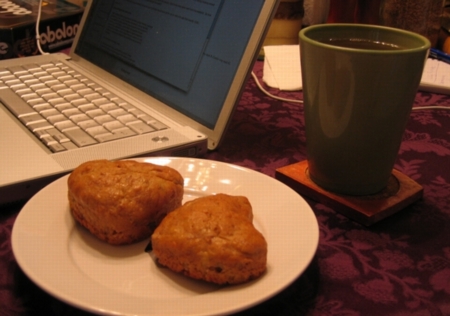
Breakfast!

banana%20bread.jpg

Breakfast!

rainy morn, groggy head
ooo! heart-shaped banana bread
big-ass pot of tea

1

Episode 27: Day of Reckoning

Our story so far: There is something a lot of people are prepared to do a lot of bad things to get, a thing of such value that for its possessor it renders the idea of money inconsequential. Charles Lowell does not have that thing, but he and his faithful assistant Alice have been caught in the middle of a struggle for the possession of a painting that is said to contain a map to the fabulous treasure.

Now Charley has the painting, and people around him are starting to kill each other at an alarming rate. Meredith Baxter, a.k.a Lola Fanutti, his employer and one-time lover, has fallen in the opening stages of a shootout on a pier over the East River.

To read the entire story from the beginning click here.

I ran through the pea-soup fog, hunched over, the package wedged close to my chest. Behind me guns cracked and chattered furiously, and more than once I heard grunts, coughs, and cries of pain choked with blood.

Ahead loomed the glow of the single bulb, and my running was finished. The light cast a feeble glow over the door of the shack that seemed to hover in the darkness, the entire world reduced to me, a weathered wooden door, and a few rough planks between us.

Behind me, the intensity of the gunfire was decreasing; I figured that most of the men still standing must be running out of ammunition by now. If only they could all kill each other. Someone would survive, however, and once the opposing faction was eliminated, they would start looking for the package I carried. A painting, Meredith had said, that carried in its imagery the key to a treasure worth dying for. Plenty of people had done just that. I wondered if there was anyone alive anymore who even knew how to read the damn clues I supposedly carried.

Meredith lay back there, dead. I thought of the look she had given me before she pulled her trigger. Did Meredith die — kill herself, really — because of me? Because I had contacted Cello?

It didn’t matter, I told myself. Dead is dead, and the top priority now was not becoming one of the dead myself. There would be time for second-guessing later, on the long nights when the whiskey wasn’t enough. Remorse is a luxury reserved for the living.

Cello. He was dead now as well. How had he found us? I had passed word to him, but nothing specific. Obviously he had other sources of information as well. In the end, all I had done was give him a way to get under Meredith’s skin, a tool he used at the cost of his own life. He hadn’t thought Meredith would fire, either. She was colder than that, not prone to such an emotional response.

Damn, I wanted a drink.

Silence had fallen over the pier. I listened to the gentle sloshing of the water below me, smelled pungency of decay and life and fuel oil. There was a whiff of something else as well, something that didn’t belong here.

With my pistol I smashed the light bulb, but I didn’t try the door to the shack. It wouldn’t protect me in any case, and that’s the first place anyone would look for me. The first place and the last place; there was nowhere else to hide except in the darkness itself.

I groped my way to the left, careful not to fall off the pier. My hands met the rough wood of a pylon and I crouched down, thinking, waiting, hovering between earth and the dark water below, the water that held the secrets of this mad city, the people and things lost and forgotten save for quiet whispers and legends. Gone, now, all of them, all those people, gone along with their hopes and dreams, reduced to lunch for the eels who lived in the darkness. In the end, that’s all any of us could hope for. We were born to feed the eels.

Footsteps approaching, heavy on the planks; two people, one’s shuffling gait betrayed injury. They moved cautiously, and carried no light that would make them a target. I considered trying to slip past them, hugging one edge of the pier. I decided to make a move when they were checking the shed; the noise they made might help mask my own movements. It was about the only chance I was going to get. Despite the chill air my palm was wet where I held my little Walther.

It seemed an eternity for the footfalls to come close; the silence and the heavy air played tricks with the sound, making them seem closer than they were. In the distance I heard a siren.

The footsteps stopped, only a few feet from me but the source still invisible. There was a pause as the two men sized up the shack in the darkness. After a few seconds the silence became absolute once more. Finally one of the men cleared his throat.

“Charley?” he said. “You in there? Mr. Lowell? It’s OK, it’s just us.” He didn’t specify who just us referred to. I waited.

“Mr. Lowell,” the other man said, “Ms. Fanutti told us to look after you if things went wrong. Told us to do what you said.”

The sound of sirens was close now, and I heard the screeching of brakes. I could convince myself that back down the pier I could make out the throb of flashing red lights.

“Mr. Lowell?” one of the men said. “Listen, we’ve got to get out of here.” I heard a rustling sound from within the shed. The door opened with a soft moan. Suddenly light shone from within. “Who?” was all the first man said before four more shots cracked out in the night, the four muzzle flashes turning the surrounding fog brilliant white for an instant. The light from the shack went out before the two had even hit the ground. The door of the shed closed quietly. From shore came more excited voices as the police prepared to assault the pier.

“Charley,” a voice said, quietly, in control. A woman’s voice. “I’m glad you’re all right. There’s not much time. I have a boat over here.”

“Alice,” I said. “I thought that was your perfume.”

Tune in next time for: The Invisible Hand!

1

A Short History of Nearly Everything

Bill Bryson is a talented and entertaining writer; he has written more than one book that I enjoyed quite a lot. When I opened up A Short History of Nearly Everything and read the opening paragraphs, I told myself that I was in for a treat. Bryson, it seems, had throughout his life stumbled on questions about why things were the way they were and how we came to understand them. Finally, after one such episode, he set out to find answers to those questions and report back to us what he discovered.

The title is misleading; the book is much more a history of how we came to understand the world, rather than a history of the world itself. It would be better named A Short History of Science. Even that would be a little off, however, as it quickly becomes apparent that what fascinates Bryson isn’t so much the science as it is the scientists. A Short History is a very interesting book about the personalities behind modern scientific thinking, and about how those people and their disciplines interacted. And, well, as such, it’s not very short. It’s hard to see how it could be, since it covers so many discoveries by so many people, and often discusses the controversies around those discoveries as well, and about how some people got totally screwed by their less-scrupulous peers.

Some of the science history was surprising to me. When I was a kid I learned that the Earth was about 4 billion years old. This number, to me, fit into that bin of “things we’ve always known.” That number has been refined since, but the tweaks have been minor. What I did not know was that when I was a kid, the 4 billion figure was pretty new. As late as the 1920’s, the dominant estimates for the age of the Earth were much, much, less. That is just one example of the tremendous rush of knowledge that occurred in the 20th century. Things that were taken for granted by the time I was in grade school were considered wacky theories (if they were considered at all) by the previous generation. After centuries of muddling around, science in the early 20th century managed to reach a state across multiple disciplines to finally allow mankind to lay a solid theoretical foundation for just what the heck is going on in the universe. We talk about the rush of technology today, but that was all made possible but the enormous strides in physics, chemistry, biology, medicine, geology, cosmology, and on and on.

There are a few aspects of the march of science that Bryson finds much more interesting than I do. One area where we particularly diverge is the classification of plant and animal species. Bryson explores at great length the competing systems and the proponents of each. My take on the whole thing: *yawn*. This debate is critically important to a few professionals, and I’m not one of them. About the third time taxonomy came up, I thought, “Let’s get back to Darwin’s social difficulties, please.”

Remember how I said that the first paragraphs had me rubbing my hands in anticipation? Well, there’s another problem. The rather over-the-top style of the introduction got pretty tiresome as the book wore on. Opening a page at random, I came across the phrase “splendid waywardness” to describe the property of ice floating on liquid water. It’s a nice phrase. There are way too many of them. Another annoying trait is the never-ending parade of metaphors to illustrate what a very long time ago things happened. If the first three didn’t get the point home, then then one about flying backwards in time for three weeks to get to the beginning of human life, but twenty years to get to the Cambrian Explosion isn’t going to do the job either.

Despite my complaints, this book is filled with historical tidbits about the lives of people whose names you know and quite a few that perhaps you should learn. It shows how preconceptions and petty jealousy have dogged the advancement of human knowledge, and the book often instills a sense of wonder in it all. It is a flawed read, but there’s really nothing else like it that I know of. As such, I recommend A Rather Long History of Scientific Thought.

Note: if you use the above link to buy this book (or a Kindle, or a new car), I get a kickback.

Hangin’ With That Girl

I write this while sitting at John’s XLNT Foods. The waiter just asked me, “You doin’ well, buddy?” which struck me as an odd combination of casual address and unusually correct grammar. I am in a neighborhood called Willow Glen, which has a nice little main strip of shops. Most of the places are trendy and upscale; there are at least five coffee shops — only two are Starbucks — and there are no bars. OK, actually there is an upscale-looking wine bar, and I bet they even serve beer, but it didn’t look like the kind of place to settle in and open up a laptop. So I’m at John’s, and while (as you will see) there is no reason at all for me to order food, I noticed that they had egg salad sandwiches on the menu, and a craving ensued. It was, um… excellent.

Things have been quiet here the last few days. The drive from Arizona to the bay area was routine; I stuck to the big roads and arrived much sooner than I expected to — and earlier than That Girl expected me to, as well. I cooled my heels for a while in a nice little deli, ate a remarkably good sandwich, and read a few chapters. Overall, it was a good way to transition from life on the road to life in an apartment.

When enough time had passed I popped over and was made welcome. There’s something different about the second time you come to visit someone. The first time is an unknown; anything could happen, it’s an adventure undertaken with limited expectations. For the second visit there is history, and it has been recognized by all that there is something going on that is worth developing. Consequently, there is something to lose. It is the visit, to harken back to a previous episode, when you open the mysterious door. (My mysterious doors have proven to have rusty hinges and missing handles. That Girl is patient about that; she figures I’ll manage to pry them open when the time is right.) The second date is the time you regret not mentioning you don’t like mushrooms during the first visit. There’s a lot at stake, and already the misunderstandings are piling up.

We have a good rhythm, That Girl and I. We talk a lot, snuggle often, and when we need to we get out of each other’s way so we can work. That Girl has a square job, so her weekends are valuable for doing what she really loves doing. Yesterday she spent several hours tucked away in her office, working on her own media empire, and I know what it’s like to have other personalities around pushing into your space. We went to our respective work places, enjoyed the quiet, but (at least in my case) it was just a little better knowing in the back of my head that the mental elbow room was a gift happily given by someone close by.

That Girl cooks excellent meals, and I pay her back by making yummy noises as I eat. I feel like this arrangement is one-sided, but one thing I’ve noticed about relationships is that it’s OK for things to be lopsided. There are even times when both parties feel they are getting the better end of the deal, and those times are what we have relationships for.

Weekdays when That Girl is at work I’ve devoted to getting my work done. I have The Screenplay That Refuses to Get Shorter to wrestle with, and last night I submitted “The Short Story that Probably Should Be Longer” to another paying market. It is the third time I’ve submitted the story; the first time it was 1100 words, now it’s up to 2000. At some point the words will be there to allow the reader to see what was in my head. If it gets rejected enough, it will end up an epic. But a good one.

So now I sit at John’s XLNT Foods, sipping Sam Adams, belly full despite the large amount of really tasty leftovers filling the fridge back at That Girl’s place (and cookies! Cookies cookies cookies! And home-made truffles! yum!). Paying John six bucks for a sandwich, however XLNT, is really pretty dumb, but there you have it. I mean, come on! Egg salad!

Mad Dog’s Dog House, Last Observations

As I released urine back to the wilds (Andy Williams singing “Born Free” in my head throughout), I discovered that I had the opportunity to purchase “the ONLY glow-in-the-dark condom certified to prevent unwanted pregnancy and the transmission of sexually communicated disease”. That quote is, I afraid, only approximate, but the word “prevent” was definitely there. I cringed a bit at that; I suppose it’s already been argued in court just what reduction in statistical probability qualifies as “prevent”. Foe me, prevent is absolute; condoms are not. So somewhere, I imagine, “reduce the probability by 99%” has been legally defined as “prevent”. Meanwhile people in the real world read that word and believe prevent means prevent.

I’m just sayin’, is all. I’m not arguing against condoms, far from it. 99% protection is massive. Maybe it’s better than 99%, but they are imperfect, and lives are at risk. Not a time to be harboring unrealistic expectations.

And… crap. When I started this episode I had the serious thing to discuss and then the light thing. Start serious, go light. Journalistic gold. The light thing has long since wandered off to the sunny meadows where happy thoughts romp, and unfortunately I forgot to put a radio collar on the idea so now my chance of tracking it is negligible. It’s a funny thing (in the not-funny sense of the word); I set out on this episode absolutely confident that there was no possible way I could forget the second point. Whatever is was. It probably wasn’t that good anyway, or I would remember. That’s what mom used to say, but maybe that was before she realized what a rockethead I am.

Cyberpunk theme: You get an idea, and you say “tag that”, and the machine that is part of your brain applies a verbal recall code to your thought. The machine then remembers the idea for you, and you can recall it by invoking the tag. The crisis: most people decide to tag everything, which leads to hopeless clutter, and civilization teeters. The moral: there’s a reason you forget stuff. Most of it is crap anyway. I see a sit-com…

2

Mad Dog’s, Kingman, Arizona

It’s been a long day, and a quiet haven with decent beer is just the thing. I’m sitting now at Mad Dog’s. It is quiet in here right now, a couple of locals are playing pool, a few more are sitting at the bar, and I’m across the room in one of the booths. There are televisions, but the big ones are turned off due to lack of sports, and the small ones are quiet enough to be avoidable. I am drinking Black Dog Ale, which has a nice balance between hops and malt. It is also quite reasonably priced. There are paper towel dispensers on the tables, an indication that ribs are on the menu. There is a very big Iguana in an enclosure, and he’s territorial. I looked in on him and he immediately began to go into the old head-bobbing, throat-flap-showing, weird-disk-throat-things (ears?) flashing routine. The dude’s got to be five feet long.

Behind the bar is a pitcher to hold donations for Biker Bob. To meet his expenses. I asked, and Bob’s dead now. Pancreatic cancer. The locals lost a bit of color recently. I wonder how long that pitcher will be there. Could you take it down? Will you rate a pitcher?

As I write this, I am pausing periodically to take a deep breath. Air in, stress out. Prolonged adrenaline shock. It all started in Holbrook, where I had planned to stop so I could assault the pass in Flagstaff after the storm passed. That was going to leave a long, long drive tomorrow, and then I heard the weather guy say that things were going to be no better in the morning, and perhaps worse. I decided to forge ahead.

At first things went pretty well. The snow started coming down in big, fat, flakes, but there was enough traffic to keep the slow lane fairly clear. We all just slowed down to 40 mph and trundled on. At the flagstaff exit that leads to the hotels, things were going well enough that I decided to keep going.

The “things going well enough” lasted another mile. There I was in a long line of trucks keeping the slush churning so it wouldn’t freeze, then every damn one of them went south on I-17 toward Phoenix. Road conditions got suddenly, dramatically worse, and they stayed that way. To make matters worse, there was no place to pull over to put on chains. In Donner Pass chains are commonplace, but through Flagstaff no one had them, or, like me, they were unable to find a place to put them on. The next exit was a ways on, and after slipping and sliding down the road I reached the exit to find it unplowed and untracked. I decided not to guess just where the road was, and continued on down the freeway at a nerve-wracking 20 mph.

At one point traffic came to a stop as we worked past an accident. Despite the level ground the back wheels broke free when I tried to start moving again. Finally I put the car in 2nd gear and worked the clutch very, very gently and managed to creep forward again. After a couple of miles of barely moving, my clutch leg was wearing out.

My old ice-driving skills slowly came back to me, and things were going smoother, but there were accidents everywhere. On truck had a trailer folded in a big ‘V’, with boxes strewn about, interspersed with what looked like loaves of bread. There were plenty of solo spinouts as well. Traffic crept on, and in the distance I saw another truck off to the side of the road, next to a structure I couldn’t make out. As I got closer I realized that I was looking at the underside of a horse trailer that had tipped over. Holy crap. As I passed I saw the two horses standing off to the side, but that must have been a pretty traumatic time getting them out of the tipped-over trailer. I hope they weren’t hurt.

Not long after that a truck passed me. It was a flatbed trailer carrying steel, and as it pulled up next to me it hit the brakes. I could just imagine the trailer skidding to the side and swatting me off the road like a fly. I started making emergency contingency plans. Nothing happened. We all continued our creep over the divide and gradually down the other side.

After a while tires started making the splashy hiss of water, but it was a long time before anyone on the road summoned the courage to speed up. The collective trauma of the pass still held us all, and it wasn’t until many miles later that traffic gradually picked up speed again. That was fine with me. Snow turned to rain as darkness fell, Half the traffic sped up while the other half continued to creep along, adding one last threat before I saw the lights of Kingman and said, “No mas.”

The girl at the hotel desk pointed me to Mad Dog’s, an easy walk, and it was the right choice. The juke box is playing now, and the tunes are pretty good (at this moment Jimi Hendrix is playing “The Wind Cries Mary”), and loud enough to be worthwhile.

One more deep breath, one more beer. It’s OK now.

2