Green Chile Cheesy Bagel!
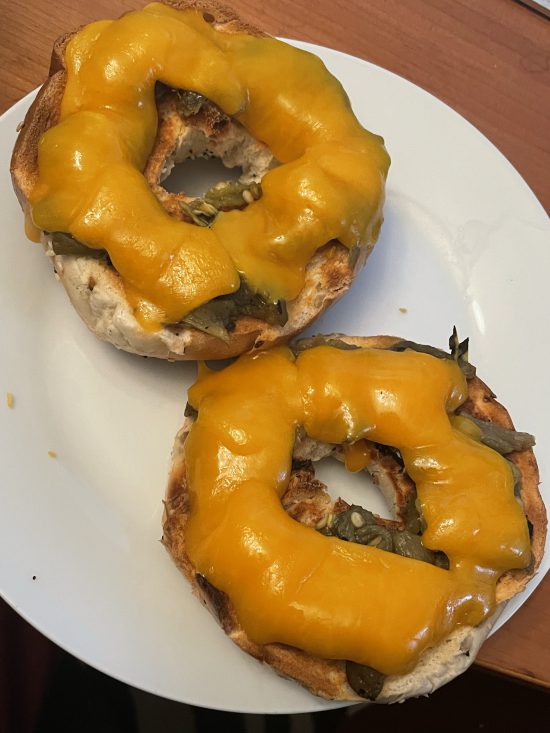
Featuring “Some guy in Albuquerque with a roaster in his garage” brand chiles! The best!

We’ve applied a lot of science to ritual cannibalism in this house, trust me. It started a few seasons ago when we had roast duck for dinner on the first night of the season when the Sharks hosted the Anaheim Ducks. The duck didn’t turn out as well as it might have, and the Sharks lost. In the ensuing seasons, the duck has been ever-more delicious, and the Sharks have won the season opener against the rival Ducks by ever-more comfortable margins. Last year, after stuffing the duck with orange quarters, we shut them out. Orange county, you see.
The science of ritual cannibalism is, therefore, irrefutable. We eat the duck, we beat the Ducks.
This year, as the home team has progressed through the playoffs, we (and by ‘we’ I mostly mean the Official Sweetie of Muddled Ramblings and Half-Baked Ideas) have explored the proper dishes required to vanquish ever-more-fearsome foes. For Nashville, whose fans throw catfish onto the ice, we ate catfish.
St. Louis was a little trickier: They are the Blues. How do you eat a musical style? We went with the color, which is slightly less tricky. We started with (yummy) Blueberry Crumble, but of course that didn’t work: we took their crumble, leaving them steadfast. We switched to a (delicious) blue cheese sauce on pork chops and never looked back.
Of course, there’s plenty of other Fan Science at work as well. Official Sweetie’s old-school Sharks t-shirt is banned from the living room at game time. When things aren’t going well, a glass of Canadian Whiskey will reverse our fortunes. The list goes on.
Pittsburgh has proven to be our greatest challenge yet. You don’t just pop down to Costco and grab a family-size tray of frozen penguin. Happily there are gummy penguins, and where there’s a will there’s a sauce.
For game one it was chicken (a flightless bird) with penguin sauce, and while it was most tasty, it was not effective. The Sharks started the game poorly, and though things stabilized after I turned to the whiskey it was too late. A heartbreak goal in the waning minutes sent our boys back to their hotel with heads bowed.
The menu for game two: Game hen with penguin sauce, with black and white rice. Really, really, tasty. Another close game; the whiskey brought the team back but they gave up a goal in overtime and were down in the series 2-0. Either game could have tilted the other direction, and while the Penguins seemed to be in charge much of the time they weren’t scoring very much. It wouldn’t take much to turn things around.
More research was required.
Thank goodness for the Internet. Sidney Crosby, the captain of the Pittsburgh Penguins and a darn good hockey player, is a man of ritual. On game day, he always has a peanut butter and jelly sandwich. Aha! we had found the chink in his armor.
And speaking of science, pork chops are a proven winner. Forget the symbolism of the flightless birds; go with what works!
For game three tonight, we pulled out all the stops for victory. Pork chops grilled outdoors with a peanut butter and jelly and melted penguin sauce. Do not cringe, my friends, it was absolutely delicious. The char from the barbecue added the perfect bitter note to work with the sweet/salty sauce. Rice and grilled green beans rounded out the meal. I wore the black t-shirt, not the gray one. Canadian Whiskey, as always, stood at the ready.
We found out not long before game time that one of the Sharks’ best young players would not be playing due to injury. Tomaš Hertl had hit the iron frame of the net three times in the game two heartbreak; had any one of those three shouts bounced the other direction the Sharks could well have won. It was going to be up to the pork chops to make up for the critical loss for San Jose.
It was a nail-biter, I have to tell you, but in the end the good guys prevailed, scoring in overtime after steadily looking more confident all game. Joonas Donskoi, or “Donkey” as we call him, slipped a shot past the Pen’s excellent net minder as the home crowd made enough noise to be heard in space.
As we celebrated at home the Official Sweetie said, “I hope we have more pork chops.”
This is a big technical discourse that ends with a restaurant endorsement. Because Agave in San Jose is a good place to be.
Today pretty much sucked. It started last night, when I ran a routine software update on the heroic little computer that brings you these ramblings. It is a Mac Mini tucked away on a shelf in a climate-controlled facility in Henderson, NV; a little machine that just plugs along year after year.
As a primer before I dive into that part of my hardship, let me take a moment to describe the UNIX world. UNIX is a computer operating system that has been copied and recopied into different kinds of Linux and BSD, as well as Apple’s Darwin, but philosophically the different flavors have much in common and share a lot of little programs. In fact, it’s all about the little programs. Each little app is designed to solve one problem perfectly, and larger applications use these underlying facilities. A graphics program could depend on dozens of underlying libraries.
So when you install one of these programs, how can you be sure all the parts it depends on exist on your system? It’s a huge chore, made much simpler by package managers. Package managers are special programs that maintain a database of who-needs-what so when you install SuperGameMachine it will automatically install CleverGraphicsLibrary, and that in turn will require StupidGraphicsLibrary, and that will require something called gl (actually the names of all these things are criminally terse, so you can never deduce the purpose from the name — CleverGraphicsLibrary would be named cgl).
Anyway, a major upgrade of ncurses just came out, and it gave me a hellish few hours. That database of who depends on what? Well, it turns out is wasn’t so complete, in the MacPorts world. ncurses had been so stable for so long that many program maintainers didn’t even realize they depended on it. The update came along and those programs were still looking for the old version. One of those programs was bash. bash is part of mac OS, but there was a massive (MASSIVE!) security hole in bash and I went to MacPorts to get the new version faster.
When you watch hackers on TV, when they’re typing cryptic symbols into their black screens, mostly they’re giving instructions to bash. Bash is a shell, which is a name for a program that takes stuff you type and does stuff as a result. For veracity, hackers in movies might compare the merits of bash and zch or tsch, but at this time bash is boss.
So when you open up a window to type those cryptic commands, it will launch your chosen shell. If you set your preferred shell to be bash, and then bash is broken, you are screwed. You are especially screwed if you don’t have physical access to the box. You try to log in, bash fails, and you sit at your terminal in helpless frustration, shouting to the uncaring gods of the night. Even if the package manager eventually sorts out the problem, you can’t get in to run the repair.
OK, this is getting long. I got through that, but there wasn’t a lot of sleeping involved. (Two bug tickets at MacPorts now closed.)
Then, today, after a rather frustrating meeting at work, I was betrayed by my bar. By my BAR! By my quiet haven in this noisy world. We had a contract — I paid a chunk in advance and got a discount on my first frosty mug of happiness on each visit for the rest of my life. I am not dead yet, but new(ish) ownership of Rookies Sports Lodge says it will no longer honor the deal. Should I shout? Threaten? Walk away?
It’s going to take some doing to make today come out right.
So here I am at Agave, the neighborhood cantina, and things are starting to feel better. I am working up the vocabulary to make sure that the official Muddled Sweetie gets her chicken burrito smothered with lots of good stuff. None of the English-speaking staff seems to be on tonight.
But make no mistake, these guys here make good food, for a good price. The menu now has many prices lined out and raised with a ball-point pen, but those big-ass burritos still hold the price line. And even the new ball-point prices are a steal. There aren’t many places in this town where my internal cheap bastard and my internal gourmand can party together, but this is one.
Waiting for the food, sippig Negra Modelo, listening to music with bright trumpets and tight vocal harmony, things are starting to feel better. I’m gonna be all right.
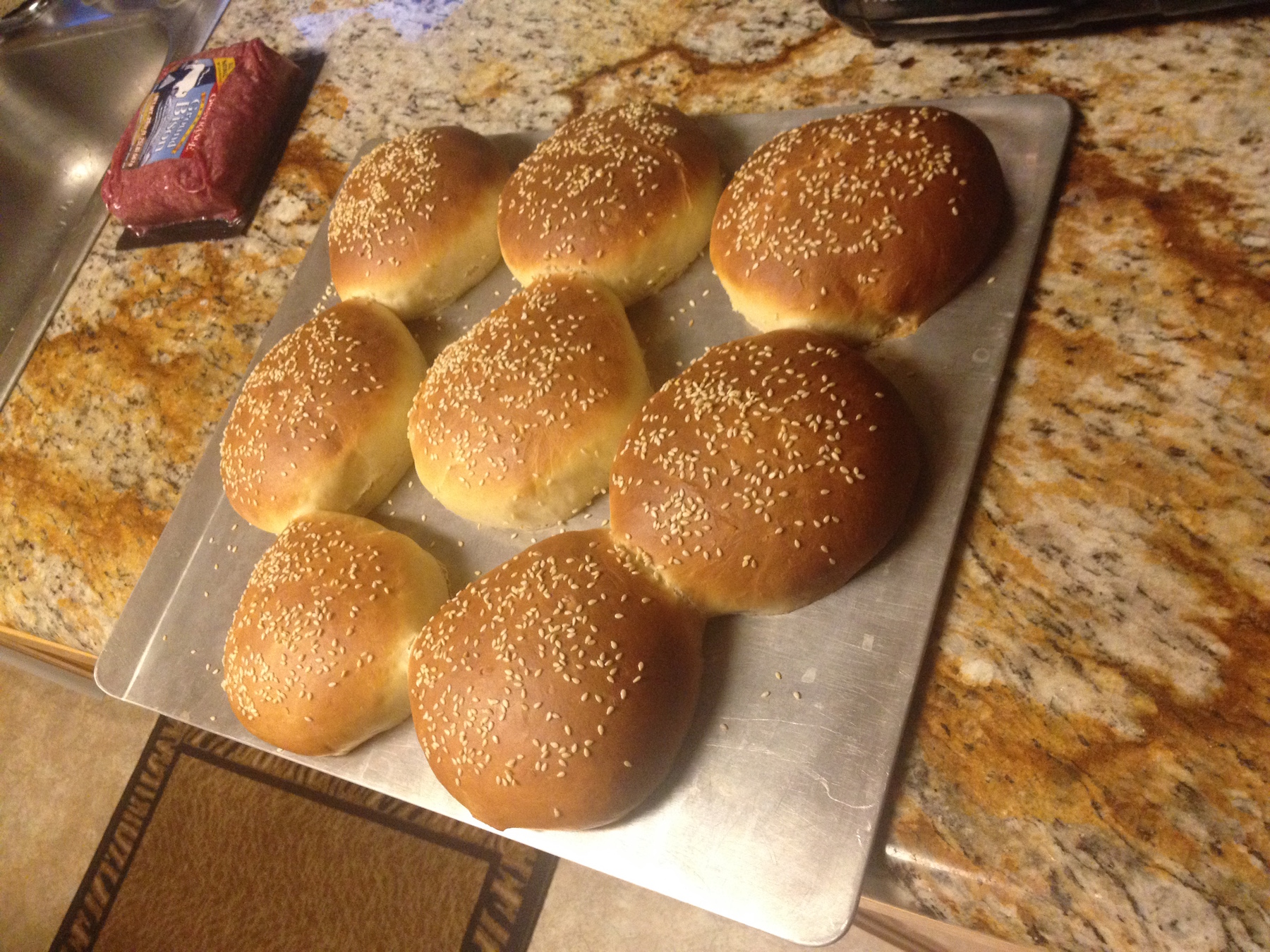
I mentioned to the light of my life that I was craving burgers to replenish my strength after my last (for a while) visit to the colon doctor.
For most people, the response would be, “where do you want to get them?” Not so my sweetie. Her response: “I’ve been wanting to make burger buns!”
And so she did.
It’s time to revive Space Food Sticks.
There are few things better than fresh tomatoes straight from the garden. One of those better things is several different kinds of fresh tomatoes gracing your summertime entrée, all fresh-picked from within thirty feet of where your dinner plate is.
I didn’t count how many different kinds of tomato we had tonight; there are ten different varieties growing out in the back 40, but they’ve never all had ripe tomatoes at the same time. But tonight there were definitely several types represented, and they were all delicious.
When I was a kid I didn’t even know there were ten different kinds of tomato. The growing interest in pre-industrial versions of the food we eat is definitely a happy thing. And healthy, too.
“What should we have for dinner?” my sweetie asks me fairly often.
“Um…” Think! What haven’t we had lately? What complements the weather? Do I have a hankering for something? How much work will it be to prepare? “… chicken?”
“OK, how about chicken with a buttery-garlicky sauce and spicy mashed potatoes? We can have a salad later. Would that be all right?”
Would that be all right. My sweetie is funny sometimes. So after the anguished seconds it takes me to simply name an animal, she dashes off a complete menu that she pulls from thin air, along with a schedule.
I’m eating well these days.
When telling a story, it’s important to know where to begin. Do you start at the temporal beginning, the moment when, confronted with an idea so mind-bogglingly awesome, so blindingly obvious in retrospect that it must be the work of genius that you lose the power of speech? Or do you start at the other end, a day later, with the moment of truth when that idea faces reality and your own personal test begins? Or do you approach the story sideways, beginning with the thought that defines what it all means?
Or do you find three sentences, one for each of those moments, and let them tell the entire story — a tiny play in three acts:
“Peanut butter banana bread,” she said.
She set the two slices of banana bread — one chocolate, the other peanut butter — in front of me and said, “I really need you to be objective for a minute.”
I laughed and said, “I didn’t think I could love you more than I already did until you said, ‘peanut butter banana bread.'”
“Enjoy your hot sandwich” the sticker on my breakfast said. Unfortunately, I failed to follow directions. I did not enjoy my hot sandwich. Despite a rather good supper earlier in the flight, and sevaral tasty things that accompanied the hot breakfast sandwich, the sandwich itself was so ** that the presense of mushrooms only made it a little bit worse.
I expect the sticker was intened to serve as a warning. “Caution! Hot!” is not nearly as friendly (but easier to comply with).
**: still searching for just the right word. it seems that airline breakfasts the world over feel obligated to include some sort of hot egg-based food product. The person who finally comes up with a breakfast product that can be reheated in a microwave, includes egg, and is not so laden in fat (in this case cheese, butter, and oil on a croissant-like bread product) that you start to feel shiny just looking at it, will make a mint. The **ness of the modern options is so oppressive that a token mushroom or two will just vanish in the palatal goo.
Accompanying the sandwich was a cup with a foil lid. On the lid it said (something like) “Breyer’s Premium Smooth And Creamy Extra-Rich Low Fat.” I wondered if anyone in the hype department at the company noticed that they left off the nature of the product itself in their haste to pile on more superlatives. So many adjectives, no noun. (It was yogurt, by the way, and exceptionally good yogurt at that.)
After I wolfed down my breakfast I closed the box it came in (per instructions) and there on the top was the quote “All happiness depends a leisurely breakfast” attributed to some guy named John Gunther. Hm… should have read that instead of the thing about enjoying the hot sandwich.
I’m sure other people have already thought to be afraid of this, but it’s new for me. I was thinking about genetically modified foods the other day, comparing them to newer, faster computers. It’s not the end consumers who benefit most from either technology; in the case of computers it’s the software and OS developers who win. For genetically modified foods, it’s the farmers and the big agricultural companies who benefit the most.
Sure the end users may benefit indirectly from having more awesome small-shop applications to try (modern power-hungry operating systems are packed with features that make creating robust applications simpler) or less pesticides on the food (plants can be modified to fight back agains pests), but for the most part people are not getting much of a perceptible lift.
Sometimes the practices of the big agribusiness companies like Monsanto don’t even help the farmers. They have now created versions of their big-selling products that don’t reproduce. That is to say, a farmer can’t keep some of his crop from one year to use as seed the next. He must go back to the big seed factory each year if he wants to grow crops that have the other benefits that make his farm profitable. (My information on this is actually a few years old; I don’t know what has happened since, so I might be totally wrong. That happens fairly often.)
I promised at the start that I would give you a new source of fear, and I’m a man of my word. Here’s the scenario: Farmers grow crops that can’t be used as seed. Then Something Happens, and the agri-giants are unable to create seed crops, either. It could be something as simple as bankruptcy or a corporate move to manipulate seed prices. It could be some sort of genetically engineered snafu if you want to Fear the Machine while you’re at it. Whatever mechanism you want to invoke, suddenly all these high-tech seeds that the farmers were counting on are not there. In their place – nothing. As winter comes farmers are reaping a record harvest they can’t replant, and they already know that there are not enough seeds for spring. Not nearly enough. Then what?
To make the story scarier, it would be best to wait until the agricultural giants are more entrenched in developing countries as well, but even if it happened now it would be something to worry about. Worrying is one of the things I do best.
The Easter Bunny paid a visit last week, leaving a treasure trove of yummy goodies on my nightstand. For whatever reason the leporidal spring icon snubbed my sweetie's nightstand, but being the guy I am, I'm happy to share. Thus it came to pass that we found ourselves with Peeps and chocolate bunnies to munch. As we contemplated our sugar-laden feast The Light of My Life looked at me with round eyes. "We have graham crackers!"

Cracker, bunny head, and peep, ready for the microwave
As every red-blooded American knows, marshmallow+chocolate+graham cracker = s'mores. Traditionally smores are eaten around campfires, where one heats the marshmallow over the flames and then wedges it into a sandwich were the hot marshmallow softens the chocolate. We lacked a campfire, and used our trusty microwave oven instead.
Many of you may be aware of what happens to marshmallows in a microwave. With Peeps it's even better. Let me tell all of you now: Drop whatever you are doing, go to the store, buy some peeps, bring them home, and put one in the microwave. Do it! I'll wait...
You're back? Great! Wasn't that the funniest thing you've ever seen? Ever? Unfortunately, my attempts to photograph the peeps while in the microwave failed, so those of you who did not drop everything to put a peep in the microwave will just have to perform the experiment later.
Once the peep and the chocolate were all gooey and yummy we slapped on graham cracker lids and sat in front of the television stuffing our faces with sugar. And that, dear readers, is what Easter's all about.
For the next couple of days we will be holding the official ceremonies to commemorate my sweetie’s embarking on her fifth decade of life. Heady times! Yesterday I got to meet a sister-of-sweetie, one I had not had the pleasure of meeting before, and tonight we will be gathering at the parent’s house for The Casserole.
I’m not sure what The Casserole is, but when the light of my life mentions it I can hear the capital letters.
Back around 1959 or soon thereafter, the powers that be in the Czech Republic were looking for something to do with some sort of caffeinated byproduct of the coffee roasting process. They turned the problem over to a chemistry lab which developed KOFO syrup. Shortly thereafter Kofola was born, and Eastern Europe rejoiced that their children could also rot their teeth on carbonated sugar water.
Kofola boasts some 14 “natural” ingredients, and while the various references agree on the number, I could find no list stating what all of them were. The Wikipedia article (and the dozen other places that quote Wikipedia without citing it) focuses on things like apple extract, while others mention cardamom and licorice. They are proud to have less sugar than Coca-cola (almost certainly beet sugar in Kofola’s case), and essentially the same amount of caffeine as Coke, which is pretty tame by today’s standards.
According to the boys at Kofola, they are every bit as popular as the American invaders, but in my personal experience I don’t see how that could be true. Maybe it’s a city-country thing. More likely it’s a generational divide, and the people who drink Kofola were the ones who learned to like soda when the western options were limited. Among the people I know, however, Kofola drinkers are rare enough that in my years here I had never tasted Kofola. I decided this was one of the things I had to do before my return to the US.
I went to the corner store to buy a small bottle of the stuff. While I stood scanning the soft drink choices I noticed that the 2-liter bottle was the same price as the 1/2-liter bottle. Hm… I paid my money and hauled the big boy home. After all, if I liked the stuff, I wouldn’t want to regret not getting more for the same price.
I held my anticipation in check, deciding that my first taste of the stuff should be chilled. I wedged the bottle in the freezer next to the carp and waited. Before long I felt tired so I moved the drink from freezer to fridge and went to sleep.
The next morning I was up at the crack of midmorning and ready to try Kofola. I poured a glass, sniffed, swigged. As you might recall from the title of this episode, Kofola isn’t very good. I can also say that it defies description. Anyone who buys into Dr. Pepper’s claim as the most original soft drink in the world has not had Kofola. Perhaps if the communists had asked a kitchen to develop the syrup rather than a chemistry lab things might be different. Perhaps. Perhaps the recipe is “the fourteen things they had a surplus of in 1960.”
Now I have in my refrigerator most of two liters of Kofola (I had a second glass of the stuff to see if it might be one of those flavors that grows on you), and two carp. In the spirit of Communist Czechoslovakia, perhaps I should find a recipe that combines the ingredients I have a surplus of. CArp au Kofola, anyone?

