Shorn!

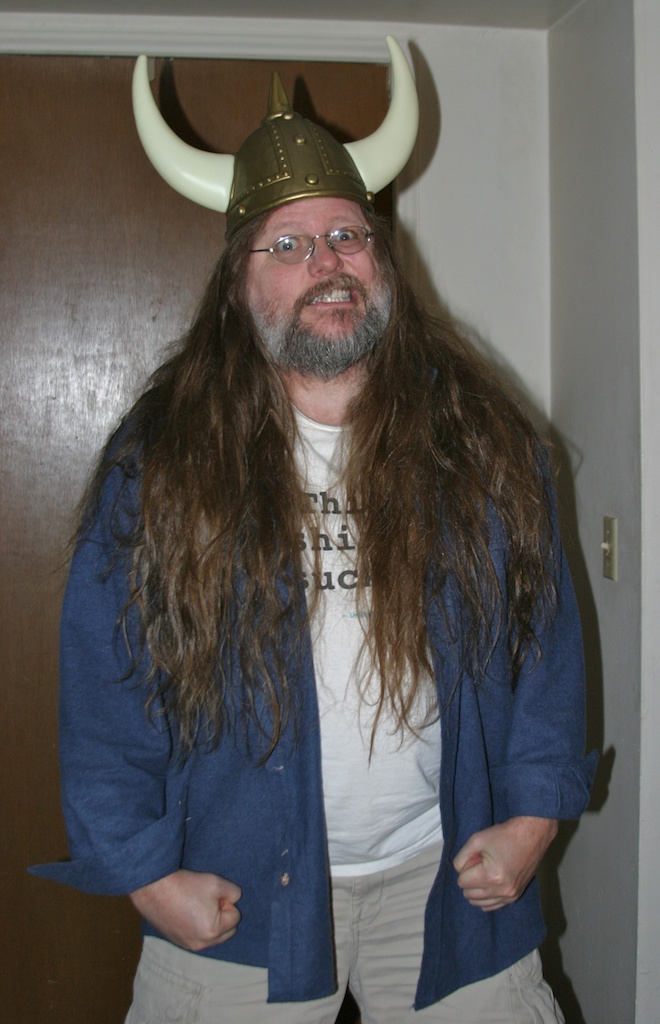
Here’s a picture of me taken yesterday:

Yeah, buddy, that's his own hair.

Pretty stylish, eh?

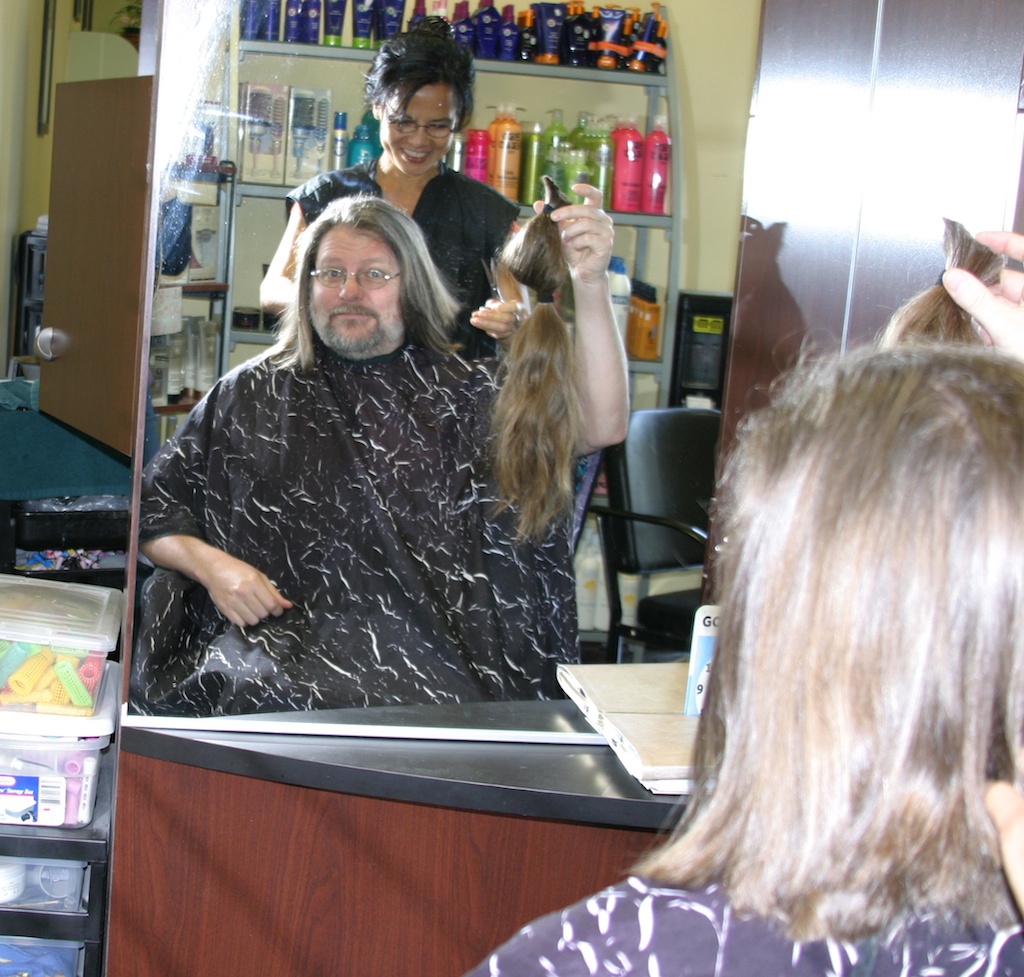
Here I am this morning:

It's going to be a wig!

And shortly thereafter:

Soon thereafter

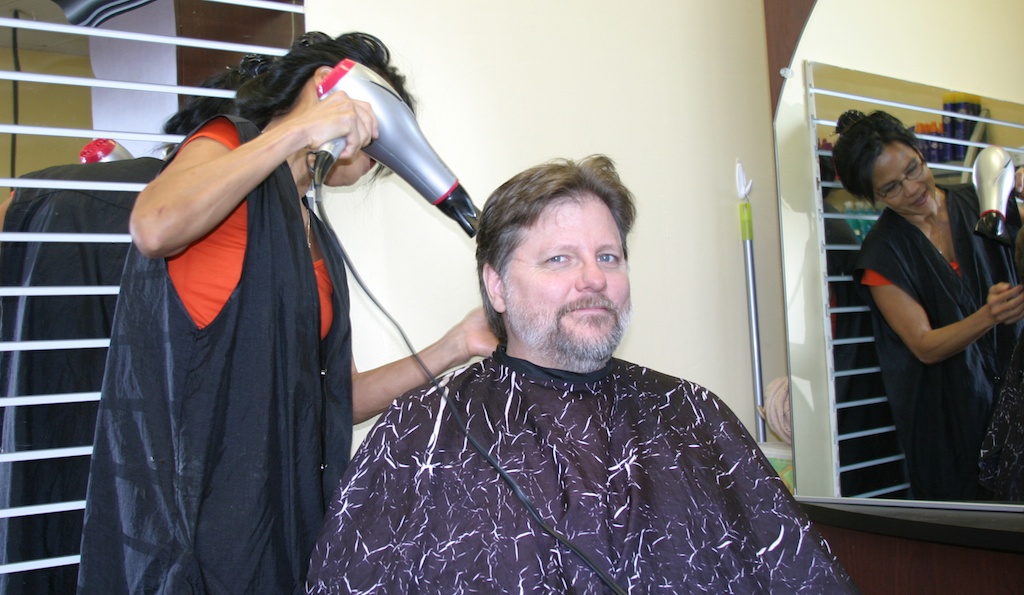
This is what I look like now.

Almost respectable! I don’t think there’s much more to say. Thanks to everyone who participated in the fundraiser. Maybe I’ll do it again in a few years.

1

An Admirable Man

A pal of mine threw a link my way. In that article was this link to an article about the man who made Foxconn. He’s compared to Henry Ford in this article, but I don’t think that’s apt. Ford seemed much more interested in the social effects of his industry.

I wrote the title of this episode with full irony, but there really is a lot to admire about this guy. Not long ago, we would label Gou a classic success story. It is a luxury we now enjoy that we can better calculate the cost of one man’s success against the lives of others. That’s a good thing.

On the last page of the profile, we learn that Gou is diving deeper into China, to chase cheaper labor. It felt a little creepy to me at first, but there’s no reason for that to feel any different than anything else he’s done. In the end, it’s all a little unsettling.

You Say that like it’s a Good Thing

I think I might have mentioned this before, but it’s just getting worse. I’m not sure I’ll ever be able to buy a new car again.

“Look at all the shit we’ve packed in!” the marketers brag. “Techno-gizmos out the ass!”

I work for a techno-gizmo company, and I’m not against techno-gizmos. In fact, I’ve got a gizmo in my pocket that would make Spok weep. It works in my car, so I’m already set, techno-gizmo-wise.

I don’t need:

  • A backup camera
  • Someone to unlock my door from far away
  • Electric windows
  • voice-activated command center
  • phone
  • electric locks
  • ass-cushion airbags
  • dvd player
  • heated seats
  • automatic parallel parking
  • Multi-zone climate control
  • gps
  • etc

To me, all those things add cost, weight, and new points of failure. They do not improve the actual car, or its ability to move me between the proverbial points A and B. They are things I have to pay for that later I will have to pay to fix. (I have a feeling in my gut that a GPS failure will somehow cause my tires to deflate, or the turn signal will go out and I’ll have to pay a thousand bucks for some hoobajoob module.)

Ironically, the only cars I know of without all that crap are high-performance supercars. I can’t afford a car without the accessories. I think that is a reflection of their actual value.

1

Don Quixote

Back when printing was young, fantasy stories were all the rage. They went by the name Chivalry Tales back then, and followed a well-defined formula involving stout hearts, unrequited love, and great feats of heroism against mythical beasts and evil sorcerers. Good fun.

Sometimes following a formula can be a good thing, allowing a reader and a writer to get down to business with little wasted verbiage. Interesting characters can make the formula worthwhile, and even in suspense novels there’s really not much question who’s going to win in the end. It’s about providing an enjoyable journey. There just aren’t that many plots in the world, when all is said and done; you can argue that every story follows one of a limited set of formulas.

On the other extreme, there’s “literary fiction”, the genre defined by the resolute insistence that it’s not a genre, the more extreme practitioners of which often take avoidance of formula so far that they also avoid having any plot at all. Whee.

But, even if formula isn’t necessarily bad, ‘formulaic’ is. If a story is just another rehash of the same old shit with no new twist or compelling characters, it’s not fun, and just confirms to the literati their snooty contention that all formula is bad. Jerks.

What do you do if you’re surrounded by mediocre fantasy novels? If you’re someone like me, you make an online scoreboard and fiddle with a parody called The Quest for the Important Thing to Defeat the Evil Guy. If you’re Miguel de Cervantes, you write Don Quixote. (Yes, I just said Quest and Quixote are siblings. You got a problem with that?) In Don Quixote, there is a scene in which a few of the more rational characters burn copies of many popular titles of the day, with commentary. A few they preserve. Let there be no doubt that this novel intends to disparage the knock-offs. The dude names names.

As a thought experiment, I repeated the book-burning scene in my head, substituting some of the bigger titles from the modern fantasy library. It was pretty fun. A few titles survive, by virtue of history or quality, while many are mocked and burned.

When I first loaded Quixote onto my readin’ machine and opened the virtual cover, I saw how big the sucker is. Holy crap, 1500 pages! It’s in two parts, separated in publication by several years. Interesting story — Cervantes kept talking about writing a sequel but he was too busy trying to transform theatre (without success). Then someone else published a sequel to his story and that lit a fire under his ass.

How do I know this? Because the very long book is prefaced by a very long introduction by the translator. He discusses other translations, their strengths and (mostly) shortcomings, and that was pretty interesting. He mapped the change in the perception of the story over time. He also argued that the story’s just plain funnier in its original language, as Cervantes has a terse, laconic wit that Spanish expresses particularly well. (While a chicken-and-egg argument might be fun here — does the language shape his humor or the other way around — the point remains, his jokes are tuned to the Spanish ear.)

When looking for an edition to link to here, I chuckled when I noticed that Amazon sold a “Spanish Edition” of the novel.

As fun as that part of the introduction was, things got really interesting when we came to the biography of the author. Cervantes was one remarkable dude, in a way I’ve been completely unable to capture in one or two sentences. He wasn’t put to death even after his third attempt to escape from an Algerian prison. I’ll leave it at that.

So, the story. It’s big, as I mentioned before. We meet an aging man of modest means, who has come to believe all the chivalry stories he has read as literal truth. The stories are, in fact, more true for him than anything else, and all his perceptions are filtered through the conventions of the fantasy story. The famous windmill incident happens early on, and is fairly minor, in the scheme of things, though it doesn’t go well for the good Don Quixote.

In fact, nothing goes well for him. His campaign to right the wrongs of the world is a series of disasters. Some of the mishaps are funny, some are merely sad. Other people suffer as a result of his delusions. Then there’s faithful Sancho Panza, his squire. Sancho, filled with dreams of inheriting an island kingdom following the inevitable triumph of his master (that’s how these things work, after all), follows Don Quixote (sometimes reluctantly) and receives his own share of abuse. As the story progresses and Cervantes gains more confidence in Sancho’s voice, his comments become both subtle and cutting, while maintaing his aura of simple servitude. It’s the sidekick that makes this story an enduring tale.

How many times do you have to be kicked in the face before you give up your quest? Don Quixote’s saving grace is that he will not, he cannot, give up. I suspect that many of the mythical heroes he compares himself to would have long since packed it in and gone home, faced with the downturns Quixote has faced. But on he goes, because hardship merely proves the worthiness of the cause. It’s not supposed to be easy. If he weren’t a nut job, he’d be pretty easy to admire.

Coincidence is a mover in this story. In the end, everyone who matters winds up at the same inn, and hijinks ensue. Blake Edwards made a living off this sort of stuff a few centuries later. Thinking about it, I’d be interested in seeing what someone like Edwards did with the story. (This translator did mention that Don Quixote suffered for centuries perceived as merely a bawdy farce. It seems now I’m proposing returning it to that low regard. But it would be fun.)

There are sonnets in this book. Lots of them. At first I didn’t know what to make of all the friggin sonnets. Then I realized that they’re part of the parody. The old chivalry tales are silly with sonnets. But… these are almost good, to my ear. It’s with the sonnets I felt the gulf of language and time most profoundly. Are they hilarious? Merely awkward? Over the top? Filled with contemporary references? Makes me want a time machine and a babel fish.

I wonder about the translation on a couple of fronts. Translating a work of literature from one language into another is difficult enough, but this translation has to cross centuries as well. In this version, uneducated commoners speak in what today comes off as really upper-crust language, and it’s ponderous and hard work to read. “Thee” and “Thou” abound. Regular folk in this story don’t talk like regular folk do here, now.

I contend that if Cervantes wrote his story today, in English, the word “fuckin'” would be in it. While adding a word like that would be an extreme liberty on the part of a translator, I don’t think it’s going too far to make regular guys back then speak like regular guys today. It would be a conscious decision by the translator to move the story across time as well as borders, but I think the result would more closely mirror the experience readers had back then. There’s an extended poop joke, for crying out loud, and the word ‘shit’ does not appear in this translation. I didn’t bother searching on ‘turd’. I might have used ‘steamer’, were it up to me to translate. The aromatic qualities come into play.

I’m done with part one, a bit less than halfway through the monster. The opening notes indicate that the translator at least thought part two was where Sancho really got going and that it is the better half of the opus. I’m… not eager to continue at this time. I will read the rest someday, I have no doubt. But not yet.

Note: if you use the above link to buy this book (or a Kindle, or a new car), I get a kickback. You should also know that if you have an electronic reading device, you can download this sucker for free. I chose to link to an edition with illustrations; I don’t know if it’s the same translator.

Another Indication I Have it Pretty Good

When my sweetie asks, “would steak be all right tonight?”

1

Machine

I am a machine
opinions and facts, without
the heart I once had

3

Welcome to a More Beautiful Web

That’s Microsoft’s new slogan to promote Internet Explorer 9. This could also be written as, “welcome to the Web everyone else has been seeing all along.”

I don’t have to support Internet Explorer when I build Web sites. That’s pretty nice. I don’t even have to support Firefox (mostly). When I’m interviewing prospective employees, their eyes light up at the prospect of writing to standards and not being limited to what IE 7 supports.

So on behalf of my peers out there who don’t have the luxury I do, allow me to get behind Microsoft on this campaign. Please, if you have to use Internet Explorer, upgrade.

And if you still use IE 6 (I’m looking at you, Asia), maybe it’s time to let go.

The Mighty Have Fallen, tv Edition

Tonight I saw an ad on one of the silent tv’s that surround me, which prompted me to search ‘John C. McGinley broke’. I suppose it’s a credit to the robots that bring us information that I got plenty of references to the actor’s performance in Point Break. But that didn’t answer the question, “Why does a guy who had a lead role on tv for years have to do an insurance commercial as an anonymous father figure?”

Interesting note: when I plugged the quoted phrase above into the Google Monster, the top hit was Cher.

My sweetie is a fan of McGinley, and I certainly respect his “I’m an asshole deal with it or go away” persona on Scrubs. To see him in a throwaway role in a thirty-second spot makes me a little queasy. They didn’t cast him for his history or his fame, he’s just a dad in a commercial, a role he might have been excited about before he was in feature films and had a long run on a successful tv show. Now, watching that spot, I have to wonder what happened.

It’s possible, I suppose, that the writers and producers of the ad said, “Yeah! We got Jonh C. McFuckinGinley!” and went on to write a script that utterly failed to harness his charisma or even nod to his previous roles. He might have walked out of the shoot saying to himself “Holy shit that was a disaster,” sensing that everything he had built was about to be torpedoed.

Hoping that the above might explain what happened, I resolve to be more tolerant of actors reputed to be ‘difficult’. (This dispensation does not extend to actors who can’t be bothered to be on set on time.) I wonder if, had McGinley been a little more difficult, if he had insisted on letting his acting chops show, whether he could have forced them to make a better ad.

Alas, I don’t think that’s the case. I think McGinley did this commercial so he could make his next mortgage (or cocaine or whatever the bugaboo is in Hollywood these days) payment. It’s such a career downturn nothing else makes sense. The dude is a seriously good actor, but maybe he did his Scrubs role so well that people aren’t going to let go. Advice to John C.: Bad Guy in a (well-written) psychothriller. Take that ire, compress it, understate it, and slide out evil. Mellow, likable evil, the kind that makes the audience wonder if you’re actually the bad guy.

You could kill that role, Mr. McGinley. And a character like that can buy you several years on tv. After that you won’t have to prostitute yourself in a dumbass commercial ever again.

Wait…

First-Name Basis

The marketers of pop icons understand this: When the world knows you by only your first name, you win. Pop stars resort to contrived names to achieve this goal; I’ve never met any other Madonnas or Beyonces (I know there’s an accent in there somewhere). But then there’s Steve. Where I work, you say ‘Steve’ and there’s only one person you could be talking about, and he doesn’t even work there anymore. We also have Jonny, Tim, and Peter.

Peter may only have first-nam mojo within the finance group, but where I sit, when I hear “Peter wants this by Friday” there’s no question of who Peter is and there’s no question of when the project will be finished.

Tim. Peter. Steve. Jonny. Simple, non-manufactured names that have reached their stature by earning the respect of tens of thousands of people. There’s not a Jerry here. Yet. First I have to get that thing done for Jodee by next Friday.

1

Selling the Moon

In less than twenty-four hours fuego pointed me to two news articles that directly affect my plans for building a hotel on the moon. The first was about a space elevator, and I was excited until I realized that the company involved hadn’t progressed past the press release stage of research. It was nothing more than attention whoring. Carbon nanotubes are the material du jour for building this thing, and when mankind can build them economically I expect we’ll have us a space elevator. That makes me happy.

Except for the problem of the huge transverse force at the base of the elevator to conserve the angular momentum of the Earth. As we move stuff up the ladder, the Earth has to slow down. Not much, but a little. The force to slow the Earth is transmitted through the base of the cable. Our friends the nanotubes are really strong when you pull them, but will snap like toothpicks when stressed to the side as the elevator car rises.

I really want to think of the answer to that one.

Meanwhile, fuego sent me a link to another credulous article, this time about robots which could build structures on the moon, using the materials at hand. Well, duh. You’re not going to carry bricks to the moon to build your house, you’re going to use the materials that are already there. Also, it makes complete sense to have a robot do the work. There is a cool video of a wall-building robot. Apparently the breakthrough that inspired this particular article is an animation of hypothetical robots building hypothetical structures on the moon. Wow! That’s some serious progress! I do note in the animation, however, that past the perimeter wall, the lunar landscape is untouched.

The first moon colony may not even have windows, and even if they do, the inhabitants will likely cover them up, because the construction scars that dominate the landscape will outlive mankind. The first house on the moon will have a view of a junkyard. On their days off the first lunar inhabitants will say, “Let’s go find someplace without footprints.”

They will go to my hotel.

1

Remembering Topstar

This is how far I got before I realized that the idea in my head wouldn’t fit in a short story.

Despite the altitude, it was too hot to sleep. Jor lay on his back and stared up at the stars. The captain had told him what would happen to the sky as they traveled, and while Jor had believed him it was a different thing altogether to see it for himself.

Topstar was no longer directly overhead. It was a little off-kilter, revolving drunkenly around the place in the sky it used to hold. The sun, too, was behaving strangely, dipping and rising as if a year passed every day.

The captain was moving carefully in the unseasonal darkness, stepping over the loose rocks that covered the slope. He crouched down next to Jor. “Drink some water, son,” he said, offering a tin cup. Jor took it and drank greedily.

“Thank you, sir.” He returned the cup.

The captain nodded and stood. “Be ready to march in an hour,” he said.

“Yes, sir.” Jor scrambled to his feet, his hand on his hat to keep it from blowing off. “Have you informed the naturalists, sir?”

The captain smiled and put his hand on Jor’s shoulder. “I thought I’d let you do that.”

Jor managed not to flinch from the contact. The farther out they got, the more familiar the captain became with his men. Jor managed a nervous smile. “Yes, sir.”

Jor watched the captain move on to the next soldier and gathered himself for the coming confrontation. Somehow dealing with the naturalists had become his job. They were like children, demanding yet ignorant of the smallest hazards of the wilderness.

The canvas tent that dominated the center of the plateau shifted and strained at the moorings that held it in place. Uncousciously Jor rubbed at the welt on his arm where a rope had whipped across his skin while he and the others had erected the damn thing.

The tent was bad enough, but Jor reserved his hatred for the scientific instrument which lay inside. He stepped through one set of flaps and then another to reach the still air within. The naturalists huddled around the apparatus, talking quietly. Even though their voices were civil, Jor knew they were arguing. It seemed to Jor that was all they ever did.

The “instrument”, the subject of Jor’s ire, towered over the three figures huddled around its base. Whoever had designed the instrument was clearly not worried about having to carry it. The four legs of the pyramid were heavy iron pipe, with solid spikes to drive into the earth to anchor the frame. From the peak of the frame a weight was suspended from a cable, hanging almost to the ground. The pointed end of the weight swung inside a circle of dominoes. As time passed it would knock over a new tile, progressing slowly around the ring.

“Excuse me, sirs,” Jor said.

They stood and pretended like they hadn’t heard him come in. The old one with the beard sighed heavily. “Hello, Jor,” he said.

“Time to strike the instrument. Captain’s orders.”

The youngest naturalist, barely older than Jor, said, “Please tell the captain we need just a little more time.”

Jor shook his head. “I’m sorry, Professor Hod. Captain wants to move by, um… spring. So we have light.”

“Please. Tell your captain that this is an unprecedented opportunity to calibrate our measurements. We’ve never been so far out and still able to see the sky. A little more time here will make the rest of the expedition much more worthwhile.”

Jor tried to look sympathetic. “Captain’s orders,” he said.

The bearded old guy, Professor Timkin, spoke up. “The captain does not understand science.”

“Are you asking me to explain it to him, sir?”

Timkin laughed. They were friends when the naturalists wanted something. “Fair engouh, Sergeant. But this really is important.”

“You said you would need 50 hours. It has been 60.”

“We thought that would be enough. But some of our measurements are unexpected.”

“It’s the altitude,” Hod said.

“I think not,” Timkin said. To Jor he said, “We need more time. Important measurements, you have to make many times.”

The third naturalist spoke at last. “It’s pointless,” she said. She looked at Jor with unsettling intensity, her black eyebrows pulled down over her eyes. “This one is powerless.” She turned her gaze on old Timkin. “And the instrument is limited. We’d best bank what little goodwill we have for when things get difficult.”

Jor was surprised to find an ally in Professor Rej. He was powerless, after all, and was happy to have that recognzed. Unfortunately Rej had already squandered her goodwill, both with the soldiers and, Jor suspected, with her colleagues. The naturalist just didn’t seem interested in what people thought of her.

“Two more hours,” Hod said. “Jor, you can tell him.”

Jor thought he caught Rej rolling her eyes and almost smiled. “I’m sorry, sirs. We will begin striking the instrument in ten minutes. If you can convince the captain before then, I will be happy to not carry it for a little longer.”

A couple of notes:

Originally the three naturalists were all men, but I decided to skew the story a bit toward the old adventurous science fiction, with the obligatory female and inevitable repercussions (some of them not-so-old school). I’m picturing hostile natives, continuously worsening conditions (constant horizontal hot rain), lots of soldiers dying, equipment abandoned, and a collapse of discipline that leaves the female singularly threatened. Meanwhile, the commander is going slowly mad, driven by dreams of conquering the south pole. He’s not turning back for any reason.

I am particularly happy with Jor calling morning ‘spring’. I kept the names short, thinking that might reflect a culture with a low population. I think of the names I came up with, however, ‘Hod’ is the only one I like. Rej I like, but in English there’s no simple unambiguous spelling. It’s a soft j; in Czech it would be Redž.

1

The Poetic Pinup Revue

I like words carefully strung together to create a new thought. I like beautiful photographs. Harlean Carpenter (who is a fiction) has, with a little technical help from me, created a magazine that exploits the synergy between the two.

Even as I helped assemble the magazine, I avoided reading the poetry. I wanted my first impression to be when my head was in a poetic place, that elusive region where metaphor is reality. Turns out in my current day-to-day life that doesn’t happen as often as I’d like. At last, a couple of days ago, I quit waiting to stumble into that place and just picked up the damn magazine and cleared my head.

And it was good.

I knew already that there were some amazing photographs. I’m happy to report that there are some good words as well. I have to be honest, there were some poems that left me flat, but come on, it’s poetry. Given something like 30 poems, there’s no way I’m going to agree with Harlean on all of them. But, dang. There’s some good shit here. If you read it, you will agree, although you might choose different poems.

And then there’s the photographic work. Dang. I’ve got a long way to go.

Looking at the final product, a few lessons emerge.

Lesson one: There are typesetting errors in one of the poems. One of my favorites, in fact. My “I don’t want to read until the time is right” attitude robbed the publication of a crucial proofreading step. Just know that I love bundt cakes but I don’t know why. (Note: if we order more of the first issue, we will fix the error. If you’re of an ‘I knew them when” frame of mind, you want to get in on the first printing.)

Lesson two: Putting your magazine on maximally heavy paper affects the way the middle pages are trimmed. They’re cropped closer to make the magazine pages line up when it’s closed. On a side note, heavy paper feels great.

Lesson three: When two poem/photo combos share a spread, pairing up similar pages leads to ambiguity.

Lesson four: Trust yourself more than you trust the Canadian Post. This is the biggest lesson of all. Don’t put out what you think people want, stand true to your vision and put out something you love. I can hold up a (surprisingly heavy) object that I helped make real. I flip through the pages and I’m both inspired and humbled. This is a singular vision, the kind of thing the corporate fashion monkeys dream of creating.

Lesson five: Don’t trust the Canadian Post.

1

Marketing the Fundraiser

Many people who read this blog have contributed to the Muddled Fundraiser for Locks of Love, an outfit that provides a semblance of normalcy for kids undergoing cancer treatment. In a nutshell, it boils down to this: when the donation threshold is met, I’m donating my hair. I have a lot of hair.

While you guys have been great, my efforts to drum up support in my workplace have not been as successful. It’s a different medium, and by the time I realized that the poster I put up outside my cube failed to emphasize the fundraiserness of the endeavor, it was too late. People had learned not to see the sign.

But I work at a technology company, by jing, and technology can help. Starting Monday I will have my iPad hanging outside my cube, with the following sequence of images running in a continuous loop, using the ‘picture frame’ feature. (That way I can let the pictures run without unlocking the iPad itself.)

I’m not putting the images up here at full size, and I may go back and change the font and the size of the text, but I thought I’d share my handiwork to date.

[photofade time=’10000′]

A couple of notes: Yes, I’ve fixed the error with the chopped-off line of text. I’ve got the cycle time set at ten seconds per picture here; I may lengthen the time for each image in the actual presentation. And finally, this thing looks great on an iPad screen.

If you haven’t donated yet, well, it’s not too late!

Do Not Attempt

One of the best things about modern advertising is the fine print. This is the craven cover-your-ass verbiage that expensive lawyers advise their clients to put under an ad to limit the advertiser’s liability. Here is a list of things I’ve been advised not to do:

  • Drive down a ski slope and do a barrel roll on a big jump.
  • Erect an enormous structure with a narrow track and drive through flamethrowers high above the desert floor.
  • Eat while lying on my back.
  • Pull a trailer.
  • Drive on Highway 1 at a reasonable speed on a sunny day.
  • Drive in an empty warehouse.
  • Drive on a city street at night.

Some of those things would be pretty stupid (and expensive) to attempt. Yet if I were to take all the automotive admonitions seriously, I wouldn’t be able to drive anywhere, ever. The sum of the auto warnings is, “Don’t use our product.”

Last night an ad reminded me not to drive very fast in a straight line on an unused runway, but oddly neglected to admonish me not to release a wild cheetah without taking measures to protect myself.

The ski slope barrel roll warning was actually phrased playfully, with the implied “yeah, we know this is ridiculous, but we’re going to do it anyway.”

People will blame our litigious culture for these silly admonitions, but except for a few well-publicized (and usually misrepresented) cases, I don’t think someone sliding a pickup truck down a ski slope has much hope of suing Toyota, warning or not. I think there’s a culture of fear that makes boardrooms timid, just as parents drive their kids to school despite ample evidence that the kids are better off walking. It’s all about worst-case thinking.

Who benefits from that fear? Some guy on retainer to Mazda who gets paid five thousand bucks to look at the latest ad and say, “Put ‘Professional driver on a closed course. Do not attempt.’ at the bottom.” Based on Mazda’s lawyer not altering the text to mention angry carnivores, I wonder if he even watched the ad before submitting his careful analysis. What does Mazda get in return? The VP of marketing can tell the board “we asked a lawyer” if someone gets upset.

My strongest argument for why this is corporate cowardice rather than a reflection of our litigious society lies in Hollywood. There are no disclaimers in movies. Stupid people have died replicating stunts in movies. There was a movie where people lay on the double-yellow in the middle of a road. When a kid died replicating that stunt, the studio was not sued out of existence.

In the face of ample evidence that disclaimers are unnecessary and not even that useful when things do go wrong, advertisers still tell me not to operate my car in any circumstances. Hollywood is simply braver than Madison Avenue, as hard as that is to believe.

Moonlight Sonata

A stranger in a Prague café brings a message from a dead Bluesman.

[podcast]

I’m getting the hang of this podcast thing, I think. Despite the fact this is a longer story the recording and editing went quickly. Cowboy Bob’s voice softens over the course of the reading, reflecting that my voice was getting a little tired, but other than that I’m pretty pleased with the results.

Naturally there are a few lines I think I could have done better, but my reading was helped by the fact that a couple of years ago I coached someone else through the words, and realized that Bob speaks staccato, while the narrator likes to roll with long vowels. I cleaned up the language just a touch, as I’m not sure just where “the line” is at the iTunes store.

Recently I linked to a fellow blogger’s post about the life cycle of blogs; I can see the same tendencies for podcasts. This is my fourth episode, and, well, according to the numbers from PowerPress (the plugin that simplifies publishing to iTunes), the popularity of the series is trending, if at all, downwards. Taking a two-month break didn’t help anything, I’m sure, but I think my expectations may have been a touch on the unrealistic side. So, more work than expected to produce plus no instant celebrity probably kills a lot of podcasts early in their careers.

Then I remind myself that I have a blog which I spend too much time coding on and hasn’t earned me any recognition either, even after nearly a decade, and I’m still plugging away here. Um… wait, was that supposed to be encouraging?

5