A Fine Way to Start the Week

Fortunately I planned ahead and started stretching the Miata’s top last night — it had been down so long that it had forgotten what up was like. Then on the commute this morning: Thunder! Lightning! (Not necessarily in that order!)

California freeway in the rain? This isn’t So-Cal but the rain still makes already-awful traffic awfuller. Except this morning was the lightest traffic I’ve experienced in weeks, with drivers showing a little extra courtesy I’ve long since given up expecting. Go figure.

Tomorrow back on the bike, but welcome, rain. Don’t be a stranger.

1

My NaNoWriMo Helper

My NaNoWriMo Helper

My NaNoWriMo Helper


I don’t know what I’d do without her.

1

November 1, 2015

It has become a tradition for me to post my first day’s efforts for National Novel Writing Month here each year. Some years the day-one spew is more interesting than others; this year my approach to NaNoWriMo is somewhat different and so the product is different as well. What I’m doing is more like research than it is the actual story.

You know how you pick up some stories and you start reading and all of a sudden you’re “treated” to chapters of “how character X got to be here” junk? It’s all stuff that happens before the real story begins, but the writer doesn’t trust himself to show you the character organically so he feels compelled to go off on a huge tangent to explain who the main people are in the story. But it’s not part of the story, and if you can’t make a character’s behavior in the here and now make sense without first presenting a complete biography, then maybe it’s time to review that behavior.

There’s nothing wrong with writing a full backstory for characters, just remember that it’s for you as a writer, not for the reader. Write it, but don’t publish it.

Or, if the backstory is interesting, you can publish it on your Web site as a supplement to the core story. That can be fun for everyone. Just let people meet your characters in the story first.

Oh, by the way, this episode is all backstory. I’m writing it to answer to myself one simple question: “What’s the story with Bags’ pretty sword?” I wrote that in as an interesting detail all the way back in episode one, but I have no more idea what it signifies than you do. So I better figure that out. For the next couple of days I’m writing a story for me only, to hash through Bags and to try to find ways to make him interesting. After that I’ll do the same for Kat. Martin, maybe, maybe not. He lives so much in the moment that the past doesn’t seem to matter to him. He just is.

After that I’ll probably start gushing out versions of what TFNIWLNW would be like if I were to actually write it. The main thing I need now is a plot. Characters and setting will only get you so far. (Though there are plenty of big-name authors who coast on character and setting once people are hooked to their interminable series.)

Anyway, all that backstory I just said one should not publish? Here’s some of it now. One thing about writing backstory just for the sake of backstory: it’s almost all exposition. I’ll be getting into more character development later tonight, but this part is already pretty long to expect a blog audience to read.

I will say, what with it being a series of events, a lot does happen, even if I haven’t examined very much yet what the significance of those events is. At the very end of this bit I finally start getting some traction in that arena.

Anyway, here’s the first part of the first day:

The Fantasy Novel I’ll Likely Never Write: Research

When Baxter Mongret was enjoying his fifth summer, his father went off to war and didn’t come back. When news of father’s death reached the modest cottage where Baxter had been born, all were pleased — but not surprised — to learn that he had died well. “Die young but well and leave plenty of offspring” might have been the family motto, were it not, “In Glory, Everything.”

Each generation of Mongrets saw a few of the men survive long enough to enrich his family with the spoils of war and the favors of grateful nobility, but Baxter’s father had so flawlessly embraced the family’s unspoken credo that he had died gloriously, slaying many enemies and saving the life of a bastard son of a minor prince, but expiring before any of the rewards of such heroism could be conferred upon him.

So it was that Baxter, his still-beautiful mother, one younger brother, and two sisters, found themselves living under the care of his uncle Traistin, one of his departed father’s older brothers.

The next few years were the best of his life. Baxter was set upon by his older cousins, beaten, taunted, and tormented in every way that the nefarious minds of children can invent. He fought them with fist, boot, tooth and words. He always lost. But sometimes he would pause, surrounded by the larger boys, and see Uncle Traistin watching, with a faint smile on his face, and he would give a nod of approval aimed at Baxter alone. Those moments made everything else worthwhile.

One by one the older boys were given over to the master at arms, to begin formal training, and were no longer allowed to tussle with the children. It was a grave and solemn graduation from child from youth, and later from youth to young man. Young men could serve warriors, and would eventually achieve that station themselves, somewhere around their twentieth birthdays. The only step that followed that one was ‘corpse’.

By the time Baxter, or ‘Bags’ as his unkind cousins had taken to calling him, turned seven there were no longer any cousins who could best him. He wasn’t the biggest, though he had the bones to suggest he would be. He wasn’t the most skilled; he moved with the awkwardness of a large puppy still trying to gain control of his skeleton. But he was strong, and he was fast, and more than anything else he was releltlessly untiring. Combined with a patience born of being overmatched, of enduring and waiting for the one chance to strike a blow that might turn the fight, he had the discipline of a mature warrior.

His younger brother William, or “Worm” now to most of his cousins, did not recieve the same attention. He was still too young to be involved in family politics, and as he got older he grew into awareness of his surroundings already knowing the cousins his age. Worm was small for his age, and while he shared his brother’s quickness, he was obvioulsy never going to be a great warrior. Luckily, you don’t need to be a great warrior to die bravely. It might even hasten the path to glory.

On Bags’ seventh birthday, then, one year ahead of when most boys were sent for their arms training, Traistin stood to speak in the family mess hall, and solemnly announced that Baxter Mongret was ready to join the master at arms for formal training. There was much cheering, because Bags was popular among the adults and respected by the other children, but some of his cousins did not like it. Their own father was showing some interloper greater respect than he ever had shown for them.

“You better watch your back, Bags,” Clyde hissed across the table. “We’ll be using real weapons next time.”

Bags smiled. His life would once again become what he was accustomed to. He was going to be the target again, and he was going to learn how to fight all over again.


Only it didn’t work out that way. First, all their fights were carefully controlled by their tutors. Even when the tutor was an older brother of the cousin Bags was fighting, they kept things scrupulouosly fair, lest they dishonor themselves. Nobody was prepared to diminish himself in the eyes of the master at arms. Second, After the first few weeks while he accustomed himself to the new tools of violence, Bags started winning. He fought with joy and daring, without ever being reckless, and he was steadily matched against older and older opponents. The graying men who presided over the training too notice, and gave him personal attention with more sophisticated attacks and defenses. The masters hoped, quietly, to themselves, that Baxter would have many offspring before his inevitable fall. Out loud they told Traistin that Baxter was going to bring great glory to the family.

They were wrong about both those things.


When Bags’ mother got pregnant again, Bags thought nothing of it. Pregnancy was someting that happened to women. Other people seemed terribly upset about it, though, especially Uncle Traistin’s wife Greta. Greta had come from far away to marry Uncle Traistin, and she had never much liked Bags’ mother. She didn’t seem to like anyone, for that matter — she went out of her way to make it clear she was unhappy pretty much all the time. But for Bags’ mother there was a extra special sort of hatred that Bags did not understand, as much as he was aware of it at all.

Most of the other people around the place didn’t seem to care all that much. It all went with the Unspoken Credo. Leave many offspring. A bastard could die gloriously just as well as any other.

Things only got worse when word came that Uncle Traistin had been killed in battle, hundreds of miles away, along with his two eldest sons, fighting for some prince Bags had never heard of. The messenger had ridden through sleet and rain and winter’s muck to bring the news as quickly as possible, as if another day of not knowing would have mattered. His horse died right there in the courtyard, while Bags looked on sadly.

His uncle had died a violent death, but that’s what it meant to be a man in his world. From Bags’ point of view, Glorious Death was the sole reason battles even happened, and princes only existed so that men could die for them. Without princes, what would his family even do?

Traistin was the last of his generation, and his oldest surviving son was a mere seventeen, only now starting on the “many offspring” part of his destiny. Just married and to be honest rather stupid, he was ill-prepared to be head of the household. Which allowed Greta to take control, at least until more distant testicle-bearing relations could make their way to the compund. While she had the ear of her sons, she made two decisions. One, that not all her sons would die in battle. Two, there was no room under her roof for beggars and whores. By whom she meant Bags and his family. Mother and sons she turned out into the winter; Bags’ sisters she sold to a caravaner passing through.


It was only a few weeks before Greta was executed by the men of her family for bringing Dishonor on the name Mongret, but by then the damage was done. Penniless and starving in the snow, Bags’ mother died giving birth to a little boy, who died hours later while Bags held it, crying helplessly. “They turned their backs on us,” His mother panted while she bled into the snow, her doomed infant son wailing in her arms. “Listen how your tiny brother cries for vengeance.” She shuddered. “If you share his cries, Bax, you must remember one thing. One thing…” She coughed and took another shuddering breath, her face as pale as the snow around them. “They must die the death of cravens, or your vengeance will merely hasten them to glory.”


Bags couldn’t even bury his mother and brother. The ground was too hard and he had no tools, and no way to get them. As night fell he heard the furtive sounds of scavengers and predators, drawn to the scent of blood. He woke his younger brother who lay pulled into a ball, shaking in his cloak. Bags pulled him shivering to his feet. “Never forget this place,” he told Worm. “We must always remember.”

Worm nodded. “Always.”

“We have to go now.”

“What’s going to happen to her?”

“She will become part of the forest.” Wolf shit is part of the forest after all.

“Like a spirit?”

Bags nodded, though he had no idea how these things worked. But there were spirits in the woods, and they had to come from somewhere. “Yes,” he said. “And we have to remember this place, remember her, or her spirit will fade.”

Worm, solemn as ever, said, “I will always remember. Even when you forget, I will remember.”

“I won’t forget.”

“You forget everything. Everyone in our family forgets. They forget what people looked like as soon as they’re gone. They forget the happy times they had together. I think we have to forget or we’ll be sad all the time.”

“But not you?”

“Not me. I remember everything.”

“I won’t forget this,” Bags said. “Not this.”

“I won’t let you,” Worm said.

The creatures of the night were getting braver. “We have to go,” Bags said. He took Worm’s hand and led him out of the underbrush and onto the deserted, moon-lit road. “Which way?” he wondered aloud.

Worm pointed to their right. “That way,” he said. “Away from anyone who has ever even heard the name Mongret.”

2

Depression is Organic

Let’s pretend for a moment that the brain is an organ. Of course that’s a silly proposition, the brain is simply who we are. But indulge me for a moment and pretend.

If the brain were an organ, jesus what a complex mofo it would have to be to house our identities.

Now, if you follow me so far with this silly conceit, you have to accept that, just like any other organ, in some people the brain may not function in an ideal fashion. But for something as complex as an organ that defines out identities, “improper function” is hard to pin down. We accept a wide range of functionality and celebrate individuality. I know some messed-up, awesome people.

If we accept the idea that the brain is an organ, we are forced to accept that the brain might have well-documented weaknesses. After all, all the other organs in our bodies fail in well-documented ways. The most complex and mysterious organ in our bodies will naturally be the root of the most complex and mysterious troubles. We need to stop saying “mental illness” and start saying “brain malfunction”.

Hoo – even using the word malfunction rubs against the grain, even though it describes the situation exactly. I invite all out there to come up with a gentler phrase.

I get depressed now and then. I get the feeling that there’s no point in pushing forward. Shit don’t matter anyway. What I feel is a low. We all have lows. Since we all feel some version of the emotion, it is easier to diminish people who have lows lower than any low you will ever know. “I’ve been there,” you think. “I understand.” And implicitly because you survived your low, anyone else should survive theirs. But you don’t know low. Honestly, I don’t know low either. Not that low. For me, a trip into true organic sadness is something to savor, to milk for the characters it informs in my writing. It is not a song of self-destruction coming from somewhere behind my left ear.

There seems to be a chunk of folks (and insurance companies) that would like to pretend that brain malfunction is some invented discomfort designed to bilk you and me out of our hard-earned money. Insurance companies cover every organ except the most important of all. That, my friends, is bullshit.

1

Last-Minute Halloween Booze-Buying Advice

I have been remiss in reminding you all, faithful viewers, that the definitive (and well-written) article for best pairings of alcohol and halloween candy can be found here: The Most Comprehensive List of Halloween Candy & Alcohol Pairings Ever Written.

You can get a little more background on the process here on MR&HBI at All in the Name of Science.

Enjoy!

After

This is what happens when my hair is short.

IMG_0219

Here Comes November

The word ‘NaNoWriMo’ has not been spoken aloud in the house this year. There’s just too much other stuff that we both need to get done, that we’re already way behind on. Just the thought of adding a writing challenge on top of it all is deflating. There was a time when I looked forward to November, and I’ve “won” NaNoWriMo every year since 2001, which puts me in rarefied territory.

But it just hasn’t been as satisfying lately. I go in hoping to regain the writing-every-day mojo, and while I do get a lot of words typed, come December nothing is different.

Still, not even trying is even worse, right? It’s surrender.

Then there’s The Fantasy Novel I’ll Likely Never Write. I’m approaching the episode I’ve been working up to, the one that shows our hero’s Big Flaw, and beyond that I don’t have many ideas. Previous serial fiction published here has been an exercise in off-the-cuff writing, and while that’s fun, the lack of any plan whatsoever shows in the final product. Never mind the low level of polish that write-skim-publish provides, I look back on some of those episodes and see big opportunities lost. If I’m going to continue TFNILNW, I want to do it in a way that’s more enjoyable to read. It will be easier to make sure every word advances the story when I know what the story is.

So this November I think I’ll try to spew out some ideas of where that story might go, and see if I discover a plot. Whatever comes of that, it will NOT be the story you read here. It won’t even be a real rough draft, more a set of sketches to see if I can find something worth writing about.

I will try to do at least a little bit each day. I won’t worry too much about word count. I might write the same scene thirty times; I might drift off on a tangent to see if anything interesting crops up. I might write 5000 words of backstory on one of the characters, just to dig into what makes them tick. Whatever I come up with won’t be readable as a story, that’s for sure. If I get 50,000 words, that will be fine. If I don’t, my streak will be over and I can relax.

If I get a plot, that will make the month a success. I’d even settle for a theme. If I find neither then that will probably be it for TFNIWLNW. But I’m going to own November this year, not be its slave.

TFNIWLNW: 6

Episode 6

Civilization at last. Or a reasonable attempt at civilization, at least. Mountain Forge is a squat stone blister on the side of a mountain, habitable only because shit runs downhill. Its five hundred inhabitants, mostly male, are there to extract wealth from the stone, and for little else. But where there are men with money there will always be alcohol, and where there is alcohol and money there will be gambling. A truth as eternal as the stones under out feet. The alcohol would be watered and the games would be rigged, but those are problems a resourceful man can manage.

We slogged into town through steady rain, the gray mud sucking at our feet adding to the effort of our climb. I had long since given up trying to keep the moisture from permeating my clothes, my skin, even my bones. My cloak weighed twice what it usually did and my trousers chafed my inner thighs. My feet had swollen up in my shoes and threatened to burst the worn leather.

We hadn’t spoken much before, but once the rain came we plodded in silence, each of us wrapped up in our own personal misery. We marched, Kat in front, Bags in the middle, and me staring at Bags’ rain-sodden ass mile after mile. The trees became sparser and shorter as we climbed, until they quit entirely on the outskirts of Mountain Forge. The wind kicked up and drove the raindrops under the brim of my hat, a thousand icy needles stinging my skin.

Kat stopped before reaching the first stone hovel at the edge of town and waited for us to pull up next to her. “They will know about Sothron’s murder. There will be a reward. Someone here might try to claim it.”

At that point, I would have taken a cell in the deepest pit over more rain. Still, it’s important to remain pragmatic when running for your life. “Will there be time to get drunk first?” I asked.

Kat snorted as if I’d told a joke. “Just be alert. The baron was not well-liked here. Most people here hated him even more than they love money. But the temptation will linger in their hearts if they think they can get away with killing you and delivering your head to the authorities without having their own guts poured out in the street first.”

I looked up the muddy lane flanked by low stone structures, their granite walls dark with the rain. Coal smoke rose from chimneys only to surrender and roll back down to the ground, adding to the heavy mist, and giving the town a ghost-like cast. Farther up the lane the buildings became larger, more permanent-looking. One of those would have booze, a fire, and other entertainment. I started walking. “Speaking personally,” I said, “I’ve never heard of Baron Whosifuck. I just want a drink.”

“We’re in this together,” Kat said.

I stopped, turned, and regarded her. “No,” I said. “We’re not. There is no ‘this’ for us all to be in on. An asshole is dead. We all agree that’s a good thing. But that’s done now and the next step is to not be killed just because some rich bastard got his throat cut. I promised Bags a new shirt, and he’ll get one. But first I’m going to get warm, get dry, eat a hot meal, and try not to get stabbed for playing dice better than the locals. None of those things require your participation.”

She looked like I had taken her favorite toy away. “You don’t understand.”

“Actually, Katherine, I do. Better than you do, I think.”

Bags raised his big hand in a gesture somewhere between a wave and a salute. “See you later then,” he said.

I raised my own. “Let’s go find the blacksmith of this shithole after lunch tomorrow.”

He smiled. “You’ll still have some money then?”

“I’ll run out of welcome long before I run out of money in a town like this,” I said.

“Well, try not to get killed before tomorrow.”

“We’ll be staying in the same place,” I said. “I’ll leave it to you to keep me alive.” With that I turned and trudged up the road into town. I heard Bags and Kat exchanging words behind me, but I chose not to hear what they said. There was nothing she could say that hadn’t been said about me many times before.

first episode

1

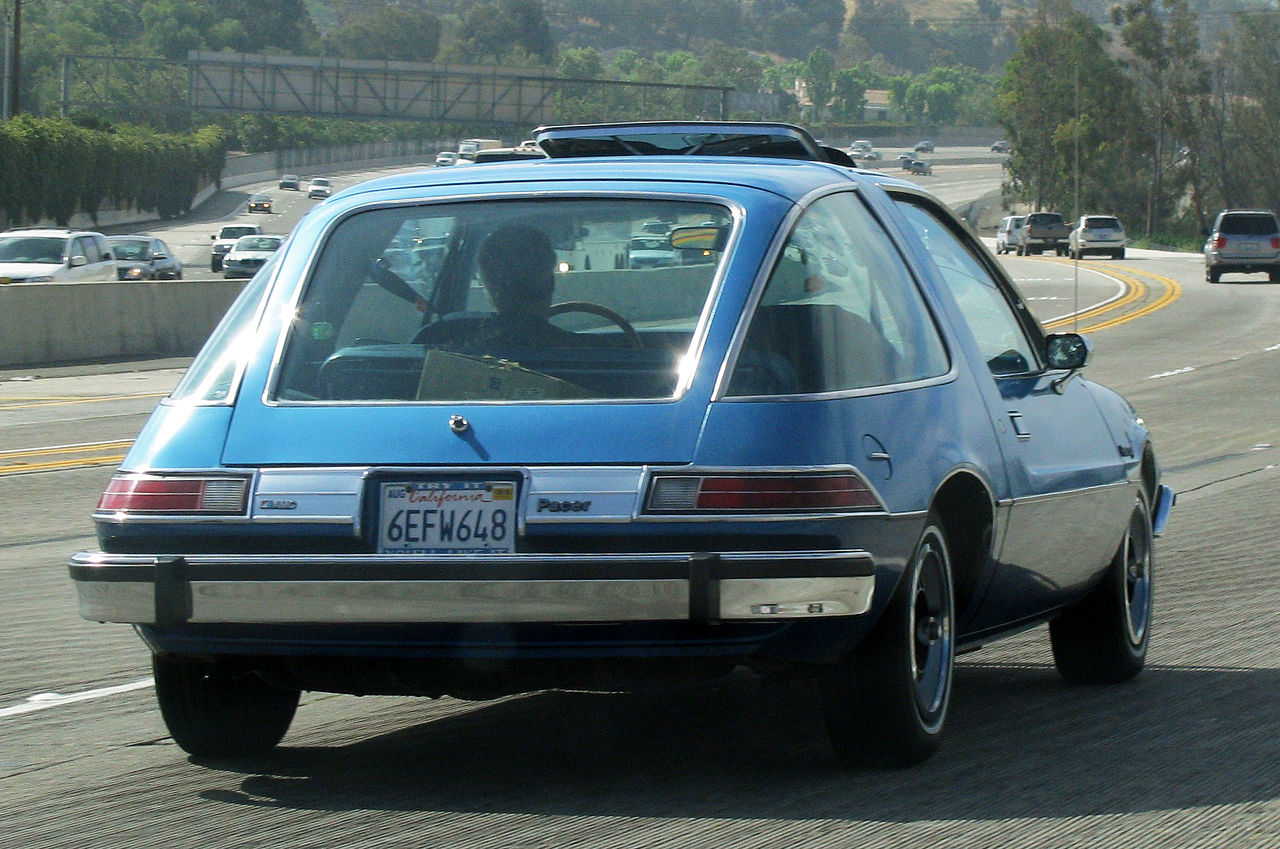
A Tip of the Hat to the Folks Who Designed the AMC Pacer

The Pacer's greenhouse. CC BY-SA 2.0 Daniel R. Blume

The Pacer’s greenhouse. CC BY-SA 2.0 Daniel R. Blume

When the AMC Pacer came out back in the 1970’s, it was freakishly ugly. Now, it’s just plain ugly. The designers of the Pacer took a running leap at the future… and missed. But all these years later, we can see that curved-glass, wide-stance aesthetic in many attractive modern cars. We just hadn’t developed the vocabulary back then to assess what they had done. “The wide-track people have a way with cars” didn’t really sell it.

By golly, AMC was actually decades ahead of its time (at least where style is concerned). But without the materials, and, most importantly, other designs to evolve from, the Pacer remains mired in the ’70’s even while it crosses into the third millennium. It’s a mix that doesn’t work. At all. But I wonder whether any of those big-name designers that went on to build the bridge between 1970’s and now credit the peek into the future the Pacer afforded them.

Altered Carbon and Spin State

It’s been a while since I’ve shared my thoughts about books I’ve read. While I tag the episodes as “reviews”, I’m not really trying to write something to help you decide whether or not you want to read the story — it’s more an analysis of the writing to give me new ways to look at my own work.

Recently I bowed to the suggestions of Amazon and bought two Science Fiction novels, Altered Carbon by Richard K. Morgan and Spin State by Chris Moriarty. I must say that the Amazon suggest-o-matic did a fine job.

The two books have much in common. For instance, both take place in universes where information is not bound by the speed of light. This gives the universe the absolute timeline that makes faster-than-light stories so much simpler. Spin State uses Quantum mechanics sleight-of-hand (thus the title), while Altered Carbon uses less well-defined hand-wavery.

This leads to the core thesis in both books: If information can go faster than light, and humans can be described as information, then people can go faster than light. And if people are information, then information can be a person. Both stories have characters who are Artificial Intelligences. (They would argue that they are not artificial at all.)

In Carbon, (almost) everyone has a module installed in their head that records the current state of their brain. In the event of untimely death (‘untimely’ open to interpretation, budget, and religious belief), that personality and everything it knew up until the moment the recorder stopped working can be restored into someone else’s head (unless, of course, the recorder was also destroyed). Bodies are now referred to as “sleeves”, and there are more people than there are sleeves. The deceased and the incarcerated are now just files in a database, waiting for flesh to host them once more.

If you have enough money, you can live forever. You can even clone up a batch of replacement bodies, keep them in cold storage all over the place, and hop from one to another as a form of instantaneous travel. You can even have multiple copies of yourself, but that’s illegal, of course.

When you can live forever, it changes you. You’re lose a little of what it means to be human. You become a Methuselah.

Takeshi Kovacs is a bad-ass Envoy for the U.N., trained to withstand the stress of dropping cold into a new world, in a new body, and Doing What Needs to be Done. This time he finds himself on Mother Earth, the memory of his last death (and the death of good friends) only minutes old, subjectively. His sleeve this time has some fairly high-end cybernetic upgrades that make him stronger, faster, etc. He’s been called in by one of the wealthy immortals of Earth to solve that man’s murder — a murder so thorough that the ancient one lost two days of memory. The police have ruled it a suicide.

Takeshi has been downloaded into a body that used to belong to a cop who has been convicted of Horrible Crimes. The Envoy’s new employer chose that sleeve partly out of spite, as it’s the cop’s lover who is in charge of the murder case. She hates the Methusalahs, and they don’t miss a chance to rub her face in their power. Now she has to deal with some other asshole in the flesh of the man she loves.

It leads to some interesting questions about identity and what it is that attracts one person to another. Is part of attraction chemical, not governed by the information of who we are and how we think, but instead by glands and receptors and the stuff that’s built into our meat? Do we become chemically familiar with the people around us?

One thing I didn’t buy: criminals are put on the shelf for a given period of time. This is supposed to be a punishment, but think about it: if you rob a bank and get caught, you will be instantly (as far as you experience) shot a hundred years into the future. Sure there’s some shock there, but unless you posit that society and technology has completely ground to a halt, the future looks pretty bright to me.

Altered Carbon is a detective story with Science Fiction clothing, and it follows the Detective Story Contract: The reader is given the information needed to figure out the answer, so when the detective reaches the conclusion you say, “ah, sweet!” rather than, “Hey, I call shenanigans!” Morgan does this well, though there are a lot of moving parts. For a while I was reading this at bedtime, and not in big chunks, and found myself going “wait – who’s that again?” a few times. If your memory’s like mine, this is a novel to read in big chunks.

I had several theories as the story progressed, and was right often enough to feel clever but there were still plenty of surprises. It was a fun read.

Notable side effect of the technology: once everyone’s wired up, advertising goes straight into your head. And it’s really effective.

In Spin State, Catherine Li is a bad-ass Soldier with the U.N., specially trained to drop in on a planet and Do What Needs to be Done. Her body has some fairly high-end cybernetic upgrades that make her stronger, faster, etc, but it’s past time she took them in to the shop for maintenance. We first meet her on a commando raid on a facility on some backwater planet. Their mission: get into the facility and stand by while a kick-ass AI gets what is needed from their data systems. An AI has no physical presence, but it can temporarily take control of a body that has special hardware installed.

The raid doesn’t go perfectly; the person who was the host for the AI gets killed, and Li blames the AI. Then she’s sent off to her next mission, which turns out to be a real bitch. It’s on her home world, and a past she doesn’t remember starts to catch up with her.

There’s a wrinkle when people are sent across the void using quantum-mechanical spin state stuff: A person’s memories don’t always come out intact on the other side. As a person makes more jumps, they become more and more reliant on hardware installed in their heads to remember things for them. That means that their bosses see everything, and soldiers only remember what their boss wants them to. Li has a vague notion that she’s done some things she’s not proud of during a grinding, protracted struggle in a war that’s over but not really. It makes me think of Stalingrad. The enemy in this case is a system of worlds called the Syndicate who have decided that the old way of making new people is obsolete; instead they clone up batches and throw away all but the best, culling them as they develop until there is a family of exceptional humans who all have the same face.

It turns out Li has one of those faces, but she’s had it surgically altered to escape discrimination in UN space. Another woman with the same face is a famous scientist who has been murdered. And Whaddayaknow? We have an action-mystery story. You see, the quantum-spin faster-than-light mechanism relies on an exotic material that only comes from one place. Once that supply runs out, humanity must return to decades-long (centuries-long?) journeys between planets, and the UN’s benign rule becomes impossible to maintain. So Famous Scientist was trying to figure out a way to synthesize the material. Or at least, that’s what she told people she was doing.

So that AI that flaked and may have cause the death of Li’s comrade? It goes by the name Cohen, was born on Earth (when Earth was still a pleasant place to be), and clearly has designs of its own, however much it may be working with the UN right now. And it has a history with Li. Cohen interfaces with the world through a variety of people who have shunts installed, and I have to tip my hat to Moriarty for his carefully natural-sounding language differentiating the host meat from the personality within.

Lesson one: Don’t turn your back on someone with a shunt installed. You never know who might show up.

Li is the natural pivot point in all this: she has hidden Syndicate roots but embodies rugged individualism; she has a connection with a powerful AI, and she does the ugly jobs for her boss who is a Big Wheel at the UN. She’s a good soldier and accepts that she remembers what her superiors choose, but she’s convinced that it’s all for the right reasons. She roots for the wrong baseball team, but I’ll forgive her that.

Warning: Spoilerish paragraph:

While the AI in Altered Carbon is an interesting side character, Cohen in Spin State is central. He (yes, ‘he’) was one of the first machine intelligences to emerge, and much of the time he seems, well, human. Later Moriarty shows us that ‘Cohen’ is not really singular, and that the nature of machine intelligence is entirely different than our mushy biological intelligence. Yet they share one thing with us: a desire for life, liberty, and the pursuit of happiness. They are also better than us at just about everything. In that light, the human engineering programs of the Syndicate start to make a lot of sense. Alter humanity or get left behind.

There were, I must say, a couple of things that bothered me about this story. I simply cannot believe that the mine for the material that the entire economy is based on would be run the way it was in this story. Even if extracting the mineral is an art form, the rest of the labor would be more cheaply done by robots in a society this advanced. I think the writer could have found plenty of other ways to create local unrest.

Also, virtual reality has advanced to the point where it’s indistinguishable from physical reality. I’m having a hard time articulating what it is about that that bothers me, except that it seems to be unable to let go of physical reality. People meet in virtual representations of real places, and can be embarrassed by the arrival of other people in that place also. If you’re a super-AI, how do you allow that to happen?

But for those nit-picks, I enjoyed this story quite a lot.

Two stories of hard-nosed people in over their heads. There is shooting, and sex, and explosions, and questions of identity. People die horribly when their heads are hacked. Philip Morris will be glad to know that tobacco has followed mankind to the stars and back again, to be thrown in an acid-rain puddle under a flickering streetlamp while taxis rush by.

Note: if you use the above links to buy one of these books (or The Kings County Distillery Guide to Urban Moonshining: How to Make and Drink Whiskey), I get a kickback.

2

TFNIWLNW: 5

Episode 5

There is a moment each morning when the night must recognize that day is coming, when darkness admits it must give in to the sun’s bullying ways, yet clings to the world for just a while longer before slinking back into the shadows. In the forest it is a time before color has awakened, when mist hangs close to the ground and the air is gravid with the scent of the earth. There is a silence then, broken only by the furtive steps of timid creatures trying to steal a meal in the stillness, before the predators of the day begin to stir.

Those who believe that the sun has no choice but to rise may not appreciate the magic of that moment. They forget that it will not be long before the uncaring ball of fire rises without them. When I am able, I stop at that moment and thank whatever gods might be out there for allowing me to know that simple peace once more.

It is also an ideal time for hunting. When my companions stirred with the growing light they were welcomed to the day by the smell of rabbits cooking over oaken coals.

“I could get used to this,” Bags declared as he tore dark meat from the bones and pushed it into his mouth, but I wondered if he could. The pace and the terrain were taking a toll on the big man. His hands bore a dozen cuts and scrapes from climbing, and fatigue was etched in his face. He favored his left foot when walking and I saw blood on his socks when he took off his boots. I had not been unhappy to bid the horses goodbye when the terrain got rugged and the forage sparse, but Bags, it seemed, had been born on the back of one of the beasts. Still he greeted each day of toil with a smile.

Katherine, on the other hand, suffered not because the pace was too fast, but because it was too slow. Each day she would range ahead, finding the best route for the big man, and then sweep behind us, checking for signs of pursuit. For every mile we covered, she walked three or more. Each night she agreed with tight-lipped reluctance to stop when Bags could go no further.

For my part I was content to pace Bags, traveling mostly in silence, encouraging him when I could, carrying his pack on occasion — though never for very long — and helping the civilized man to negotiate the wilds.

North, we traveled, relentlessly north; only Katherine sure of our destination. She knew more than I did about the people who wished us dead and the people who might still have use for us in this world, so I was content to let her choose our path, all the while knowing that while we toiled through the rough country, word of the baron’s death was traveling by road and was by now far ahead of us. A problem for another day — but each day Bags was going to be less useful when it came to dealing with the unfriendly people we might meet.

“Going to rain today,” Katherine said.

I looked up into the brightening sky. There were no rain clouds, just high, feathery clouds drifting to the east.

For a moment Bags’ smile faltered. “Well that’s just grand,” he said.

“It is, actually,” Katherine replied. She softened a bit. “Hang on a little longer, Bags, and you can rest. I made you something for your foot.” She handed him a wad of leaves that smelled awful.

Bags peeled open the leaves and looked skeptically at the gray ooze she had given him. He took a suspicious sniff. “What is it?”

“I found some dragontooth while I was scouting yesterday. I made a balm last night. Rub it on your blisters.”

“Isn’t that stuff poisonous?” I asked.

She ignored me. “When you put it on, it’s going to burn like you stuck a hot iron on your foot. But it’ll harden up your skin where the blisters tore off. And, uh, don’t lick your fingers.”

While Bags tended to his wounded foot Katherine turned to the food I had prepared. She took a bite of rabbit and nodded. “Thanks for breakfast, once again,” she said. “I appreciate not having to hunt.”

“I just put out snares,” I said. “The rabbits do most of the work.”

Bags picked up a pebble and threw it at me. “Just say, ‘you’re welcome’.”

Katherine allowed herself a hint of a smile. “You’d rather not take credit for anything, would you, Martin?” Katherine asked.

“I have always found credit difficult to distinguish from blame.”

“You’re worried I’ll blame you for making breakfast?”

“Your breakfast is stolen property. This forest belongs to someone. I would rather he never give me credit for making your breakfast.”

She made a face like she had bit into something bitter. She had extremely well-developed scowling muscles, I noted, forming small knots at the corners of her mouth and between her dark eyebrows. “Lord Wilmont can choke on his own genitals,” she said, “now that Baron Sothron won’t be sucking on them.”

I had to chuckle at the fine polish she put on her obscenity. She had not grown up poor, but she was comfortable enough living simply now. The frayed edges around the hood of her cloak and the patches on her knees bespoke a thrift I was not accustomed to finding in one raised in comfort.

It was possible, of course, that her carefully-learned diction was simply artifice, adopted with care, with the intent to conceal, rather than reveal, her origins. I am acquainted with people who have made that effort. The roll of her r’s and the elongation of her vowels hinted of the north, an impression reinforced by her pale skin, but her northness had been muted, subjugated by the tyranny of a southern-born tutor. Father dearest had hoped to improve her value in the eyes of the powerful men in the moneyed south. Based on current circumstances, I hazarded that his plans were not working out the way he hoped.

“Why are you smiling?” she asked me.

“I was jut trying to imagine how it went when your father tried to marry you off.”

She stood abruptly and reached for her bow. Apparently it was time to start walking. “Oh, I married him,” she said. “Father did very well for himself. But that’s over now.” She held her hand out to Bags and helped him to his feet. “Better?” she asked him.

He tested his medicated feet and nodded. “Better.”

I stood also and gathered my few belongings.

“My husband is dead,” Katherine said. “He was mutilated before his throat was cut, in a tavern while surrounded by his own men. No one seems to know whom to blame. Or to credit.”

first episode

1

TFNIWLNW: 4

Episode 4

It was I who heard them first. Horses pushed hard by angry men.

We had covered perhaps five miles by sunrise; the terrain was still friendly enough, and as the clouds broke up a sliver of moon provided enough light for us to avoid the worst obstacles. A bed of pine needles on the forest floor softened our steps as we wove between the dark pillars of the tree trunks. Katherine, when I could see her at all, seemed to blend with her surroundings until she was little more than a shadow. If ever needed to kill her, I decided, I’d make sure I did it in town. But today we were on the same side, or at least running from the same people, and the sound of pursuit to the south meant that blood would soon be spilled.

“Horses,” I said.

The others stopped to listen. After a moment Katherine nodded. “Riding hard — they don’t care if some of them break their legs.”

“How many?” Bags asked his partner.

“Several. Maybe ten.”

I would have wagered seven were I in a more congenial crowd. “No dogs,” I said, with some relief. Dogs are harder to deceive.

Katherine scanned the rising ground ahead of us. Not far to the west a rocky outcrop peeked above the trees, its pale face shining pink in the early-morning light. “We’ll set up there,” she said and turned that way without waiting for an answer. Bags and I followed, jogging behind her.

She didn’t slow until she was at the top. While Bags caught his breath I explored the outcrop, listening as the horses drew near. We were in a a good, defensible position, the approach to the outcrop easily visible. To the right was the gentler slope we had climbed, to our left the rocks were broken and jumbled.

“I should be able to get a couple of them before they reach shelter,” she said.

“What if they shoot back?” I asked.

She smiled. “I hope they do.”

Bags pulled his sword free. Everything about him was ragged except that blade, gleaming in the early-morning light. “I can hold the path,” he said, “’till you pick them apart.”

I studied the outcrop, and realized that I would be little help in the battle they were imagining. I have no sword, no armor, and no bow. “I’ll see you two later, then,” I said, and started down the other side, away from all the trouble.

“Where are you going?” Katherine asked me sharply.

“Not sure yet. I’ll play it by ear.”

“You godfucked son of a mongrel,” Katherine said. “I didn’t take you for a coward.”

“This isn’t my sort of fight,” I said over my shoulder.

“See you later, then,” Bags said.

Her voice was steady and hard. “I will find you, Martin. You can count on that.”

“I’m counting the minutes, Kat” I called back. Then I was among the trees, and I began moving more quickly, while wisdom warred with curiosity in my head. If I kept walking, I could live to spend the gold in my wallet, Kat’s threats notwithstanding. I could be far from the ugly politics, far from hundreds of angry soldiers. Eventually Katherine and Bags would be killed, Katherine’s connections discovered, and I would be forgotten. All I had to do was keep walking west.

Wisdom lost the battle, but of course you knew that already. Wise men rarely have interesting stories to tell; people don’t crowd pubs exchanging stories with their friends about the time they did the wise thing. I found myself curving around to my right toward the jumbled rocks on the north side of the outcrop where my friends waited to fight seven to ten well-armed men.

Our pursuit would have seen our change in direction and known exactly what it meant. They would be cautious. Katherine’s bow would slow them, and Bags’ sword would push them back, but assuming my companions won those two skirmishes, there would be other men looking for a more subtle path up. I needed to find that path first.

I found a likely spot, a fissure in the weathered granite that provided shelter from arrows and unwanted eyes. Through that passage the honorable men who wished to slaughter us would be able to get behind my companions at the top of the hill, making the fight much more fair than I was comfortable with allowing. I moved through the gap and found a nice nook behind a loose boulder. I was just settling in behind the rough, weathered stone when I heard the first man cry out. An arrow had found flesh. There were shouts, the leader instructing his men, but I couldn’t make out specific words.

Another curse, and the clash of metal, then quiet. If Bags had been overwhelmed, the enemy was now above and behind me. Best not to think about that. I had only one choice: to trust my judgement, to trust my companions, and to do what I do best.

Perhaps ten minutes later I heard the first furtive sounds of men trying to be stealthy while wearing metal clothes. By the time they were near me I had identified three of them by the sounds they made. I would have preferred two.

The knife I chose for this job was thin and razor-sharp, her blade the color of a dark dream on a moonless night. The smith who had forged her was dead now, slain by her twin. If I was going to die today, I wanted to die with this lovely blade in my hand. The steel was surprisingly resilient, but if I erred and hit armor rather than flesh she would break in a thousand pieces. Mentally I promised the piece of metal that I would not miss.

Three of them. I’d have to wait until I was right in the middle of them to make my move. If they didn’t cooperate and pass where I thought they would, my best option was to start running and not stop until nightfall.

They cooperated. The first was past me when I lunged from my little haven and cut the throat of the second, my black steel sliding through his flesh like it was air. The third in line had time to raise his sword before I found his larynx and pushed my knife home. Blood gushed onto my hand, threatening my grip, as I turned to face the one who had been in the lead.

He was facing me, sword ready, shouting obscenities that were frankly unimaginative. His feet were searching for purchase on the rocks, his hard-soled boots with tapered toes were made for the stirrup, not uncertain ground. His armor was clean and showed not a spot of rust, his green cloak hung easily on his shoulders. He held out his sword, fighting for balance on the rocks, and he knew that his only advantage was that his deadly steel was longer than mine. We seemed to be in a standoff. From above came another clash of steel, another cry of pain.

“You’re the last one,” I said. “All your friends are dead.”

“You are a lying son of a whore,” the soldier said. He was barely more than a kid, the fuzz on his cheeks more a wish than a beard.

I shrugged. “We can stand here until my big friend comes down to see what all the shouting is about, or you can drop your sword and go back the way you came.”

“If I drop my sword, you’ll kill me.”

I smiled and moved my blade to the side just enough, my empty hand in a placating gesture. “Why would I do that? I just want to be on my way. Drop your sword and start walking, and we’ll have no reason to kill you. We’ll be keeping your horses, of course.”

From above the sound of heavy footsteps. One person, favoring a leg. If it wasn’t Bags, I wanted my current situation resolved long before he arrived. “You’re time’s running out,” I said.

The sound of his sword rattling among the rocks reverberated through the forest. “Thank you,” I said. I reached out my hand to steady him as he clambered back past me. When he was next to me I cut his throat and watched his eyes widen in shock as he choked on his own blood. “You saw my face far to well, kid,” I said as he slumped to the ground. He deserved an explanation.

I turned to meet the approaching footsteps. Bags greeted me with his gap-toothed grin. There was blood smeared on his cheek, but I couldn’t tell if it was his. “Good to see you,” I said.

“Dangerous work,” he said. “Three of them, huh?”

I nodded. “Kat all right?”

“Yeah. Might go easier for all of us if you call her Katherine.”

“I know.”

“You also should have told us your plan. So we could work together.”

“I didn’t know my plan.”

“Maybe not specifics, but you did know generalities.”

“To be honest, I wasn’t sure I wasn’t going to take the chance to leave you guys behind.”

His face was almost serious for a moment. “Fair enough. Why didn’t you?”

“Still might. But you’re a good guy. Hate to see you die some anonymous death out here in the middle of nowhere.”

“You imagine a better death for me?”

“Maybe not better, but later.”

Bags laughed. “I’ll take it. And I’ll tell Katherine that I’ve already chewed you out for not being a team player.”

“A lot of good that will do.”

Again that smile. That toothless smile that lacked any guile at all. “Oh, she’ll still be madder than a cat in sack, but she won’t say anything. And she knows that you’re going out of your way to annoy her for a reason. She just has the wrong reason.” He laughed again. “She thinks you like her.”

first episode

2

Up… for now

Techno-troubles here at Muddled Ramblings and Half-Baked Ideas! The faithful little computer that has been serving up this site for the past years is not healthy right now. I didn’t realize how important this damg blog is to me until it stopped working. Just when I was getting some momentum, too.

I’m looking for the best answer now (MacMiniColo.net has a pretty spectacular special running right now), But in the meantime it’s proving tough to keep this thing up. So, sorry in advance for outages.

2

How’d They Do That?

One of the magic things about a tilt-shift lens is that if you can find a vantage over a cityscape and look down, you can make images that look inexplicably toy-like. Something about the altered perspective monkeys with the cues our brains use to establish scale.

Here’s a great example (© Jay Lee*):

There’s an Audi ad running right now that says, “this car is the best toy you will ever own.” It blends a child’s fantasy with footage of the actual car. Helicopters abound. But many of the “actual” shots have a distinctly toy-like look to them, much the way the tilt-shift-from-above shots do. Granted there’s a ridiculous amount of post-processing in the ads, but I have to think that the original videography is the foundation for that toy-like quality. Yet the perspective is not the down-from-above angle that I would expect.

I’d like to meet the director of photography for that ad and learn how he did it.

_____
* Jay Lee also weaves bacon.

3

The Fantasy Novel I’ll Likely Never Write: Chapter 3

There’s a milestone in the development of the characters I need to reach before I walk away from this setting.

Chapter 3

A gentle silence settled around us as we finished our food. We all knew what must follow. Travel. Pursuit. Fear and maybe death.

I don’t make much of an impression when I’m in a room, and that’s all right with me. Even after I killed the baron I doubted anyone who was there would be able to identify me with certainty. Were I alone I’d just need to put enough distance between my face and that ugly scene, and refrain from showing too much of the baron’s money in one place, and I’d be fine. Eventually they’d find some other bastard to execute.

Bags, however, had made quite an impression. We could get him new armor and maybe even new teeth, but it wouldn’t matter. The baron’s friends would follow him to the end of the world. It was time to find shelter from the storm.

“Know anyone who hated the Baron?” I asked my new companions.

Always-Katherine nodded. “Almost everybody.”

Almost everybody is worthless. “Anyone who might be grateful enough and powerful enough to protect us?”

She framed her response carefully. “Grateful and powerful, yes. But willing? Probably not. The baron’s enemies aren’t going to want to reveal themselves yet.”

Yet, she said. I wiped my fingers on my cloak and stretched my legs. The fire was just a glow now, painting our faces red. Bags belched and laughed. I asked the question I already knew the answer to. “What makes you think that?”

She spit into the fire. “Because one of them hired me to kill the son of a bitch.”

Bags laughed. “That’s why she made us come marching out here. To see who stole her fun.”

“And to keep you alive,” she said. She turned back to me. “Who are you working for?”

“I fill my own belly, and starve on my own account,” I said.

“Why did you kill him, then?”

“He was an asshole.” And that’s the whole truth. But people want to make it complicated.

She smiled, but it wasn’t a particularly friendly smile. “Do you kill all assholes?”

“I’d like to.”

“Bags said the baron was attacking a woman, and you killed him for it.”

Katherine was trying to like me, trying to see me as a defender of the weak, a man willing to risk his life to protect the downtrodden. A lot of people are like her; they feel a need to enjoy the company of the people around them. Those people annoy me. “I killed him,” I said, “but that’s not why.”

Bags snorted.

I let it drop. If they wanted to think I was some godfucked saint then it would be easier if I ever needed to cut their throats. “We should be going,” I said. “And Bags, can we prevail upon you to not leave a trail of blasted vegetation behind you?”

Bags gave me his toothless grin. “Probably not,” he said.

“They’ll know by now we are headed toward Bishop’s Junction.” Katherine said. “They’ll be waiting for us there. We should turn north.”

The terrain to the north got very rugged, making mounted pursuit less of an advantage. It also meant slow, hard travel and a much longer wait before I could start spending my money. “Maybe we should split up,” I said. Without Bags, I was pretty sure I could fade into the forest and emerge somewhere else, just another stranger.

She looked at me with narrowed eyes and shook her head slowly. “You’re the one who got us into this.”

“Us?”

“Baxter’s messes are my messes, too. And this one’s yours as well.”

“I wanted to do it,” Bags said as he sucked the last of the chicken grease off his fingers. “They were hurting her.”

“That’s because you’re a kind-hearted idiot,” Katherine said, but she didn’t sound angry when she said it. She looked back at me. “I don’t know what you are. We’re staying together until I figure that out.”

And not a moment longer, I added silently, because that was the truth of it. I stood. “Best get going, then. I hear the north is lovely this time of year.”

first episode

2