Žert

If you were czech, you would have recognized the title of this episode as a reference to Milan Kundera’s novel The Joke. Last night I was surrounded by strangers who spoke no English, and I tried to tell a joke in Czech. It was my most ambitious attempt to communicate orally outside my lessons.

It didn’t work very well.

I had been listening to the conversation around me, not really hoping to understand a great deal, but at times I knew enough about what was going on that had I been able to form sentences more quickly I might have had something to add. Of course, by the time I had assembled a candidate sentence, conversation had long since moved on.

More often, I would catch words I knew (or knew I should know), standing out like little islands of comprehensibility in the swirling ocean of conversation. (Czech, in fact, when spoken by several people at once, does sound a bit like the surf.) On one occasion, I caught a few words that, when combined, were amusing: “… I bought … five kilograms … piece … zebra … nine crowns …”

I prepared my sentence ahead of time, and sure enough not long after Jirka came by and asked me if I was understanding anything.

“I understand everything!” I exclaimed in Czech, which got a chuckle. “For example…” That caught people’s attention, because I actually pulled off the pronunciation of například pretty well, and it’s not a common word for non-speakers to know. In the following silence my mind went blank. “Moment…” I said, stalling for time, which got another chuckle, a polite one, and I was free to stumble through my joke. “For example, I heard one woman say she bought 5 kilograms of zebra—”

“You mean Žebra,” Jirka interrupted. “Ribs.”

I could have replied, “oooooh, ribs. That’s not so interesting, then.” That would have been funny. Instead I pressed on with the story the way it was scripted in my head, but even after insisting that I had heard zebra, everyone assumed I meant žebra, and the joke came out as someone buying a shitload of ribs for only nine crowns. Which isn’t terribly funny. “I understand everything!” I finished, and got a courtesy laugh, and conversation went on without me.

That’s not to say I would have been adaptable enough to jump on the punch line opportunity in English, either, and I did trot out a fairly complicated sentence that leaned heavily on my new past tense skills, which surprised the folks around me. So it wasn’t all bad. It could have been better, though. It could have been Žert.

A couple of fragments I like

Her lips were full and red, sensuous and stark against her pale white skin. Her blue-black hair was pulled up and back, revealing her long, slender neck. Her eyes were dark, mysterious pools with the glint of treasure far beneath the surface. She looked good enough to eat, but I was too pissed off by then.

“What’s with you guys?” I asked. “It’s like your fashion sense is stranded in the 1920’s.”

She slid an annoyed glance my direction. “At least we have a fashion sense. Look in a mirror lately?”

“Hey, I dress for comfort.”

“Huh. You can take the boy out of the forest, but you can’t take the forest out of the boy.”

“At least I don’t wear clothes I can hardly walk in.”

She turned to look me in the eye. “You don’t like this?” Her tone was haughty, but I could hear the hurt buried deep within it. She turned back and I watched the way the black silk moved with her body, light flowing over her contours.

Damn. I’d marched right into that one. Time to tuck the tail. “Yeah, I like it,” I said, letting a little of a growl into my voice. “You look good.” Luckily there was no need to lie, she would have known.

She smiled her little smile, the one that didn’t show teeth, which meant I was forgiven. She pointed at my sweatshirt and jeans. “But I’m not going anywhere with you looking like that.” I allowed myself to hope for a moment that perhaps I was off the hook, but before I could even open my mouth she said “Go change.”

“Do you really need me there?”

She sighed theatrically. “We’ve been over this. When we get a new member it’s important that everyone is at the reception. It’s a ritual that goes back centuries.”

“Yeah, but I’m not one of you.”

“If you’re with me, you are.”

“I just can’t believe what a big deal you all make of this.”

“Listen, we have to look out for each other, and it’s traumatic for the newbies. We’re not like you. We don’t just sniff each other’s butts and then go out and get drunk.”

I let that pass. I had tried the “more hygenic than shaking hands” argument before, but it never worked. I went to find some clothes she would approve of. It didn’t take long; options were limited. Black jeans, black turtleneck, and a camel-hair coat from the thrift store. I ran my fingers through my hair (no pony tail for formal occasions), and presented myself for inspection.

“Eventually, you’re going to need another outfit. You’d look good in black leather.”

“Give me a break.”

She regarded me harshly, but she liked the way I looked; I could smell it. Maybe, just maybe, I thought…

“Don’t even try it. We’re already late.” She looked over her shoulder as she passed through the door. “Try not to hump anyone’s leg.”

When her back was turned I made a face and silently mouthed the words back at her. Try not to hump anyone’s leg.

“I heard that,” she said.

Sometimes I hate the vampires’ sense of hearing.

* * *

“I can’t believe you said that to Vlad.”

“What do you mean? The dude was being an ass-wipe.”

“Just because someone’s an ass-wipe doesn’t mean you have to call him that right in front of everyone.”

“So what’s the harm? Everyone knows he’s an ass-wipe anyway.”

“Tom, you humped his leg!”

I smiled. “That was for you. Jesus, that guy bugs me. All those Old-Europe airs, that world-weary cosmopolitan bullshit. Give me a break. He’s from Cleveland, for fuck’s sake.”

“You have no right… Really? Cleveland?”

“Guess he forgot to mention that at his big reception.”

“How do you know?”

You’d know if you’d sniffed his butt. He’s the punchline to a lot of our jokes about vampires. He tried to join us and we shined him on. That’s when he went over to you guys.”

“He’s a werewolf reject?”

“That’s right.”

She smiled her glittery smile, the one with all her teeth framed between her red, red lips. “Oh, that is interesting.”

* * *

“Tell me a vampire joke.”

I thought for a moment. There was no way I was going to tell her any of the jokes we traded around the pub, but if I didn’t come up with something, things would get awkward. “All right, how many vampires does it take to unscrew a lightbulb?”

She scowled for a moment, then said, “I don’t know. How many?”

“That, uh, was the joke. UNscrew. Vampires like it dark.”

“I don’t get it.”

“Usually it’s screw in the lightbulb.”

“Hm. That’s not very funny.” Silence stretched for an awkward moment, and she asked, “how many werewolves does it take to screw in a lightbulb?”

“I don’t know.”

She turned to the ceiling and shouted, “FUCKING LIGHTBULB!” She sold it, too, letting herself go the way vampires never do, making the answer a howl of rage, even putting a bit of a wolf growl into it, and I fell in love with her all over again, even as she blushed and regained her decorum. As I laughed I wondered once more what she saw in me.

“You know,” she said, “don’t let this go to your head, but if I’d gone to that party without you a lot of people would have been upset with me. The ones worth a damn.”

“That’s surprising. Mostly what I get is ‘oh, crap, what’s he going to do this time?'”

“Half of them say that. The other half say, ‘I can’t wait to see what he does this time.’ You’re like the yurodivy, the Russian Holy Fool who is allowed to speak the truth in a sort of code, and be exempt from reprisal.”

“My code isn’t very subtle.”

She smiled. “No, but it’s fun to watch.”

1

The first day of the year shorter than the day before

The days are long this time of year, and I like it that way. This far north it is common for people to go out before sunset and get home after sunrise. (Not for me, mind — I’ll leave that to the kids.)

I was in a chat with some piker pals yesterday morning, and one of them said “It’s all downhill from here,” which summed up my feelings as well. I may have mentioned it here, or perhaps in other writings in other places, but man is the only creature cursed with the imagination to ruin any good time. Three-legged dogs don’t think to themselves, “if I had another leg I could get to that ball faster.” No, they think “Ball! Ball! Ball! Whooeee!” When a cat is curled up in a sunbeam, it’s not thinking to itself, “too bad sunset’s coming,” the cat is just thinking, “waaaaaaaaaaarm.” Creativity and imagination are the bitter pill, as well as the source of hope.

Piker pal’s comment also reminded me of a story I wrote this spring. It’s not one of my better efforts (a bit too sticky-sweet for my taste), but it does describe how I feel about days like today. It’s been sitting on my hard drive in the junk pile, but here it is, for what it’s worth. The paragraphs about dark and light I wouldn’t mind working into a better story someday. The opening line is nice, too, but doesn’t fit.

The First Day of Spring

It started small, the way grand things do.

I was sitting on a park bench sipping my first beer of the afternoon, watching the people around me take advantage of the first truly beautiful day of the year. It was a false promise, I knew, a deception; more snowflakes would fall before winter was truly over.

Summer. It is not simply a segment of the year, not here. It is a gasp of air for the soul, before it is plunged back into the cold and the dark. Each summer seems shorter, the lift it gives diminished, and I know there will be a summer that is not a summer at all, and it will be my last.

A parade of cheery folks streamed past the bench where I sat. Some moved slowly — couples taking the same walk they had for fifty years — while others flashed past, here and gone in an instant — girls pushing themselves along on rollerblades, toned legs moving rhythmically, dodging dogs and children and grandparents.

“Need a refill?”

I looked up to see someone I vaguely recognized and I hoped she wouldn’t be insulted when I couldn’t remember her name. “Sure.” I reached into my pocket for some change.

She took my glass. “It’s on me,” she said. “I’m celebrating.” She turned and headed over to the beer window. I watched her walk and she seemed more familiar from that angle, as if she had walked away from me many times before. When she reached the line at the beer window she glanced back and caught me watching at her.

I wanted to inspect her as she returned, to see if that rang any bells, but that would have been difficult. Instead I looked out over the city spread below.

“Here you go,” she said, handing me my beer. “They raised the price this year.”

“I’ll get the next round.”

“Don’t worry about it.” She stood holding her beer, this woman who had been here before, who knew me, waiting for me to say something more. Finally she gave up. She took a sip and said with a beer-foam mustache, “Mind if I join you?”

I joked to cover my impoliteness. “It’ll cost you.”

“I’m sure it will.” She sat, not too close, not too far. “Na zdravi.”

Na zdravi” I raised my glass to hers, careful to make eye contact. Around here, toasting without looking the other in the eye is like a limp handshake. She met my gaze. Her eyes were green with golden flecks, and the corners were crunched just a little bit, like there was a smile just beneath the surface — the punch line to a joke she was enjoying telling.

“Aren’t you going to ask me?”

I hesitated, then remembered. “Celebrating what?”

The smile came a little closer to the surface. “It’s my first anniversary.”

“Ah.” I raised my glass again. “Happy anniversary.” It seemed a strange way to celebrate it, buying beers for guys in the park.

She sipped her beer and looked out on the city of a hundred spires. “This is the second-best bench in the park,” she said.

Whoever she was, she knew her benches, as well. “The lady with the plastic hat had already taken the best one when I got here.”

My benchmate smiled. “She’s back? Good.”

“She’s got a new hat.”

“I hope it’s ugly.”

“She’s outdone herself this year.”

She laughed, took a sip of her beer. “Aren’t you going to ask me?”

I thought for a minute. “Anniversary of what?”

“Of the first time I came up here. It was the first warm day last year. I started down by the river and hiked all over until I found myself up here.”

The first warm day. A sacred day, a day that doesn’t go on the calendar but is universally recognized. Not a national holiday, but a human one. “It’s my favorite day,” I said.

“Mine too. There’s so much promise; the air itself is telling us how wonderful the summer is going to be.”

I sipped. She was right, but it was also the first day I started to feel the summer slip away, sand though my fingers, lost and gone forever.

“You were on the other bench that day.”

“Was I?”

“Yeah. The sun was bright, but you were dark and brooding. You scared me.”

“I’m sorry.”

“Then I caught you checking out my butt.”

“Uh…”

“I love it up here. I came back every chance I got, and you were always here, on one of these benches, adding a little darkness to the day.”

My beer was empty. I wanted to go get another, or find any reason to walk away from this conversation, if only for a moment.

“You think too much,” she said.

“Pardon?”

“You think too much. Nothing is simple for you. When you watch the sun rise you think of night, but when the sun goes down, you know the day will follow. You prefer the dark, because only then can you contemplate light without sadness. But still you take pleasure in the simple things, like sitting on a bench on a sunny day. That’s what I like about you, that you can be both happy and sad at the same time.” She took my glass and stood. “Aren’t you going to ask me?”

I looked up at her standing over me, waiting, expectant. “What’s your name?”

The punch line. The smile that used her whole face. “Allison,” she said. “I’ll get another round. It’s our anniversary, after all.”

I followed her with my eyes and I thought of the bright days ahead, and the winter that must surely follow.

Selling Soap – Life On Set

Ah, the glamor, the heady days of wine, women and song! Ah, the grinding tedium and long hours.

My life as a fake lab assistant began in the inky black long before dawn. I wasn’t sure how frequent the metro was that early in the morning, so I gave myself plenty of time to wait for the train and to make my connection. As a result, I was at the designated meeting point long before I needed to be. Better early than late, I figure, proving that I am not Czech. It was raining, so I stood in the shelter of the metro station entrance and waited to be collected.

More folks arrived, and then a production assistant showed up to gather us in. There were perhaps ten or so of us there, and the assistant had with her a list of the people she was expecting. My name was not on the list. “Great,” I thought, “I can go back to sleep.” No such luck; apparently I was a special extra, and those on the list were mere garden-variety extras. Even now I’m not sure what the distinction is, except I probably got paid more than those on the list. It’s good to be special.

At 6:15 we marched over to the empty factory building that housed the set, and shortly I was sent to wardrobe, where I was given slacks to wear instead of jeans, while the other guy in there was given jeans to wear instead of slacks. I was given a different sweater and warned that it would be cold on set. Over to makeup where they did a quick paint job on my face but left my beard scruffy, then breakfast. One thing I’ll say about this production, they had good grub, and plenty of it.

The production manager filled me in on what was going on. “You will be working in a funny mad scientist’s laboratory.” The lab-coated extras huddled in a knot and we were eventually deployed around a large set filled with old electronics and lots and lots of chemistry equipment, dish washers, and various permutations of the dishwasher detergent we were selling. All around were flasks filled with brightly-colored liquids, but as I watched, all but the blue ones were emptied into a bucket. And so began a long, slow pattern. They would set things up according to the plan. The gaffers would set up the lighting, the extras would be given their assignments, and the directior would decide he didn’t like it. An unplanned hour would pass as they redid everything, and then we would go through a series of rehersals to make sure the lab would appear uniformly busy.

The second shot of the day took especially long. The accident-prone scientist is walking through the lab and everyone is avoiding him. I was given a tray of glasses and was quite relieved when a PA taped them down. I was the last one the scientist encountered in the sequence, so my timing was dependent on how all the other encounters went.

“More glasses on the tray,” the director said, “and don’t stick them down.” So now I’m holding a tray full of glasses and dodging the main guy while going down stairs. We did lots and lots of takes, first to get the timing right and then to get isolated shots of the individuals in the sequence. It is a small miracle that I got through the scene without glassware destruction, and I came very, very close a couple of times, but finally we were done. I set down the tray with a sigh of relief. It was about 12:45, and we had about 7 seconds of the commercial in the can. (It was actually a set of similar commercials for a range of the company’s products; I estimate the total time of all the pieces needed was about two minutes.)

After that, is was much like my first day on the James and the Giant Explosive Device shoot. I had been prominently featured moving away from the action, so I wasn’t going to be much use for a while. Sure enough, that was it for me that day. My only tasks for the rest of the day were keeping warm (not easy), reading, and visiting the food tables from time to time. Had it been warmer, it would have been a good way to spend an afternoon, and a guaranteed disaster for any diet. At 8:15 p.m. I was released. Fourteen hours of action-packed fun!

Because of my specialness a van picked me up the next morning, allowing me to sleep another half hour. Special or not, I spent almost no time at all on the set for the sixteen hours I was there. I was released at 11 p.m. The shoot was running late, and they had desperately wanted to not have shots with extras slip into the next day. (Not desperate enough that they didn’t completely redo the set three times for one shot.) They still had some shots with extras for the next day, but I didn’t have to go back.

It is unlikely I will ever see the final result, but for those of you in Europe (and America too, for all I know), if you see an ad for Sun dishwashing detergent, look for a lab assistant with a scruffy beard going to gray. That’s me!

Selling Soap – This is How Stupid I Am

Apparently, the director for this commercial is slower than most. On day two of shooting, a van came and picked me up at my house and got me to the set at 7:15. At 3:30 I still had yet to be used. I sat and read near the little space heater in the room where the food was.

Sitting near me was a pretty woman, bundled up and sitting directly in front of the heater, reading a worn, cloth-bound book. It looked like literature. As other people were called onto the set occasionally, she never budged. She wasn’t wearing a lab coat, so I figured she wasn’t in the cast, but she didn’t appear to be part of the crew, either. After a while I figured out that she was the set medic. She didn’t speak much English, and she seemed a little shy when people came to ask for cold medicine or whatnot. Occasionally something amusing would happen nearby and we would exchange a chuckle. I tried to think of some way to broach a conversation with her, when we had so few words in common.

Eventually my name was called and I limped out onto the set. My shoes had given me a blister on my heel the day before. False alarm; I limped back to the waiting room. She looked up from her book and I shrugged and rolled my eyes and she smiled. I returned to my book, wondering what I could say to her. A while later the call came again, I limped back out, false alarm, and back I went. Smiles exchanged, back to the books.

Some of you, by now, may have already caught on. Let’s review the salient points:

  • There was a pretty woman sitting a few feet away from me for hours and hours
  • She reads old books
  • I wanted to talk to her
  • She was bored
  • She was a nurse
  • I was injured
  • It is her job to help injured people

You see it? The subtle opportunity I missed? To not only talk to her, but to get some relief for my heel as it bled into my sock?

Man, I’m stupid. I wonder, now, if I would have thought to ask for help if the nurse had been a toothless old man.

Selling Soap – The Books I Read

I knew I’d have a lot of time on my hands on set, so with bleary eyes I surveyed the small stack of books awaiting my attention. On this first day of shooting More Booze Than Blood by Sean Meagher joined The Art of the Novel, a collection of essays by Milan Kundera, in my backpack.

On the metro I slowly digested some of Kundera’s “Sixty-three Words”. That essay is dedicated to defining some of the words he uses and the particular meaning they have in the context of his work; it was inspired by horrific experiences Kundera has had when The Joke was translated from the original Czech. To quote Kundera directly: “In France, the translator rewrote the novel by ornamenting my style. In England, the publisher cut out all the reflective passages, eliminated the musicological chapters, changed the order of the parts, recomposed the novel.” Subsequent translations were based on one of these two, not the original Czech. It reminded me of my eariler episode in which I mention the copy editor for “Memory of a Thing that Never Was.” That was a very clean manuscript, but only if you accept my rambling style. A good translator has to have the courage to defy the traditions of the language to be stylistically faithful to the original work. To paraphrase Kundera: Critic: “That’s not how we say it in our language!” Kundera: “That’s not how we say it in Czech, either!”

I’ll discuss the substance of Kundera’s essays elsewhere, I think, or just practice dropping them into conversations when I’m playing the ex-pat writer game.

Once on location, dressed, and painted, I settled into “hurry up and wait” mode. I pulled out More Booze than Blood. I really, really liked this book. Meagher writes with balls, giving us a cast of characters broken, flawed, and unlikeable in every way, and makes us like them. We cringe and hope and want to smack them and say “Just stop it!” As the reader you see the waste, the futility, as everything slides towards violence, and they see it too. What unites these people is a sense that life is futile, stupid, insane, but there’s no sense worrying about it, because it’s not going to change no matter what you do. I was dog-tired on the metro home that night, but I knew I wasn’t going to go to bed until I finished the book. I almost missed my metro stop, I was so wrapped up. (Note that this book contains some sex, some violence, and a lot of profanity.)

Having said that, the subject of a copy editor comes up again. This book is self-published, and could really have benefitted from a good edit. Many times I got bumped out of the narrative by a distracting grammatical error. (Lay and lie are pretty much backwards throughout.) It’s a pity, but with a little attention from a friendly editor this book would be deserving of a lot of notice. If you like writing with balls, go out and buy lots of copies of this book so the next one can get the support it needs. If errors like that will prevent you from enjoying the work, buy lots of copies, don’t read them, and hope for a reprint later.

Day two of the shoot I didn’t pack the laptop, so I knew I would need even more reading material. I had no idea how right I was, as the day stretched on and on. I packed two more titles from my birthday plunder, Something Grand by John Flynn and Into the Forest by Jean Hegelund. I finished the Kundera on the van to the location, but there are parts of that I will need to go over again.

Something Grand is not in the style of Chandler, as I previously asserted. It is a series of shorts stories, most revolving around the theme of the hardships of the working poor, the impossibility of getting ahead and the passing of demons from one generation to the next. Many of the stories are very good, a couple of them hauntingly so, but others sag under the weight of too much imagery and metaphor — too much salad and not enough meat. I think there’s a school of thought these days that, much like you can’t overhop a beer, you can’t use too much imagery. There’s something for me to learn in that. There is a time for rich imagery and grand metaphor, but at some point you have to climb down into the muck with the poor SOB’s you’ve forced unwillingly into existence and make them work.

Into the Forest is, as I mentioned in a previous episode (after reading only the first paragraph), one of those books where you read the first paragraph and know you are in good hands. It is a very hopeful book about the end of western civilization, an eloquent back-to-nature piece that brings you to the mystical reconnection of mankind and nature gradually, and along the way touches on all that makes humanity grand and frail. I must confess there were parts that got too sentimental for me, but I’m not really a sentimental guy, you know? There are characters in my own writing who are far more sentimental than I am, but if there weren’t, my stories would be bleak, indeed.

Finally, having exhausted all the words I had at my disposal, I accepted from another extra a series of essays by James Baldwin, and read an interesting piece on his relationship with Norman Mailer. When he talked about his reaction when Mailer announced he was going to run for the mayor of New York, it had a strange echo with something Kundera said to me just that morning — that any public life the writer exposes undermines the work, and doing that is irresponsible to the art. Neither of them quite said it that way, and Baldwin might accuse me of putting words in his mouth, but in any case it is something for a blogger/writer to consider.

Consider, consider, consider… OK, done! On with the blog! Baldwin and Kundera would both consider me a hack anyway, though I prefer “storyteller”. (We’ll have to see if The Fish can change that.)

So, what have you read lately? There has been some of this theme stirring in the comments lately, but now I want to hear what you’ve finished reading lately and what you thought of it. What do you plan to read next and why? Am I being too shameless pandering for comments?

NOTE: If you use the above Amazon link to buy the book I get a kickback. It really was a good story.

Bum Day

Today I played a bum in movie you will never see.

I regret not getting a still shot of me fully bummed out. The makeup lady went to town on me — I think she was tired of just covering up blotches and blemishes on the other actors and was happy to have someone for whom her job was exactly the opposite. In the end my skin looked filthy (not just dirty, but that ground-in grime that extends several millimeters below the surface), I had a nasty-looking sore on my lip, and I had a black eye. Some vegetable oil for the hair, and I looked truly awful. Given time, I think she would have continued to add deformities and lesions, but this is the movie business, and there’s never enough time.

It was raining lightly when we made our way from the makeup room onto the streets of Prague. I shouldn’t have looked in the mirror after the makeup was done; I felt a bit self-conscious walking down the street. Doubly so when the first thing we did upon meeting up with the rest of the crew was duck into a little cafeteria-style restaurant for lunch. I did not look like the kind of guy you want in front you in the chow line. (Did I mention the big ketchup stain I put on my chest?)

Lunch finished, it was time to start acting. We made our way to a nearby park and selected a bench. They had forgotten the classic bottle-in-the-paper-bag prop, and so I was handed a plastic bottle of wine (if you take a bottle into most wine stores here, they will fill it for you). The wine was pretty good. We did a few takes. “I think you’ve found your calling,” Little John said. He meant it as a compliment. Actually, I might have been overdoing it a wee bit, but the crew was laughing (later in the day a shot was blown when the crew laughed as I scratched my ass), and I was in touch with my inner bum. I took a few lessons from the Miguel Martinez face book, moved with that careful deliberation that drunks use, and when I moved to the next park bench I sat very heavily.

The temperature was dropping. It was not just meandering in a downward direction, it had a heartfelt need to explore the basement. [As I write this, it is snowing.] We did the scene several times, using the camera from different angles, while I slowly emptied the bottle. For the off-the-tripod shots, the cameraman said he wasn’t able to hold the camera completely steadily after a while. But we carried on, for the art. I blew a couple of decent shots by saying “I could be you!” instead of “You could be me!” Technicalities. I had a lot more lines than I had been told about, and none of them stuck that well.

The rain continued. My shoes leak.

A woman passed by, then stopped on the corner and made a phone call. “Think she’s calling the cops?” one of the crew asked. Apparently this little venture had dispensed with some of the formalities. “Nah, she’s smilin'” another said. Our next location was right around the corner from the police station. There were cops everywhere, but none paid any attention to us at all. I didn’t think about it, I just continued to ply my craft.

That’s what actors say, right? “Ply my craft”? Because, well, I really don’t know crap about that stuff. Or about acting, for that matter. But being a bum on a park bench, that I can do. Being a guy who appears to be a bum wandering the street who is actually not a bum at all, I managed to pull off well enough to make them happy.

“You should have asked for more,” the assistant said as he paid me. Next time, I will.

The Accidental Actor

As some of you are already aware, not long ago I happened to be in the same room as Soup Boy when a message came in from a casting agent he knows. “Hey,” Soup Boy said to me, “you want to be in James Bond?” “Sure,” said I. Now, because of a simple accident of logistics, you will quite possibly see my mug on the silver screen, while interesting things happen behind me.

Recently friends of friends offered me cash money to sit in a bar drinking and being American for some direct-to-DVD movie of questionable pedigree. Drinking in bars happens to be something I’m well-qualified to do, so I agreed. I spent the morning drinking Bernard (yummy), flirting with a woman who may have been the bar’s owner (wasted), and listening while the czech actress struggled with her lines in English (awkward). The writer had tried for a literary tone for the dialog, and the vocabulary was completely out of her range. But I digress.

At one point that morning, the writer/lead actor looked at me and said, “How’d you like to play the bum?” (I must confess, when you look at me, you’re more likely to think “bum” than “Bond”.) Just like that I was cast in a speaking role in a movie that I will do my level best never to be associated with, beyond this post.

As a result of the James Bond thing, I have an agent now. I got a message from Athena last week inviting me to a casting for a commercial. What the heck, it’s only a few minutes out of my day. The waiting room was full when I got there; all around me were distractingly beautiful women and guys talking about the terrifically minor acting jobs they’d had lately. These were people who had taken up acting as a career — “Four years of acting school and now I’m auditioning for this,” lamented one. I tried to read but I couldn’t help but listen in. I recognized the game; the guys were sorting out the out-of-work actor cred pecking order. One or two of them would land roles in this commercial and perhaps move incrementally up the chain.

“I like the beard,” Athena said when it was my turn. “It makes you look like a scientist.” Better than bum, especially when the role is “Lab Assistant”. I posed for my still shots, holding a card with a number on it so they could sort us all out later. Lucky number thirteen for me, and we laughed about my credibility as a scientist when she had to tell me to hold the number right-side up. A couple of still shots, some video of me pretending to count washing machines and becoming puzzled when something doesn’t come out right, then I’m back out into the city — no blood, no foul. I had a very pleasant walk through the city center and after a few miles found a place to eat and write. A good use of a Prague morning.

I didn’t think much more about it until I got the call from Athena. “You got the role of Lab Assistant,” she said, and may have been surprised when I laughed. The Accidental Actor. I’ll be a bum on Monday, a lab assistant Wednesday and Thursday, and rent is covered for April, with beer money to spare.

Little Buddy

Any minute now, I will have a story going up over at Piker Press. It’s the April Fool’s issue, and for the occasion I decided to just have fun with an idea that could have come from the Weekly World News. I cranked out the story, and after a little tender loving care I must admit that this tale quite tickles me. I have not grown tired of reading it; I hope you enjoy it as well. (OK, it’s a little over the top, but you should see what I didn’t put in.)

This week’s Piker is an issue devoted to frivolity, and I hear there is some damn fine frivolity indeed. I’m looking forward to reading it.

Rat Trap – chapter 1

T

he warehouse was dark and quiet, a relic from an era before cargo containers rendered dockside buildings obsolete. Little glass remained in the windows, and elaborate graffiti covered the walls. The few lights that remained only made the shadows deeper.

The woman approached without fear, moving from dark to light and into darkness again. She opened a door in the side of the building, shifted the cargo she carried over her shoulders, and sidestepped through.

“Natasha,” a voice said in the darkness. “What the fuck are you doing here?”

“It’s nice to see you, too, James,” the woman said. “I brought you something.” She slid the unconscious girl off her shoulders and dumped her on the floor. “An early Christmas present.”

“What the hell am I supposed to do with that?”

“She’s one of you.”

Jim hesitated. “Bullshit.”

Natasha lit a cigarette. The flare of the lighter reflected off several pairs of eyes in the darkness behind Jim. Some of them were pointing guns at her, she was sure.

Jim stepped forward and crouched by the girl. “Where did you find her?”

“Now, there’s the interesting thing. I was paying a visit over at Cooper’s—”

“Cooper’s!”

“Yes, well, Cooper wasn’t there at the time, so I took the opportunity to look around, and there she was.”

Jim stood and looked past her at the door. “You took… from Cooper? Fuck!”

“Yes, well, as much as I don’t like you, James, I thought she was better off here than with that rat.”

“How very altruistic of you.”

“I’m a giving woman.” She took a drag from her cigarette. “Well, see you guys around. I don’t want to be here when Cooper shows up.”

“He knows?”

“Well, he’s certainly going to suspect you before he thinks of me. After all, why would I do something like this?”

“Yes, Natasha, why?”

She smiled. “Cooper is a rat. You are now the rat trap. And this,” she prodded the girl with her toe, “is the cheese.”

“You fucking bitch.”

“Oh, come now. You can handle him here, on your own turf. And don’t tell me you think I should have left her with him. One of your own?”

“So we do your dirty work. The least you could do is be here when Cooper arrives.”

“No, the least I can do is vanish and leave Cooper to you. Which is what I’m going to do.” She stamped out her cigarette. “See you, James. Later, guys,” she said to the darkness behind him. She turned and walked out, never looking back. She was reasonably sure they wouldn’t shoot her. She was half a mile up the quay when she ducked into the shadows and watched the three long, black cars glide past, headlights off. Her brow creased. She had known Cooper would react, but she hadn’t thought he could put together that kind of army so quickly. She continued walking. One way or another, one of her problems would be removed.

As she walked, the sound of gunfire erupted in the night behind her. She did not look back.

~

Allie awoke slowly. Someone was holding her, and running. The arms were strong and warm, but she was being jostled. There was noise everywhere, shouting and gunshots, and the smell of cordite and blood filled the air. She had been stolen again, she knew, but there was something about these new people she felt, perhaps in their scent, perhaps in the way the man carrying her was shielding her, that made her like them better than the last man who had stolen her.

“Get her below!” a voice shouted nearby. Allie liked below. She had always liked the dark places under the ground; she felt safer there. There was a scream somewhere behind her, then the man carrying her grunted and stumbled. He pitched forward and narrowly avoided crushing her as he fell.

“Go,” he said. “Get to the trap door.” The man pulled out a pistol and rolled over in a pool of his own blood and began firing. “Go!” he shouted back at her.

Another person, a woman, grabbed Allie’s hand and pulled her along, firing over Allie’s head. Allie looked back and saw a man standing over the one who had been carrying her. He took aim at the head of the wounded man and fired. Allie forgot to move her feet and stumbled as the woman pulled her forward. She fell, and the man walked toward her, then twitched and fell, his face ruined.

“Come on,” the woman said, but Allie did not obey. She could see them all clearly now in the darkness, and she realized that the people who had stolen her this time could see as well. They were like her. The attackers were wearing things over their eyes, and they could see too, but it wasn’t the same.

The fog that had been clinging to her ever since the first time she had been stolen was fading, and she knew what to do. She saw a piece of metal lying on the floor. She reached for it, lifted it, and drove it with all the force she could muster into the goggles of an attacker as he came through the door. He fell to the ground, his head broken open.

“What the fuck?” asked the woman behind Allie.

“I don’t like those men,” Allie said. There weren’t very many left, but most of the people like her were also down. She wanted to get below, to follow her instinct to seek shelter in the shadows of the depths, down, down, always down when there is danger, but her friends were in trouble, and as her mind cleared she knew she had to help them. She reached out and began to pull the other men’s strange goggles off, one by one. Blind, they were helpless.

The woman behind her reloaded her pistol and opened fire on the invaders who were now groping for cover or dashing for the rectangle of light that was the door. Outside she could hear them regrouping, and a volley of cannisters flew in through the windows. All her new friends were running now, heading for the trapdoor, as smoke began to pour from the cannisters. The smoke reached one of the running men and he fell to the floor, twitching. She caught a faint whiff of something she had never smelled before, yet it still filled her with a nameless dread. She turned and ran in a blind panic, wanting nothing but to get below. Around her, she smelled the fear of her new friends.

~

Natasha watched from a hillside rooftop as the three black cars sped away from the warehouse. It would not be easy for them to escape; the police were descending on the scene in cars and helicopters, and they had the area cut off. She had reached her vantage point in time to watch Cooper’s men storm the warehouse, then suddenly retreat, and resort to filling the warehouse with something more than just tear gas. They had failed to reclaim the girl and had tried to kill her instead. That seemed extreme even for Cooper.

“Hello, Natasha.”

She didn’t turn around. “Hello, Cooper.”

“I thought I might find you around here somewhere.”

“I’m not one to miss a good show.”

“Seems like you knew it was going to happen.”

“I keep my ear to the ground.”

“You don’t seriously think I’ll believe that those jokers could have taken the girl. This has your handwriting all over it.”

Natasha shrugged and fished a cigarette out of her purse. There was a gun in there as well, but there was no chance of her getting it out without finding a bullet in the back of her head first. “Don’t sell those jokers short. They handled your guys down there.”

“You have no idea what you’ve done.”

“No?”

“That girl might seem like one of them on the surface, but she’s not. She’s dangerous.”

“What were you doing with her, then?”

“That’s not important.”

Natasha lit the cigarette. “Whatever.”

“Look Natasha, I know you don’t like me—”

She snorted.

“—but you’ve really opened up a can of worms this time. If you don’t help me put things back, all hell’s going to break loose.”

“You say that like it’s a bad thing.”

“I’m not being metaphorical.”

“Just because they prefer the basement to the penthouse doesn’t make them evil.”

“You’re talking as if you like those guys.”

She blew out a long stream of smoke. “No, I just hate you more.”

The Museum, chapter one

I

woke to the sound of the cat puking.

With a groan I rolled over, pulling a sofa cushion over my head, tipping an ash tray over my chest. I don’t smoke. Cursing through a throat that felt like the Mojave I rolled over and brushed ineffectually at myself, squeezing my eyes open just enough to watch my shaking fingers move over a sweater that didn’t look familiar. My eyes felt like they were filled with kitty litter, and in my head was a junior high marching band on the first day of practice.

I closed my eyes and willed my heart to stop. For a moment I thought I had won, but after a second or so it thumped again, the pressure almost popping my eyeballs out of their sockets.

I took off the sweater and threw it across the room, along with the blanket and anything else that had ashes on it. I laid back, closed my eyes, and reflected on what I had just seen.

The sweater had hit a painting I’d never seen on a wall I didn’t remember. I opened my eyes and looked up at the popcorn stucco ceiling (could be anywhere) punctuated by a moose antler ceiling fan, wobbling slightly as the antlers lazily spun. Now there’s something you don’t see every day. No wonder I felt like crap; I had been sleeping under the thing while it blew a steady stream of antler-dust over my helpless form. God only knew what sort of sick mojo had been visited upon me in that sinister chamber. As soon as I could get off the sofa, I was out of there.

I didn’t chance another glance at the painting; if memory of my first brief glance served it might have induced vomiting no matter what condition I was in. Some genres should not be mixed, and impressionist/western nudes riding bulls was the new top of my list of Very Bad Ideas. Vargas, Renoir and Remington in a horrible collision that left no survivors.

At least, some perverse voice in my head said, it’s not on bleck velvet.

The cat began heaving again, a mighty sound for such a small creature, breaking the otherwise perfect silence of the place.

“You all right, bud?” I asked the cat. My voice sounded like I was the ogre under the bridge, but the cat took no notice of me, and kept right on heaving. “I feel for you, man,” I said. “I’ve been there.”

The cat. I rolled over and, careful not to look towards The Picture, or any wall, or the ceiling, I opened one eye and watched the tiger-striped cat cough up another load onto a Navajo rug. When it was done it turned to stare back at me. I had seen the cat before, I realized, recalling a dislocated image of the yellow eyes staring at me over a potted plant. “I told you not to eat those flowers,” I said. “Now you’ve yacked on the only thing in the entire room that’s not ugly as hell.”

The cat turned and left the room, tail high.

I summoned all my strength and sat up, putting both bare feet onto the cold saltillo floor. I put my elbows on my knees and hung my head, staring at the dark grout between the earth-color tiles. I ran my fingers through my hair and over my grizzled face. Somewhere in this house was a careless smoker with unspeakably bad taste. More important, somewhere in this house was bacon, eggs, and potatoes. And a toilet, I added as I stood. Most important of all.

My peripheral vision warned me of the monstrosities that surrounded me, so I was able to avoid looking directly at any of them. Some more resilient part of my wounded and cowering brain cataloged them, a mad collection from plastic to solid gold (and, yes, John Wayne staring out from black velvet), all somehow western, unified by the lack of any aesthetic whatsoever. It was almost brilliant in its awfulness. Blinders on, I plunged forward, through the portal the cat had used.

And stopped short, mouth hanging agape, my mind struggling to turn the messages my eyes were sending it into some sort of image. Gone was the western theme; I found myself in Van Gogh’s worst absinthe nightmare, art deco gone mad. I was not in a house, I was in a museum. An art museum with a blind curator.

The cat was watching me from across the room. “Where’s the litter box?” I asked. Tiger-stripe just watched me, unblinking. Something about the annoyed kink in her tail told me she was female. I continued my search, squinting my eyes now not because of the dry grit that still clogged them, but because after deco came primitive, and then the bathroom itself was almost as bad as the western. (If you guessed nautical, no points for you. Sports.) I stood before the shrine, trying not to be distracted by the baseball bat flusher, and NOT LOOKING UP at Kareem Abdul Jabaar staring down at me, a mild sneer on his face, his crotch at eye level.

Screw bacon. I wanted my shoes and a ride home. The shoes were optional.

I washed, splashed my face, and stepped from the Chamber of Manhood Diminishment. The cat was sitting tall, waiting for me, her tail wrapped around her front feet. I crouched down and she allowed me to rub her ears. “Listen, Tiger,” I said, “It’s not your fault, I know, but this is the most bug-ass crazy place I’ve ever seen.” She looked at me for a moment, then rubbed her head on my hand. “Whachya say, Tiger? Let’s bust outta here.”

The Dark War, Chapter One

The shots echoed up and down the twisting, deserted street. There were three, evenly spaced: pop, pop, pop, followed by silence.

The war had begun.

I moved deeper into the shadows, the metal of a security door at my back, waiting. Moments later I heard footsteps, running, coming from the direction of the shots. The shooter flew around the bend and lightly ran down the narrow lane, directly past me. Always in the right place at tht right time, that’s me.

The supressor on my 9mm reduced the sound of my shots to soft thuds. One, two, three, swiftly, the three bullets making a neat triangle on the runner’s chest. As the assassin fell his—her—face was caught by a street lamp. She crashed to the street, dead, her gun clattering across the ancient cobblestones.

In a quiet villiage like this one, the police would respond quickly, but there was little they could do now. What had started minutes before in the the little town square would have to be finished, no matter what the cost, no matter who died.

I looked at the form crumpled on the pavement, her face in shadow. For a moment I was tempted to go to her, to get a look at her face. I’d probably seen her around before. It didn’t matter anymore, though. I wouldn’t be seeing her again. She was lucky; she had only known war for five minutes, from the moment she killed the commissioner to the moment the bullets entered her heart.

She had probably wanted to grow up to be like me. In that case, I had done her a favor.

The girl had been running toward her friends; I walked the other way. I was tired, although all I had done was pull a trigger.

I dove for the shadows when I saw Hampton sprawled on the street. He was supposed to be on the rooftops, and if he wasn’t, then someone else was. Chips flew from the stonework around me as a burst of machine-gun fire tore thgough the space I had been moments before. I crouched in the recess of a doorway while the bullets continued to rain down, chipping away at the stone. My shelter would not last long.

I waited for the gunner to change clips, then turned and kicked at the wooden door behind me. It gave with a crash and I dove through into the darkness as the bullets streamed past behind me. One hit me hard in the ribs, but my ballistic armor stopped it.

I regained my balance and looked around. Stairs up, staris down. I had a choice. The town was famous for its catacombs; I chose down.

The stairs creaked above me; I turned and fired even as I fled. Someone grunted and fell. Enemy or bystander, it didn’t matter anymore.

At the bottom of the stairs was another door, locked, but no match for my steel-shanked boots. I have trained long and hard in the art of kicking things. Bullets followed me through the door into the apartment. A couple cowered in the corner of the studio. There were no other doors. Dead end.

Shadows flitted past the window high up on the wall, the feet of more people rushing to where I was. There were a lot of them. Perhaps I had at least diverted them long enough that the rest of my people could regroup or escape.

“Sorry about this,” I said to the two twenty-somethings cowering in the corner. I emptied my clip out the door, and heard someone cry out. Three cliips to go. “Is there another way out?”

The girl shook her head, a brief terrified jerk.

The situation wasn’t going to get any better. No sense in getting these two killed along with me. “Guess I’ll be going this way, then.”

I am a soldier, and a damn good one. Physically, I was blessed with the tools a soldier needs. Strength, agility, endurance. A steady shooting hand. Good night vision. But in this day and age, none of those things matter a great deal. Machines give us our strength. When you throw a hundred bullets at your opponent, you don’t have to be a sharpshooter to score a hit.

This war, however, would never involve great armies. It was an ugly war, a war of stealth and swift action. Action without remorse. It was the war I was born to fight.

I remembered the stairs I had come down, and knew just where the enemy would be. I dove through the shattered doorway, firing from memory. One, two, three. Two of soldiers waiting for me fell immediately, the third put a bullet into my armor before I sent him on his way. Above those three the stairwell lit up with furious gunfire, but they could not reach where I was, and they could not move until they stopped firing. I closed my eyes to protecct my night vision and waited.

The gunfire slowed but did not stop, and they advanced, spraying bullets before them. I pulled myself into a corner of the landing, then climbed, bracing myself between the door frame and the ceiling. I steadied myself and got one hand free.

They were blinding themselves with their own muzzle flashes, and as they descended I put a bullet into one, then the next. They assumed I had gone back into the apartment, and were working to get firing angles through the door. Another, then another fell. As the soldiers came down I would shoot a leg, then when the man fell I would shoot his face. No armor there.

My legs and the arm I was holding myself with were starting to shake. I was not going to be able to stay up there much longer. On the stairs, the bodies were starting to pile up. Whoever was in charge up there called a tactical retreat. I dropped to the floor. I heard voices above, but the ringing in my ears from the gunfire prevented me from hearing it.

I glanced back into the apartment. The two were still there, huddled in the corner, looking back at me wide-eyed. There were three bullets left in my clip, so I switched it for my last full one. I heard sirens outside; the police had arrived. That had to work in my favor now. The cops wouldn’t be able to do much, but they would try, and that would complicate any attack on my position.

I attacked. I stepped over the corpses on the stairs, counting my bullets as I put one man down, then another, then another. By the time I had killed five of them the rest were on the run, forcing me to shoot them in the back. The last of them spilled out into the glare of the headlights of the two police cars. The four cops, armed with little pistols, called for the heavily-armed soldiers to drop their weapons. Cops are so stupid. They are soldiers like me, but badly equipped and blinded by duty to something completely imaginary. They think they are defending the law, but there they stand, hoping the law will protect them. They talk before they shoot. The last of the men I had routed tore the cops to ribbons before I could kill them.

Outside again, I put my hands on my knees, gasping for breath. The windows looking down on the street were ablaze now, onlookers silhouetted in front of their laccy drapes. I stepped back into the shadow. The other guys still owned the rooftops.

Back in the shadows, I wrapped my scarf around my face and pulled my hat low. It didn’t matter who was out there, it was time to be going. Every policeman for a hundred miles was on his way, and probably the army, too.

I felt someone behind me. Close behind me. The hair on my neck stood and my ears tried to swivel to the back of my head, an ancient mammalian reaction, as I heard the action of a revolver right next to my spine.

“Excuse me, miss, do yo have a light?” The voice was a smooth baritone, calm, almost laughing. He spoke in English, my native tongue, with an accent. Austrian, perhaps.

I froze, trying to grow extra arms out from my shoulder blades, and eyes in the back of my head.

“Very well, then,” he said. “Would you like a cigarette?”

“I quit.”

“That’s too bad. Tobacco came from America, did you know that?”

“Our gift to the world.”

“Now, smoking is a worse sin than adultery in America.” He sounded mournful.

“There’s still plenty of both.” I had to do something soon. Time was moving, the world was closing in.

“Why are you here?” he asked.

“What else is a girl going to do on a Saturday night?”

“It’s Wednesday.”

“Well, damn. I should be washing my hair, then.”

“Do you know who that was you killed?”

There were bodies everywhere, but I knew who he meant. The runner. The assassin. “No.”

“That was my niece,” he said. I closed my eyes, knowing what came next. A bullet to the spine. He was more careless now, I could feel where the gun was. If I made a move I had a reasonable chance of winning. I just couldn’t muster the strength to do it. I wondered what it would be like to have a niece, or any family.

“I’m sorry,” I said.

“I loved her,” he said. “But I knew she would get into trouble.”

“I’m sorry,” I said again. There really wasn’t much else to say.

“She wanted to be like her sister.”

I knew what he was going to say, even as I knew it was not possible. I turned, hoping he would shoot me before he finished. He had lowered his gun.

“She wanted to be like you.”

Graybeard

I met up with Graybeard after my czech lesson yesterday, and the day is always just a little surreal when he’s around. He is a local character, or he’s working on it at least, and he has a slightly sideways way of looking at things that is good, but you have to be ready for it. You need to prepare yourself for his energy, his enthusiasm, and his near-manic need to pass information to you. That can be frustrating; it is next to impossible to develop a complex point, since each word you speak runs the risk of sparking a new thought in Graybeard, which he will be unable to suppress. When he has an idea, it must be said. Luckily, many of his ideas are interesting. Just don’t expect to have a conversation that requires sustained concentration. It’s the conversational equivalent of surfing the net — random, uncontrolled, a frog jumping between lily pads, not the smooth flow of the river beneath. Serendipity is the rule, conclusions are reached by accident, and by the unpredictable nature of the process the results are themselves chaotic.

That or he just doesn’t have much of an attention span.

He is American but he embodies the characteristics of neither the “go-get-’em” yanks nor the “it’ll-go-away” czechs. He is Graybeard and that is all. He likes movies, and when he dropped me a message suggesting we catch a flick he caught me at a good time. Just after I finished the previous stream-of-conscious ramble he joined me at the Soulless Internet Café. Perhaps writing it I was preparing myself for what I knew would come next.

Another thing about Graybeard. He’s a dirty old man. He’s not crude about it, quite the opposite, but he is the most unashamed and unreserved appraiser of the female form I have ever met. He’s a flirt. He is also a networker, a schmoozer, though he would probably take exception to the term. He has, for any given situation, any given audience, two sentences he can deliver that expertly sum up who he is in relation to his audience. But I’m getting ahead of myself. I am the river.

We left the loud music of the Soulless Internet Cafe and settled ourselves elsewhere in the mall, carefully situated so that no member of the fairer sex could pass between shops without affording ample opportunity for inspection. I had been at that place once before, and on that occasion Graybeard made sure his girlfriend was not blocking his view of passers-by. His girlfriend is about one-third his age; he is older than her parents. On this occasion we ate and discussed a whirlwind of topics that centered mostly around writing. Graybeard is, among other things, a poet. He uses his cell phone as his writing instrument of choice, typing his work letter by letter. Sometimes I’ll get a long text message from him, his latest work.

Yesterday we spent quite a bit of time talking about what I was working on, in a fragmented and jumping conversation that matched the style of the story surprisingly well. He brought up that movie that goes backwards in time, about the guy who had to leave messages tattooed on his body because he had no long-term memory. Neither of us could remember the name of the movie.

We decided to go see Kinsey, that movie where that guy does all the stuff. Graybeard chose a venue and a time, and we headed out of the mall, to head downtown to the appropriate movie house.

We didn’t make it.

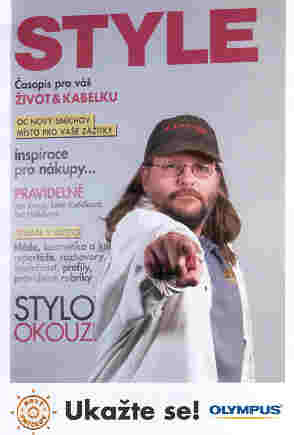
On the way out of the mall we passed a place where some magazine had set up a stage where they were photographing people in front of a mockup of their magazine cover. It was a contest; it cost nothing and the winner stood to collect a couple thousand bucks.

Earlier I said Graybeard was a poet among other things. One of those other things is an actor. I have never seen his acting so I cannot judge his ability, but he has a distinctive look that gets him work. He never misses a chance to make connections, and he was not going to miss this one. Another of the other things he does is teach English. This is not only his primary source of income, it is a way of opening conversations with any pretty girl he might happen to meet. So here was a professinal photographer (“I’m an actor,” he told the photographer, “I work for so-and-so. I’m on TV right now as such-and-such. I have my beard tied up in that one.”) and a whole bunch of pretty girls hoping to be discovered as models (“I’m a teacher,” he told the girl with the clipboard. “My agent is so-and-so,” he told one of the girls in line.) By the time it was his turn to have his picture taken, he had two potential students and one potential date.

An aside about the girl with the clipboard. She was very pretty. In his brief encapsulation of who he was, he also included me: “This is Jerry. He’s a writer.” “Oh, really?” she asked, smiling warmly. Graybeard tried to get me to use my czech, but the lesson that day had not gone well, and I only know how to say very simple things. The gap between what I want to say, with its subtle nuances and sprawling sentences, and what I can say, with only limited use of future and none of the past, is enormous. I apologized to her, but only managed a few words in her language.

She is taller than I am, though some of that is shoes, I’m sure. Her eyes were brown, and she seemed a little shy when she looked down at me and said, “You can teach me English and I can teach you Czech.” I agreed in principle. Of course, I was standing next to a professional English teacher. Negotiations got complicated. I left her my email and did not press her for her number. We’ll see.

While we were standing in line and while Graybeard was schmoozing and flirting I watched and learned the difference between a beautiful woman and a model. Time after a time I watched as a pretty young girl, dazzling and fun while hanging out with her friends in the line, became wooden on the stage. The smile would be there, but it was stiff and forced.

Then it was Graybeard’s turn. He’s had a lot of time on camera, and he was taking this very seriously. He gave the photographer some good looks, and after a minute or so he had a few good shots to choose from for his free printouts. Of course he’s hoping that someone important will see the pics, someone who could be his next connection, his next opportunity. Then it was my turn. I had watched the others, and I decided that I was going to take control of the shoot. I got up on stage, stood where I was told, and put out — but where Graybeard took things seriously, I did not. I struck poses. For the last shot I told the photographer I was going to jump as high in the air as I could. On the first try I landed before he snapped the shot — I think he overestimated how high “as high as I can” is (it’s not very high). The second attempt was a success. The best shot of all was one where I was pointing directly at the camera, looking down my outstretched arm.

Style! Now, when I say “best”, perhaps “most interesting” would be a better term. “Best” implies a scale of goodness, but these photos cannot be evaluated on that axis. I am not a model. I will not be winning 50,000 Kč for my efforts. But I’ll tell you this: at first those waiting behind me in line were laughing with me, understanding that for me this was nothing more than a lark, but by the end they saw what I had already seen: You gotta put out. The photographer isn’t going to do it for you. When I started calling the shots, I separated myself from the wanna-be’s. I still won’t win; I’m just too ugly for that. They want a pretty girl to parade around, not some shaggy guy with a beer gut. I’d like to think that one of the girls in line behind me perhaps found the courage to throw herself at the camera, and by winning will make me a spiritual winner. Someday, perhaps, some famous runway model will recount the time she was in the mall and some dumpy guy out-modeled the others, and inspired her. Hey, a guy can dream.

In the end I got a couple of printouts, and Graybeard also got a copy of the shot with me pointing at the camera. Seeing how some of my other silly poses came out, I know I could do better given another chance.

Missed opportunity: I didn’t do a Kung Fu pose.

Graybeard and I went to a different theater and saw the movie, and it wasn’t bad. They glossed over a few too many things to consider it a biography, but it was a good story, and there was some good acting. We emerged into the light after the movie and prepared to go our separate ways. He pulled out his copy of my picture, produced a pen, and asked me to autograph it. Honestly I have no idea why, but Graybeard doesn’t always have a concrete reason for doing what he does, just a feeling that it might come in handy some day.

I laughed, accepted the pen, and signed the back of the photo. Around me people were trying to figure out who the hell I was, that a man with a long gray beard would stop me, already have a picture of me, and ask me to sign it. At that moment I was implicitly a celebrity, and if only they had known how to ask they could have got my autograph, too. I was a supermodel.

The onlookers had not seen me bum a few crowns off Graybeard for a metro ticket. I’m guessing that would have undermined my mystique.

1

Is this working?

Day of Atonement

Chapter 1

The rain fell gently, whispering on the roof, welcome after the heat of the previous day. I was standing at the window, enjoying the cool air and the fresh smell, not seeing even though my eyes were open. The moment strecthed, dilating until time itself was merely an abstraction. My mind was far from the rain, far from my motel room. It was in another place, hot and dry and shimmery, long ago when I was a different person, not the stranger I had become but a youthful and vigorous man. I had had a future back then.

A lonesome car hissed past on the wet pavement outside. My eyes followed the progress of the nondescript Dodge, probably blue once, until it vanished around the bend. Lush foliage crowded the 2-lane blacktop, threatening to swallow it back up into the forest. Eventually the forest would win, but by then no one would even notice. Only the locals had any use for the old highway, and they, too, were a dying breed.

Besides my car there was only one other vehicle in the parking lot, an old Chevy pickup that was more rust than metal. It was parked by the office, where the manager had a room. I had been there two days and had not seen any other guests.

Now that the back of the heat wave had been broken, it would be a good day to travel. I looked at my truck and wondered where to go. Anywhere but there. Anywhere but the windswept grave tucked between rock outcrops, far from the curious eyes of humanity, with the headstone, crudely carved, that said only “Helen 1952 – 1987”. I had known her birthday, but not her last name.

I was stalling, of course. I knew exactly where I was going to go. No need to check the wallet to know that I was going to head down to the gulf to find George and accept his offer. I had been resisting for a long time now, but he was patient. All those years ago we had both known the day would come I had no choice.

I looked around the room in a habit deeply ingrained, even though there was little I had left that I could leave behind. I hefted my pack up off the sagging bed and fished out my keys. The door to my room had swollen with the moisture and was wedged tightly shut. I gave it a yank and hoped the doorknob didn’t break off. With one last grunt of protest the door swung open and I was free.

The red lettering on the side of my run-down Scout had faded in the sun, but with some effort I could make out “Schmidt Geological”. Beneath that the black lettering was doing much better: “Exploration and Assay”, followed by a phone number that hadn’t meant anything in years. Not for the first time I wondered idly what would happen if I dialed it.

I tossed my pack in and climbed in beside it. I flipped the switch on the dash I had wired in when the ignition switch had worn out. When I pushed the doorbell button next to it the engine came to life. I coaxed the truck into gear and began my journey south.

Chapter 2

“I’m Helen,” she said, standing on tiptoe to offer her hand through the open window of my truck.

I shook it. “Robert,” I said. “Robert Schmidt. Most people call me Bob.”

She smiled, a little lopsided. “You look more like a Robert. Thanks for coming out.” Her face was brown beneath the white brim of her floppy sun hat. She wore a red flannel shirt with the sleeves rolled up and cut-off denim shorts. Her boots were sturdy and broken in. Where her sun-bleached hair had got loose from the scarf holding her hat down it blew randomly in the wind. Unthinking she would push it away from her face, but it would just blow right back a few seconds later. She had a line of sunscreen along her jaw; I resisted the impulse to reach over and rub it in for her.

I levered open the door and stepped out into the desert. Even that early in the morning the sun began immediately to bake the top of my head. I reached back into the truck and pulled out a straw cowboy hat, once white but now stained with sweat and grime. “What can I do for you?” I asked.

“I think I found something,” she said. She looked around as if it would be possible for someone to be eavesdropping out there. “I didn’t want to talk about it on the phone.”
I nodded. Much of my business was telling people they had not found gold. “What did you find?” I asked.

“I think maybe you should see for yourself.”

Chapter 3

I had been drifting in the general direction of the Gulf for several weeks now, knowing in the back of my heart that the day was nearly upon me when I would have to make the decision to track down George. It had been at least five years since I had heard from him, but I knew he would be down there somewhere, waiting for me, and he would make sure that I could find him when the time came. I pointed the Scout south down the narrow highway.

The truck ran well, enjoying the rain, but the old beast was always thirsty. After about fifty miles I pulled off the road for gas and breakfast. Fifteen gallons of regular would see me through till lunch time.

The parking lot of the little cafe was full, and I could see through the plate-glass windows that it was crowded inside. Must be the whole town in there. I parked on the road and didn’t bother locking the truck’s door.

It was loud in the cafe, and full, but there was still room to sit at the counter. I made my way between tables filled with well-dressed locals. Must be Sunday, I thought. “Be right with you, hon,” said a frazzled woman, her hair piled high atop her head, reading glasses dangling from a chain around her neck. She was the classic.

“No problem,” I said, but she had already moved on.

I looked around the room. The men were wearing their polyester suits, all navy blue, all from the same rack in the same department store. These weren’t the sort of folks who had to wonder which suit they were going to wear. For all uniformity of the men, their wives were another story. It was spring, and I was in a garden of floral prints. The women were dazzling and proud in their finery, and joyful in thier communion. There was no one in that place less than fifty years old, with the possible exception of the waitress. She may just have been tired.

On the wall was a poster with a kitten hanging from a pole by its front paws, eyes wide. “Hang in there, baby!” the caption read.

Chapter 4

“Hang in there, baby,” I said as Helen clung to my hand. I pushed the hair back where it stuck to her sweating face. “Hang in there.”

Chapter 5

“Coffee?” The patch on the waitress’s shirt identified her as Evelyn.

“Sure.”

Evelyn poured me a cup in a practiced gesture, just a quick splash that filled the cup without spilling a drop. “Not usually so crowded,” she said, “But, you know, Easter.”

I nodded and sipped my coffee.

“You know what you want?” she asked, although she had not given me a menu. There’s no need in a place like that.

“Bacon, eggs over easy, hash browns,” I said.

“You want some biscuits and gravy? Good on a rainy day.”

May as well live it up, now. “Sure.”

Evelyn was gone again. There were only so many places I could look while I waited for breakfast, so I pulled out the battered piece of paper and unfolded it for the throusandth, and possibly last, time. In faded pencil George’s awkward scrawl spelled out the name of a roadhouse somewhere near Pensacola. Lucky’s, YYY Fla.

Chapter 6

“You’d like this place,” George said, writing with furious concentration. The pencil looked tiny in his giant hand, and he was having difficulty controlling it. The black man was sweating profusely in the summer heat, turning his t-shirt dark.

Finished at last, he handed me the slip of paper. “They call me Big George down there. You just ask and they’ll know who you’re talking about.”

I folded it twice, neatly, and slipped it into my wallet, intending to throw it away later.

“It’s going to be fun working with you,” he said.

“I’m not going to do it, George.”

“Oh, yes you will. Sooner or later you’ll come knockin’. Your ghosts won’t give you no choice.”

“I’ll have to take your word for that,” I said. “You’re the one who can see them.”

He laughed. “Oh, I don’t see them; I just know they’re there.”

Chapter 7

Helen reached over and rubbed my earlobe. “Sunscreen,” she said.

“Thanks. You have some here.” I gestured to my own face, along the jaw.

“Which side?” She rubbed both. “This stuff works great, but it’s hard to rub in. How ’bout now?”

“That’s got it.”

“Thanks.” She flashed me another of her lopsided smiles.

After a pause I said, “So where is this thing?” She had told me we would have to hike in, and we would probably camp at least one night.

“About twelve miles. Is that OK?”

I opened the rear door of the truck and pulled my pack out. “Nothing left worth seeing that doesn’t require some walking.”

“Do you know this area?”

“I’ve been here and there.” There wasn’t much out here of interest to my clients, but I got out this way occasionally.

She nodded and turned to her battered, dusty Subaru. She had hiker’s legs, lean and strong. She fit the landscape perfectly.

Both our packs were heavy for their size; we were carryning lots of water. I added another canteen at my waist and watched while she did the same. The army surplus belt was adjusted as small as it would go, but it still rode low on her hips, making the canteen bob as she walked. Finally she pulled a bottle out of her car and took a long drink. She offered it to me when she was done. “Carry your water inside you, the Bedouin would say.” I had my own supply, but it seemed impolite to refuse her offer. Somehow she had managed to keep the bottle cool, and the water felt refreshing going down.

“Good water,” I said, inspecting the bottle.

“Finish it off,” she said. “I have more.” I did as I was told.

When I could drink no more I shouldered my pack. “Better get going,” I said.

She was looking distractedly behind me, back the way I had come. “You’re sure no one followed you?”

“I would have seen their dust cloud for miles.”

She nodded, not completely satisfied, and hoisted her own pack, settling it onto her back and cinching down the waist strap. I stepped to follow her up the canyon when she paused and looked at me over her shoulder, her face pensive. She opened her mouth, hesitated, closed it, and continued on her way.

Chapter 8

“You want anything else, hon? Some pie for the road?”

By the time I was mopping up the last of my gravy the cafe had quieted, only a few of the Easter celebrants remained, lingering over coffee and cigarettes. Evelyn and the others fell into an easy rhythm as the pace of the morning slowed.

“No thanks. I’ve got to get going.”

She started adding up my tab. “Where y’all headin’?”

“South. Florida panhandle.”

“They got some nice beaches down there. Howard and I go down there every summer.”

“Sounds nice.”

“Way better than Miami.”

“I’ll have to check them out while I’m there.” As I counted out my money she returned with a small container.

“For the road,” she said. “It’s on the house. Happy Easter.”

“Thanks,” I said, mildly nonplussed. “Happy Easter.” It sounded odd when I said it.

1

Almost Midnight

It was two weeks ago that my clock stopped. Two weeks ago, two minutes until midnight. The second hand was on the upsweep, challenging the gods of time in the way that second hands do, impatient and self-important, when it was forced to yield to influences it knew nothing of: Gravity, friction, and the inevitable.

It’s the only clock in the place. Out of habit I look at it several times a day, and it is always two minutes before midnight. How quickly I became accustomed to its presence over the door, ticking loudly. The clock stopped once before and I put in a new AA, but that didn’t last long at all and like hell I’m putting in another one.

It is not, and never will be, two minutes before noon. The clock stopped at night, just before the moment, and it hovers there yet, the hands waiting patiently for the impetus to sweep the final two minutes. I look that way and I wonder what I would do if that hands moved again. It’s two minutes until something big, but the clock is not ticking. Not that I can hear, anyway.