Gambler’s Update

I’m not sure my sports curse still applies to the San Diego Chargers, (the Padres certainly managed to suck without me), but although I did just check in on tonight’s game in time to see San Diego fumble while deep in Raider’s territory, I’ll not be watching the rest of the game.

Reminder: Cyberspace Open

Round one of the Cyberspace Open writing contest is this weekend, and it’s going to be a hoot! While I don’t know whether anyone out there is interested in participating at an official level (if you are, you must enter by the 16th), I thought I’d remind you just in case. Even if you don’t register officially, you can still play along. Whee!

From the official Web site, here is the description of round one of the competition:

Round One: Your Lost Weekend

This round is like this real-life situation: A producer calls you at 5 pm Friday and says “We desperately need a new scene first thing Monday, or production stalls, with a $50,000/hour crew sitting around!”

This is your chance to save the production. We send every entrant the same premise and set of characters by email at or slightly before 5 p.m. Friday, Sept. 18, 2009. The premise will also be posted above on this page where indicated in case you don’t get the email.

Contestants will have the entire weekend, until 9 AM Monday Sept. 21 — but not one second more– to write and submit one final version of one scene, three to five pages long, on line.

Then, judges from CoverageInk.com, the manager of the competition, will grade each scene. Entrants will receive feedback and a score from a judge by email.

Exactly 100 highest-scoring writers advance to the tighter deadline of Round Two.

I don’t know about anyone else, but I’m really looking forward to participating. When I get the notification of what the scene is supposed to be about, I’ll post it here, and when I submit my entry I’ll post that here as well. If anyone else writes something based on the challenge that they would like to share, I’ll happily post that as well. It could be a movie scene, but you could attack the subject in regular prose, poetry, or even photos if you want. I’m the only one who has to please a judge. Use it as an excuse to spend some time with your creative side.

At the very least, please stop by over the weekend and cheer me on!

Screenplay Taxonomy

When writing a screenplay, the word ‘scene’ has a very specific definition. More or less, whenever the scenery on screen changes, it’s a new scene. Walk from the kitchen to the living room, new scene. Walk back, new scene. Simple enough. At first blush it seems similar to the scenes of a stage drama, but it really isn’t. In a screenplay, scenes can change quite frequently, and may only last a few seconds. You can have many scenes that fill the dramatic role that a single scene does on stage. For instance, in a screenplay, the scene can change several times during the course of a running battle.

I’m working with script-writing software that allows me to rearrange scenes, but what I really want is a way to manipulate the groups of scenes that comprise the larger dramatic unit. All the scenes that are part of a chase, for instance. I’ve been fooling the software by calling the scenes that make up the sequence “shots”, so they are treated as part of the same dramatic unit. While this leads to correct formatting and lets me manipulate my script the way I want to, it subverts the meaning of ‘shot’ in a screenplay. It’s not a bid deal for me since calling shots is way, way, down the production road, but it’s still a little off to mislabel script elements like that.

From a storytelling standpoint, the larger unit is the important one — the continuous action that can span several scenes but has a clear identity in terms of the story. I think ‘sequence’ is the word I’ve heard used in that context, but it’s imperfect, and the script-writing software I’m using has no concept of the sequence to help me organize my scenes. Jer’s Novel Writer allows the user to define things like that quite easily, and JersNW performs way better than Celtx on my old laptop, but Celtx provides other shortcuts and automatically formats things in an industry-standard way.

I think it would take me two months to make a screenplay version of JersNW. (If I didn’t use the time to also upgrade the way the documents are structured, which I would do.) It wouldn’t have all the features to help production that Celtx and Final Draft have, but it would be writer-friendly. I often joke that Final Draft is a fine piece of software once you have a final draft – it’s not very good for the actual writing. Celtx seems to want to pursue Final Draft, once again at the expense of the writer.

But all that’s a digression. I really just wanted to ask folks if they knew a better term for ‘group of scenes that comprises a dramatic unit in a screenplay’. It really seems like there should be one.

1

Just Break Up With Her, Already!

One of the apartments in this complex is occupied by students. They are louder than most of the other residents, but most nights it’s no big deal – especially now that school is in session. I was occasionally on the loud side back in the day as well. One of the kids has a girlfriend, however, that is gradually driving me insane. It’s just that, well, she’s bitchy.

The guy’s parking place is right below the window I’m sitting next to right now. Every time she comes or goes there is conversation. Almost always she’s in a bad mood and she’s taking it out on the guy. Or whoever’s on the other end of her mobile phone. Or the other voices in her head. Good lord that woman has a lot of complaining to do, and directly below this window seems to be her favorite place to do it. The hour of the day or night makes no difference; in fact, the later it is at night, the more she’s accumulated to bitch about. 3 a.m.? A fine time to rail on and on with her unseen friends.

Why, oh, why can’t the guy just give her the heave-ho? Is her company at other times so charming that he can ignore the constant stream of complaints I get to hear? Is there some field around this window that puts her in a bad mood? I just want to put my hand on the guy’s shoulder and say, “Dude, if you can put up with that shit, you’re going to make some other girl a fine boyfriend.”

Some quiet, polite girl.

The Worst Thing That Ever Happened to the Internet

I mentioned in the last episode that Internet Explorer was the second-worst thing that ever happened to the Internet. Today I’ll talk about the absolute worst. It’s really a long technical rant that doesn’t matter, but it feels good to let it out. What follows is an underinformed ramble about the scourge that did the most harm to the developing computer network that went on to transform our lives — damage that we still live with today. Without this one corrupting influence, we would have had Internet applications that didn’t suck a decade ago, if not longer. In fact, it was because of this electronic plague that Microsoft was able to cause so much harm with Internet Explorer.

The culprit? The ball and chain that modern technology has dragged along despite its obvious flaws? Hypertext Markup Language, or HTML.

First, let’s start with the name. HTML is not a language. Not even close. It is a document format. That its inventors did not recognize the difference tells you that the wrong guys were doing it.

Second, it’s not a very good document format. At its heart, the inventors wanted a format that did three things: connect related documents, embed external resources (like images) and contain standard formatting information that would be interpreted by viewing software consistently. They were not the only ones developing systems like this; Josten’s Learning invented a similar system when they built the first multimedia encyclopedia for Compton’s New Media. Where Berners-Lee and friends had URL’s, Josten’s engineers created BRU’s, but beyond the initials the function was the same.

I don’t want to be too harsh on Berners-Lee, Cailliau, and the others who grew HTML, but I wish they’d been a little more far-sighted. I say ‘grew’ rather than ‘invented’ because it’s clear that they never sat back and asked themselves “What is a tag? What roles do they perform?” Even now, XHTML, the supposedly more rigorous (if still misnamed) descendant of HTML has fundamental inconsistencies.

For a simple example, take the <br /> tag. It exists because in HTML all whitespace (tabs, spaces, and returns) are mushed together and presented on the screen as a single space. Thus

<p>this markup</p>

and

<p>this
 
        markup</p>

come out the same on the screen. That’s fine if you know what’s going on. But what if you want to put in a line break or a space? Well, for a space you add a special character code &nbsp; and for break you add a tag <br />. Why is one a character and one a tag? Because on the day HTML’s inventors decided they needed line breaks, a tag seemed like a good way to go, even though semantically it had nothing to do with the roles of other tags. It could just as easily been &br; or something like that. That’s how HTML grew up. And thus the World Wide Web was born.

Another fundamental flaw is that the content (what to display) is all mixed up with the presentation (how to display it). What if you want to show the same document in different formats? Nope. While some tags were geared toward identifying the type of content that they enclosed (like the <p> tag), others were direct formatting instructions (like the <i> tag). This inconsistency in the role of tags in a document is a reflection of the organic (and sloppy) way that HTML was grown.

I really can’t blame the inventors of HTML for what came next. Everyone started using it. Everyone. The flaws and inadequacies of the format quickly became apparent. Different document viewers (browsers) rendered things differently. Formatting options were extremely limited. The systems were vulnerable to abuse by unscrupulous people. Right then, there was a chance for people to say, “hold on a second! Let’s take the idea of HTML and apply the lessons we’ve already learned in other branches of computing, and make something that doesn’t suck.”

Rather than scrap HTML, browser makers and others set out to fix it. That was the Big Mistake. After twenty years of tweaking and bickering and incompatible extensions introduced by browser manufacturers and squabbles and lawsuits, HTML has been upgraded from awful to poor. Along the way, companies like Adobe and Macromedia thought to get their technology adopted as a replacement to HTML (the Web in pdf? Interesting…) but those efforts were doomed from the start because they did not provide free, simple tools to create the content.

HTML’s greatest shining virtue (and it’s an awesome one) is that it’s accessible to anyone who can type. Anyone. No special tools required.

So, now we have style sheets to help separate content and presentation, XHTML to fix some of the semantic craziness of HTML, and browsers are finally starting to agree on what all the formatting instructions actually mean. We could have had that fifteen years ago if people had just let go of HTML, but here we are now, with an almost-functional system. There are still plenty of flaws, however. Things that seem so normal now that we don’t even think about how dumb they are.

Take this blog, for instance. It’s a pretty well-built Web application, based on reasonably up-to-date practices. Yet were you to click the comment link at the bottom of this episode, you would go to a new page. On that new page the browser would reload the same header and the same sidebar it just erased. What a waste! Why does it do it? Because that’s how HTML (and HTTP, the underlying part that communicates with servers) works. There have been abortive attempts to fix that over the years, but they have all been flawed. Now, at long last, techniques have been developed to overcome that problem, but they are not quite ready for prime time yet. For one thing, they are very complicated, and for another they rely on browsers working just right. Why was it so hard to implement? Because at its core the Web was not made that way.

Even in the days when almost everyone was on dialup (except the people inventing HTML), no one stopped to say, “hey, let’s make a way to only update the content that changes.” That problem has now been ‘solved’ by adding a new layer of complexity on Web sites. By adding this layer (on top of CSS and so forth), we get sensible Web applications at last, but we take away the one super-cool thing about HTML. It is no longer a simple format that can be harnessed by anyone with a text editor. We have lost the attribute that was the only reason to keep HTML around in the first place.

So now we have a system that is both inaccessibly arcane and flawed. Yay!

3

The Ghost of Projects Past

I couldn’t sleep last night, and on nights like that it is natural to think of things that might have been. One of the thoughts that grabbed hold of my too-active brain was the memory of PeoplePost, an Internet-based photo-sharing application that allowed groups of people to build scrapbooks together. We called it a virtual refrigerator door. It was pretty slick.

The project failed for a number of reasons. First, we tried to ‘roll our own’ instead of springing for sophisticated Web development tools. (Back then, the tools were very expensive.) To save the cash we added months to the development, and in the meantime something fundamentally changed on the Internet. People began to expect everything to be free. You remember the two-year span when Web services stopped trying to make money and figured they would find some way to be profitable in the future? Probably not, but those were the years we were working on PeoplePost.

This happened as the dot-com boom was just getting started, before Google had finished making the Web a useful place. WordPress did not exist then. No MySpace, no Facebook, no Friendster. Geocities was around, but had PeoplePost taken off, we would have had to invent modern social networking as the next logical step. At the time, our networks were closed communities with no way to discover what other groups were up to.

Another thing that killed us was a dead-wrong prediction I made way back then. I said that the browser was the Swiss Army Knife of the Internet, and that soon people would turn to specific applications to perform specific tasks. “Swiss knife is good,” I said, “but soon people are going to want cutlery.” Boy, was I wrong about that. Instead of using applications designed for a specific purpose, people worked with really crappy applications that worked through the browser. People tolerated crap that worked in some browsers and not others, and they tolerated bad aesthetics, wasted bandwidth (on their modems!), and wretched user interfaces that left them cursing the screen. Why? I still don’t get it.

Nevertheless, we made PeoplePost a downloadable application (with a really slick self-updating scheme), and when people downloaded and installed it, they would then go back to the browser and wonder what to do next. It’s the Internet! It must be in the browser!

The application was written in Java (not Swing, but that’s another post), so we managed to get the whole thing shoehorned into the browser — suddenly dealing with four different security systems and a host of other issues, like Microsoft’s passive-aggressive antipathy toward the language. What a pain. Still, a few people started to use it.

What we really needed at that stage was widespread broadband. We were diligent about saving bandwidth (all graphic elements preinstalled, for instance), but with advertising banners now harshing the lovely fridge door environment and eating up precious pipe, the user experience on a slow modem was not so great. Pictures are big. Still, we got Compaq and HP excited (shared photos become printed photos, which moves paper), and they helped get the product out there.

But we couldn’t charge for it, and we weren’t making money on advertising. It was going to be a long haul to make the product a financial success. An expensive haul. We couldn’t do it.

Skip forward to today. Finally, browsers are getting consistent enough and powerful enough that it’s almost (but not really) possible to make a decent application that runs in the browser. Meanwhile we’ve all been trained to put up with shitty software while online, so actual good software on the Web is big news. Now Internet Explorer (the second-worst thing to happen to the Internet) is finally close enough to the standards that people can write sophisticated user interfaces, using techniques that are often bundled under the term AJAX.

In the intervening years, galleries of many stripes have popped up on the Web, but nothing like PeoplePost. There are places people can share pictures, but they boil down to “here’s a big pile of my pictures; now post a big pile of your pictures.” Nice, but it could be better. A lot better. I was reminded of how cool PeoplePost would be this summer when the family was looking for a place to share photos from the eclipse cruise. There is nothing that allows people to collaborate, to build an album with text and photos and comments, and to allow everyone to contribute to the same album and build a true group identity. Combine that with modern social networking and you’ve got something.

Maybe it’s time to dust off the old failure. Maybe the world is ready for it now.

1

Shake It Up, Baby!

This morning at 2:47 local time (my sweetie made a point of remembering the time), a mild shaking made its way through my dozing, sleep-fogged brain and brought me to full wakefulness. The window was rattling softly and I knew that we were having an earthquake, albeit a very mild one. The shaking soon subsided and I resumed my quest for slumber.

No big deal really, earthquakes happen every day around here — literally. Most go unnoticed, and considering the alternative to lots of little earthquakes is one large one, I’ll take all the mild temblors the shifting plates want to throw at me.

As a bonus, this was my first time using this site to report my experience. (USGS – Science for a changing world!) Reporting only took a moment (Did things move? What did you do?), but then of course I had to poke around the maps checking out all the other recent earthquakes around the world. Big fun!

New Sidebar Feature – Tag Cloud (sort of)

Most blog systems support tags these days. Put simply, tags are just words that can be used to create informal groups of posts. Tags aren’t as rigidly defined as categories, and so a ramble that covers many topics can have many tags. The purpose of the tags is to allow folks like you to find similar stuff. Since moving to WordPress I’ve started to pay more attention to tags, and at the bottom of each episode you can find a link or three to episodes with similar tags. It’s kind of cool, and it’s search-engine friendly.

Now I have added a widget to the sidebar that provides a ‘tag cloud’ — a list of the tags with the most-used tags in larger font. (I think this is a misuse of ‘cloud’, which in this context is also supposed to show relationships. A true cloud would group tags by how often they are used together.) There are much fancier tag cloud widgets out there, but I was starting to spend way too much time investigating the options. I settled on a nice, simple, colorful widget which is over there now. It’s called “ILW Colorful Tag Cloud” (or something like that). There are a few aesthetic tweaks I’d like to make, like condensing the text, but that shouldn’t be too much trouble.

The widgit’s all right, but the colors are arbitrarily set by me. It would be cool if the colors actually meant something. Since the number of times a tag is used is already represented in the font size, color could be used to show relationships or (better yet) indicate how many times a tag has been clicked. That way the tags more people found interesting would be highlighted.

Another minor problem with the tag cloud as it stands is that most of the 1200 episodes I created with my old blog system have no tags. I’ve gone back to retrofit tags on a few obvious ones, but overall most of this blog is untagged.

But no, not today. No widget modifications, and no more tag retrofitting. I’ve already spent far too much time on this silly feature.

Bangin’ Out Scenes

My brother sent me a link to a screenwriting contest this morning that looks like it could be pretty cool. One of the best things about this contest is that it can’t eat up a whole lot of my time. That’s the point of the exercise, in fact.

The contest is an elimination tournament of three rounds. For each round the writers are provided a premise, and writers must produce a 3-5 minute scene based on the premise. Only the best go on.

In the first round, participants have a weekend to prepare the scene. The submissions are graded and the top 100 writers advance to round two. The site promises feedback for each entry, but I don’t expect they will have time for anything terribly in-depth. Creativity is 25% of the score, and all over the site writers are encouraged to ‘think outside the box’.

Round two: A new premise for another 3-5 minute scene, and a new deadline. Overnight. The top ten advance.

Round three: Ninety minutes.

The top ten finalists will be judged at the Screenwriting Expo. Actors will rehearse and perform three finalist scenes before the expo audience, in what promises to be a pretty fun event. The winner walks away with a cool three grand and some pretty serious bragging rights.

I’m not sure how many people will be participating, but I will be one of them. It would be fun to make it to the second round, but a lot depends on whether the genius idea strikes at the key moment. I expect the competition will be pretty fierce. I’ll just sit back, relax, and let fly, and hope it sticks. With an entire weekend, the danger is over-editing or trying to do too much. The second round may actually be easier.

I’ll post each of my scenes here, as well. In fact, what the heck — I’ll do the following rounds even if I don’t advance, just for the fun of it, so there will be a total of three scenes here, no matter what the judges say. At the start of each round I’ll echo the premise in these pages, and if any of you care enough you can brainstorm rough ideas how you would treat the premise in the comments. If someone else wants to participate (either officially or as a shadow) I’d be happy to make a page here to share everyone’s results. Let’s make it a party!

1

World Fantasy Convention!

Well, it’s official; I’ve paid my money and everything. I’m going to this year’s World Fantasy convention, and I’m not at all sure how to prepare. It’s the sort of event I should have been attending for years now, and being able to do stuff like this is a fortunate side-effect of living in North America.

On that subject, aren’t these things supposed to have wacky names that end in ‘con’?

So what is this convention? As far as I can tell, it’s an event where boatloads of writers and publishers and agents and other industry folk gather for three days of… stuff. Elbow-rubbing. Looking for deals. Writers trying to get published, publishers trying to find writers that don’t suck. Panel discussions and whatnot. A few key people who are paid to come and encourage the masses. Others who have come simply for the love of the genre.

If all that sounds pretty vague, it’s because I’ve never been part of one of these things before. It’s an important part of my chosen profession, however, and contacts I make at this thing could turn my career. Or not. Or maybe I’ll make an impression with someone that pays off years from now. You never know.

I do know it pays to be prepared. To have things to hand to publishers and agents that they will love, things that at a glance will tell them that they are just dying to read my novel. “Stop the presses!” they will shout into mobile phones, “we have to rearrange the 2010 catalog!”

Another opportunity I have is to impress people in person in ways that anonymous submissions never can. I can talk to important people and leave them thinking “That guy’s an intelligent, articulate guy with a refreshing vision of the fantasy novel.” This will simultaneously be the easiest and most difficult thing for me to do. Once I get into a conversation with the right people, I’m sure I’ll do well. (I’ve been lying awake at night devising my elevator pitch.) The thing is, I’m really, really bad at getting into those conversations in the first place. I’ve been to other industry conventions and utterly bombed at networking (even at the conference about networks).

So, anyone out there have any suggestions? Both for specifics that I should take with me and for the more general hob-bobbing? Any help will be greatly appreciated!

Programming Note

I’ve put in a new anti-spam layer in the comments. It’s supposed to nip spam in the bud before it even reaches the spam-catcher I already have in place. Almost no spam has been getting through to your eyes, but behind the scenes the comments have been building up, and this should simplify administration of the site. In addition the new spam layer helps prevent robots from scraping email addresses off the site and other antisocial behavior (not that I will depend on that stuff). The name of the Plugin is “Bad Behavior”, for those who might want to try it out.

The system uses a variety of techniques that are supposed to be completely invisible to you, but please let me know if you have any trouble leaving comments. My email address is addy

Lite Brite

Last night as my sweetie and I were sharing a big salad and watching TV, she turned to me and said, “We should do Lite Brite!” I readily agreed. I had never seen an actual Lite Brite in action.

You remember Lite Brite, don’t you? It is a backlit frame into which you can stick translucent plastic pegs. The colored pegs glow merrily. Lite Brite! You can paint with light! the jingle went (approximately).

I had given the Lite Brite a lot of thought back when I was roughly four years old, and occasionally thereafter. I only remember little bits and pieces of the kids’ program Captain Kangaroo, but I remember the Lite Brite ads that supported the good Captain and his loyal sidekick, Mr. Greenjeans. I remember the ads very well, because it was one of the earliest engineering challenges I ever tackled. How the heck did the dang thing WORK?

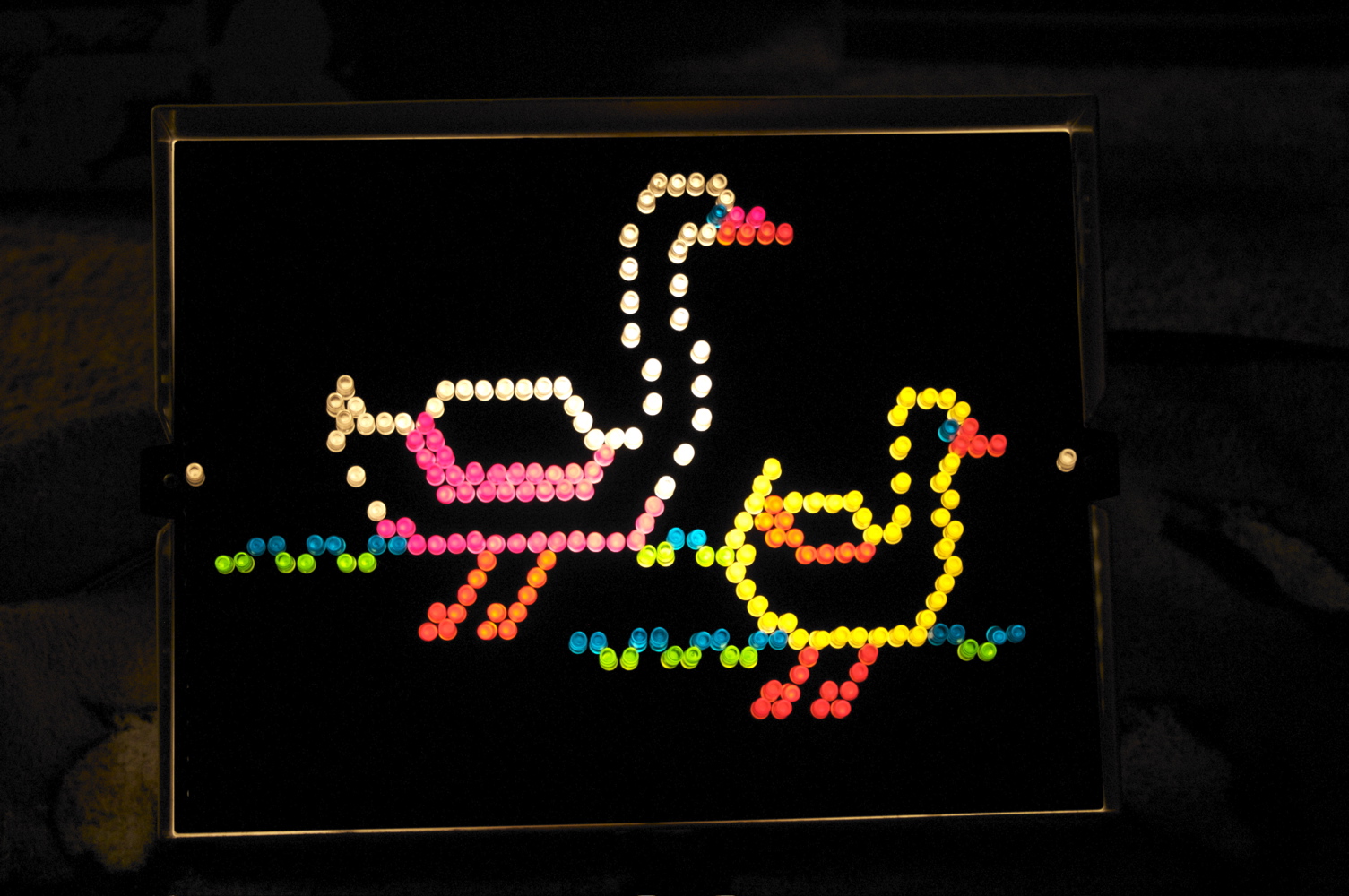
Lite Brite Masterpiece: Ducks

Lite Brite Masterpiece: Ducks

In the ads, the pegs are pushed into a black surface and light up. Sweet! obviously there is something backlit and when a peg is pushed in it glows. At first I tried to come up with a system where pegs could be placed anywhere, and stay in place. And then came the real engineering challenge: making the holes close back up when the peg was removed. This last feature was obvious—otherwise the toy would not be reusable, and the smallest mistake meant you ruined everything.

After more careful observation, I saw that the pegs were always in a grid pattern on the board. So, I realized, there was a grid of holes that the pegs could be punched into. With that knowledge, I imagined a system with little spring-loaded doors for each hole. Push the peg in, the flap opens and light comes through. Pull it out, and the flap closes. I watched the ads closely for any sign of the doors. There was none. The black surface seemed completely uniform. Perplexing. Over the years I mentally fiddled with different designs for the Lite Brite doors that would not be prone to light leaks.

Fast-forward forty years, when I came to live with someone who owns an honest-to-God Lite Brite. At last the Engineering mystery would be resolved.

The answer: black paper. No doors, no flaps, no self-repairing gelatinous layers. You mount opaque paper over the grid and punch holes in it with the pegs. There is no undo. The black papers that come with the LIte Brite have little letters printed on them, for color-by-numbers fun. And really, can you imagine how long the delicate little mechanisms I had been imagining since my very first days of TV watching would have lasted? In my gut I knew that there had to be a simpler answer, but I never let go of my assumption that you could take the pegs back out again.

We sat on the floor, my sweetie and I, taking turns punching in the little pegs (I had trouble differentiating the pink and orange ones before punching them in), and had a good ol’ time. When we were done we kept the Lite Brite plugged in to bask in the glory of our masterpiece. And it was good.

1

The God of Small Things

I picked up The God of Small Things by Arundhati Roy off the shelf at a thrift store. “Winner of the Booker Prize,” The cover said in tastefully-restrained block capitals. Winning a major literary award is often a good sign but not always. Sometimes I think an Emporer’s New Clothes Effect takes hold and the judges are ashamed to admit that the opaque prose left them baffled, so they give a prize to a mixed-up jumble of words. Not so in this case. This was a good story written with a clear if creative voice.

Near the beginning of the book (but not the beginning of the story) we are at the funeral of Little Sophie Mol, Loved from the Beginning. Something has happened, something Horrible, but even though it is only days past it has become Something No One Talks About. When Ammu, mother of two-egg twins, goes to the police station and says, “I killed him,” even the police do not want to talk about what happened anymore.

The language the author uses is playful, coining words and bending others to reflect the Indian ears that hear them. The language provides rays of light even when things are dark. In a way the whole book is a Muddled Ramble, a story that builds not through time but through the growth of the words themselves.

The story moves about in time, simultaneously tip-toeing up to the Horrible Events and drifting away through the aftermath. Before, we pass through the trip by the family to pick up Sophie Mol at the airport (cousin of the two-egg twins, Loved from the Beginning) and the events of that trip that set in motion the final run to the Horrible Events. After, we see a home with no life in it, the occupants slowly decaying or leaving, slowly dying. The family business long dead, the Bar Nowl that lived in the rafters of the pickle factory now just a pile of bones in an unused vat. Even the river, once powerful, is dead and sluggish. All that’s left is a pair of two-egg twins, one mute, separated for twenty years.

a) Anything can happen to Anyone.
b) It’s best to be prepared.

What ties all the threads of the narrative together, what really defines the flow of the story, are words. Special words, coined capriciously, that, as the story progresses, take on greater and greater weight, until some of them are almost breaking under the freight they must carry. Later. Lay. Ter. Only when the words are ready can the Horrible Events be told. And after the Horrible Events, there’s only one thing left to tell, one thing that had the power to drive all the rest.

This is the sort of writing that is both humbling and motivating, the sort of story I aspire to write—if I had the courage to really let go. Read this book; you won’t be sorry.

Note: if you use the above link to buy this book (or a Kindle, or a new car), I get a kickback.

2

A Perfect Match?

I am complimented on my dialog now and then, and that makes me feel good. However, I am constantly reminding myself to be more descriptive of the surroundings. Often I’ll put characters in an off-the-shelf setting and let the reader fill in the details. Lazy, and plenty of missed opportunities. (“Furniture”, on the other hand, is all about the settings. One of the reasons I like it so much.)

Yesterday I spent some time looking for writing contests with minimal or no reading fees which may fit things I’ve already written. There are a lot of writing contests out there, but almost all of them smell much more literary than most of the stories I’ve written. (Maybe this makes up for the relative scarcity of markets that consistently pay good rates for the literary genre.)

While I was poking around I found this contest, which in part reads:

The Rules: Compose a short story entirely of dialogue. You may use as many characters as you want. Your entry must be under 3000 words. Your entry does not have to follow standard rules for writing dialogue. Your entry cannot use any narration (this includes tag lines such as he said, she said, etc.). These are the only rules. Manipulate them however you see fit.

Interesting! While I don’t have a story that fits that (and in fact I just went back and added a great deal of descriptive text to a story that had some nearly all-dialog scenes), this seems like a contest that might play to my strengths. Like I have the bandwidth to take on another story right now…

A Typical Night at Home

My sweetie and I kicking back after a hard day's work

My sweetie and me, kicking back after a hard day's work

There’s nothing like putting one’s feet up after a long day counting your gold and precious gems.

6